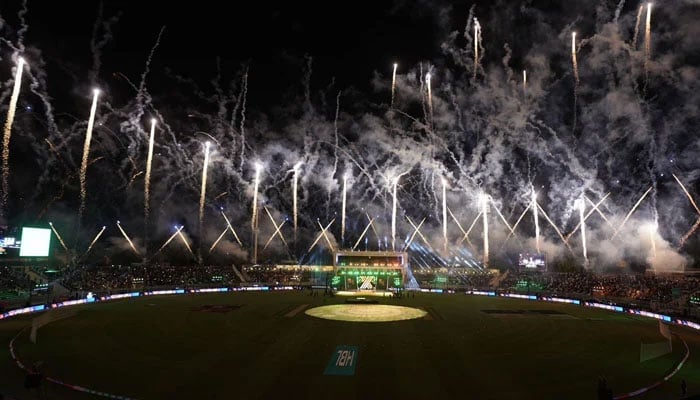
The Pakistan Super League began as an industry experiment but has since become an important thread in Pakistan’s sporting and economic narrative.
Launched in 2016, the PSL was not merely a cricket tournament, but a response to a deeper structural challenge: how to restore high-level international sport within Pakistan in a sustainable way. Nearly a decade on, the league faces questions not just of competitive quality, but of longevity and strategic coherence.
The recent expansion to eight teams invites a broader conversation about whether the PSL can endure as a stable institution, rather than a series of high-profile seasons marked by intermittent hosting and episodic disruptions.
From its early days, the PSL has had to adapt to circumstances that extend beyond the pitch. In its first three seasons, most matches were played in the UAE, with only finals held in Pakistan. Even as security conditions improved and international teams gradually agreed to tour, hosting remained partial at best. Across multiple editions, a significant proportion of PSL matches have been staged outside Pakistan. This limits the league’s ability to unlock full local economic benefits, including hospitality revenues, transport services, temporary employment and city-level commercial activity.
The 2025 season again highlighted this vulnerability. The tournament coincided with heightened regional tensions following a military standoff with India. While matches proceeded, uncertainty around travel advisories, security protocols and broadcast logistics affected momentum. These disruptions are not merely symbolic. For leagues dependent on predictable scheduling, even short-term instability translates into higher costs, cautious sponsors, and reduced fan engagement.
Against this backdrop, the PSL’s expansion from six to eight teams is ambitious. In early 2026, two new franchises were auctioned, with Hyderabad and Sialkot securing bids reportedly exceeding Rs1.7 billion per year each. Combined, the new franchises are expected to add over Rs3.5 billion annually in franchise fees alone. This outcome suggests that private investors continue to see value in the PSL’s brand and long-term potential, even amid broader economic uncertainty.
However, expansion also magnifies structural weaknesses. A league is not simply a collection of teams. It is an ecosystem that depends on broadcast stability, venue readiness, operational consistency, and franchise governance. The experience of Multan Sultans illustrates this tension. Despite strong on-field performance and fan following, ownership disputes led to repeated transitions, eventually requiring temporary intervention by the Pakistan Cricket Board. The episode demonstrated that commercial promise does not automatically guarantee institutional stability.
The economic argument for a domestically hosted PSL remains strong. According to estimates by the Pakistan Institute of Development Economics (PIDE), a fully home-hosted season could generate between Rs15 billion and Rs18 billion in direct and indirect economic activity. This includes hotel occupancy, transport services, food and retail consumption and short-term employment. When matches are hosted abroad, much of this value shifts away from the domestic economy, leaving broadcasters as the primary beneficiaries.
At the same time, the PSL operates within a constrained macroeconomic environment. Pakistan’s advertising market remains limited, shaped by high inflation, modest GDP growth and cautious corporate spending. While PSL media rights have grown substantially since the league’s inception, they remain modest compared to global benchmarks. Expansion therefore increases pressure on sponsors, broadcasters, and franchises to extract greater value from a finite commercial base.
Player availability is another challenge. The global T20 calendar is increasingly crowded, with leagues competing for windows and talent. For the PSL, scheduling around larger leagues can affect the quality and depth of player pools, particularly for new franchises seeking to build competitive squads. If expansion is not matched with careful calendar coordination and player welfare planning, the league risks diluting on-field competitiveness.
None of this suggests that expansion was inherently misguided. Greater regional representation has the potential to deepen fan engagement and broaden the league’s cultural footprint. Cities like Hyderabad and Sialkot bring distinct cricketing histories and commercial possibilities. The issue is not expansion itself, but whether it has been matched with parallel investments in governance, hosting certainty, and franchise stability.
For the PSL to truly endure, survival must be understood as consolidation rather than scale alone. Predictable domestic hosting remains central, not only for economic reasons but for restoring the league’s relationship with local audiences. Transparent ownership structures, realistic revenue sharing, and long-term operational planning will matter as much as auction prices. The PSL’s future will be shaped less by headline figures and more by institutional resilience.
The appetite shown at recent franchise auctions reflects confidence in the league’s potential. The challenge now is to convert that confidence into stability. Endurance will be measured by the PSL’s ability to function consistently, generate sustained economic value and maintain competitive integrity in an increasingly crowded global sports market. Expansion can add reach and narrative. Survival, however, will depend on whether the league can build depth beneath its growth.
The writer is a transnational educational consultant, freelance columnist and policy analyst based in Lahore.