ISLAMABAD: Pakistan said on Wednesday it had signed an agreement with a firm connected to World Liberty Financial, the main crypto business of US President Donald Trump’s family, to explore using World Liberty’s $1 stablecoin for cross-border payments.
The Pakistan Virtual Asset Regulatory Authority (PVARA) said in a statement that a memorandum of understanding with SC Financial Technologies, a little-known company it described as an “affiliated entity” of World Liberty, would enable “dialogue and technical understanding around emerging digital payment architectures.”
The announcement represents one of the first publicly announced tie-ups between World Liberty, a crypto-based finance platform launched in September 2024, and a sovereign state. It also comes amid a warming of ties between Pakistan and the United States.
Reuters was the first to report that the deal had been signed ahead of the regulator’s announcement.
Under the agreement, SC Financial Technologies will work with Pakistan’s central bank to integrate its $1 stablecoin into a regulated digital payments structure, allowing the token to operate alongside Pakistan’s own digital currency infrastructure, a source involved in the deal said.
The memorandum was announced during a visit to Pakistan by World Liberty’s co-founder and chief executive Zach Witkoff, who is the son of US special envoy Steve Witkoff.
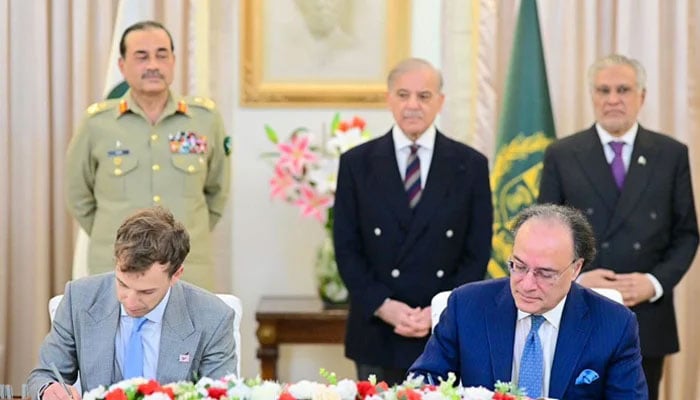
A government photograph showed Finance Minister Muhammad Aurangzeb and Witkoff signing the agreement, with Prime Minister Shehbaz Sharif and COAS CDF General Asim Munir standing behind them.
Witkoff is also the CEO of SC Financial Technologies. The company, registered in Delaware, co-owns with World Liberty the $1 stablecoin brand, according to documentation on the stablecoin’s reserves from July 2025.
World Liberty did not immediately respond to a request for comment on the visit and tie-up. “Our focus is to stay ahead of the curve by engaging with credible global players, understanding new financial models, and ensuring that innovation, where explored, is aligned with regulation, stability, and national interest,” said Finance Minister Aurangzeb. Stablecoins - digital tokens typically pegged to the dollar - have ballooned in value in recent years.
Under Trump, the United States has introduced federal rules widely seen as beneficial to the sector, and countries across the world are beginning to examine the potential role of stablecoins in payments and financial systems.
World Liberty has fuelled a sharp increase in income for the Trump family business, known as the Trump Organization, including from foreign entities, in the first half of last year, Reuters reported in October. Last May, MGX, a state-controlled Abu Dhabi investment company, used the World Liberty stablecoin to buy a $2 billion equity stake in Binance, the world’s largest crypto exchange.
Meanwhile, a delegation of World Liberty Financial USA, led by Zachary Witkoff, called on PM Shehbaz Sharif in Islamabad on Wednesday.
Deputy Prime Minister Ishaq Dar, Chief of Defence Forces and Chief of the Army Staff Field Marshal Asim Munir, Minister for Finance Muhammad Aurangzeb, SAPM Tariq Fatemi, and Chairman Pakistan Virtual Assets Regulatory Authority Bilal Bin Saqib also attended the meeting.
Welcoming the delegation, the PM shared his vision for digital Pakistan aimed at increased connectivity, access, transparency and openness for the citizens. He said the rapidly growing pace of digital payments and financial innovation are essential parts of Pakistan’s rapidly expanding digital economy.
The PM appreciated the growing international interest in Pakistan’s digital financial markets and noted with deep sense of satisfaction that Pakistan is fast becoming part of global digital finance.
Zachary Witkoff showed keen interest to engage with Pakistan for a secure and transparent digital payment infrastructure, including innovations in cross-border settlement and foreign exchange processes. He lauded Pakistan’s policy framework which is helping to position the country as a leading contender in the global digital finance landscape. He expressed keen desire to further deepen engagement with Pakistan to explore next-generation digital payment and cross-border finance innovations.
Prime Minister Muhammad Shehbaz Sharif and CDF/COAS Syed Asim Munir later witnessed signing of MoU between the Government of Pakistan and SC Financial Technologies LLC, an affiliated entity of World Liberty Financial, to enable structured dialogue and technical understanding around emerging digital payment architectures for cross border transactions. Minister for Finance Muhammad Aurangzeb and CEO World Liberty Financial Mr. Zachary Witkoff signed the MoU on behalf of the respective sides.
Also, addressing the cabinet meeting, Prime Minister Shehbaz Sharif said the government signed a memorandum of understanding with a financial technology company to promote digital transactions in the country.
Under the MoU, digital infrastructure will be developed, and transactions will be carried out through data centres and cryptocurrency, which will significantly benefit Pakistan’s economy.
Separately, DPM and Foreign Minister Ishaq Dar Wednesday described International Monetary Fund (IMF) programmes as “anti-growth”, asserting that Pakistan must pursue economic expansion above its population growth rate of 2.6 per cent to achieve meaningful progress. Addressing the Pakistan Policy Dialogue, organised by the Policy Research and Advisory Council (PRAC) in collaboration with the Corporate Pakistan Group, he said any growth below 2.6pc should be viewed as zero or negative growth, while growth above that threshold constituted net expansion. He recalled that Pakistan had achieved 6.3pc growth in 2017 after three years of effort, arguing that the country still had the potential to attain higher growth with consistent policies.
Dar said the economy faced a twin-deficit challenge, particularly an external account gap of around $30 billion, which he believed could be bridged through a $10bn increase each in remittances, exports and services. He maintained that public debt remained manageable, noting that the Fiscal Responsibility and Debt Limitation framework was a self-imposed measure introduced by a PMLN government rather than an IMF condition.
Citing examples of advanced economies with higher debt-to-GDP ratios, including the United States, the United Kingdom and Japan, Dar said Pakistan’s ratio was comparatively lower. While external debt and liabilities stood at about $130bn, he pointed to the country’s vast mineral resources, estimated at $6-8 trillion, stressing there was no cause for alarm, though sustained and consistent policy efforts were essential.
Stressing geo-economics as a pillar of foreign policy, Dar said Pakistan’s diplomatic engagement was increasingly focused on economic outcomes. He noted progress on CPEC-2, plans for the realignment of the Karakoram Highway, renewed international space for Pakistan, defence exports such as JF-17 fighter jets, and improving ties with several countries, including re-engagement with Bangladesh after more than a decade.
He also expressed optimism over the rollover of $3bn from the UAE, adding that $4bn had been arranged from China and $5bn from Saudi Arabia. Reiterating the need for a Charter of Economy, Dar warned that policy reversals had repeatedly undermined growth. Federal Finance Minister Muhammad Aurangzeb, speaking on the occasion, said remittances were expected to exceed $41bn this fiscal year, up from $38bn last year. He outlined ongoing structural reforms, including the transformation of the Federal Board of Revenue with a focus on compliance and enforcement.
Aurangzeb said corruption-ridden, subsidy-dependent entities such as the Utility Stores Corporation, PWD and PASSCO had been shut down, while 24 institutions had been handed over to the Privatisation Commission. Although debt servicing remained the largest expenditure, he said savings of around Rs850bn had been achieved last year, with similar savings expected this year.
The finance minister announced that Pakistan planned to launch Panda Bonds within the next two weeks, adding that surveys showed 73pc of investors were favourable towards investing in the country. He said the current account remained within targets despite a higher trade deficit, large-scale manufacturing had posted positive growth in the first quarter, private sector credit had risen to Rs1.1 trillion, and stock market investment had increased by 41pc over the past 18 months.
Planning and Development Minister Ahsan Iqbal warned that without peace, stability and continuity of policies, sustained growth was impossible. He said Pakistan needed a literacy rate of 90 per cent to progress, yet around 25 million children were out of school and more than 40 per cent of the population suffered from food stunting and poverty. Privatisation Adviser Muhammad Ali said Pakistan’s core problem was not lack of talent but weak capacity utilisation and outdated structures. He argued that the state had unsuccessfully tried to run airlines, railways, power companies and factories, and now needed to focus on creating high-quality jobs, investing in human capital and expanding production beyond domestic consumption.
Climate Change Minister Musadik Malik said Pakistan borrowed externally at interest rates as high as 12pc, while in the past $4 billion had been extended at zero interest to a small elite. He said prosperity for ordinary citizens required productivity gains and that concessional financing should support small firms rather than wealthy individuals.
Former Advisor to the Ministry of Finance and Economist Dr Khakan Najib asked for reviving the economic growth on a sustained basis, as the country had experienced a boom and bust cycle in the past. He asked for renegotiating the IMF programme. He advocated for the expenditure reforms as it was the way forward for reviving the economy.
Former Federal Secretary Younas Dagha said Pakistan plunged into a debt trap. He was of the view that the country faced cost-push inflation, so the policy rate went up to 22 per cent. He warned the trade deficit had surged and the tax burden was choking the economy. He also mentioned that there was a 35pc idle youth bulge. Pakistan’s labour productivity stands at $7.2 compared to Bangladesh $8.8, India $10.8 and Vietnam $12.7.
Meanwhile, World Bank’s Global Economic Prospects report, released from Washington, said Pakistan’s economic growth was projected to remain at 3 per cent in FY2025-26 before rising to 3.4 per cent in FY2026-27, supported by a recovery in agricultural production and reconstruction activity following the 2025 floods.
The report notes that easing import restrictions and an expansion in bank credit, partly due to improved financial conditions, have strengthened economic activity in Pakistan, particularly in the industrial sector. This improvement has allowed for multiple policy rate cuts, although monetary policy remains relatively restrictive to keep inflation under control. The WB, however, cautioned that Pakistan’s current account deficit is expected to widen in FY2026-27 as stronger growth fuels import demand and remittance inflows normalise after post-flood support. It also warned that further increases in US import tariffs could significantly affect exports of oil-importing countries such as Pakistan, especially given global trade policy uncertainty.
Regionally, the report highlighted risks stemming from higher trade barriers, which could dampen exports, investment and business confidence. Economies with concentrated export markets were seen as particularly vulnerable to trade-related shocks.
Inflation across the region is expected to remain broadly stable in 2026-27, slightly above long-term averages. In Pakistan and other oil-importing countries, easing inflationary pressures could allow for further monetary policy relaxation, supporting demand and growth.
On the upside, the WB said that stronger implementation of growth-enhancing structural reforms could lift medium-term prospects. In Pakistan, deeper regulatory reforms aimed at boosting private sector activity were seen as having the potential to accelerate growth, reduce informality and generate employment.
Separately, Bilal Bin Saqib, chairman of the Pakistan Virtual Assets Regulatory Authority (PVARA), said Pakistan’s rapid move to regulate virtual assets was establishing the country as a serious and credible participant in the global digital finance ecosystem.
Speaking in London, he highlighted that Pakistan has decisively introduced structure, oversight, and legitimacy to a sector that had long operated without formal regulation despite its scale and widespread adoption. He cited visits to Pakistan by international figures, including Steve Witkoff of World Liberty Financial, Binance founder Changpeng Zhao, and TRON founder Justin Sun, as evidence of global confidence in the country’s reforms.
“These engagements are not symbolic,” he said. “They signal that Pakistan is now being taken seriously as a jurisdiction that understands both the risks and the opportunities of digital assets.”
Bilal, who previously advised World Liberty Financial in London, emphasized that Pakistan’s young, tech-literate population and large user base made regulatory clarity a strategic necessity. “For years, this market existed without rules. The real risk was in doing nothing. We are now building safeguards, systems, and institutions at speed,” he said.
He stressed that his role at PVARA is entirely pro bono, focusing on national capacity building. “Pakistan’s youth should not be limited to low-value roles in global digital economies. We must enable them to build, innovate, and create value from within Pakistan,” he noted.
PVARA’s mandate, Bilal explained, is to convert Pakistan’s large crypto market into a credible and well-regulated one, aligning domestic oversight with international standards on anti-money laundering, consumer protection, and market integrity. Exchanges are being licensed using a risk-based approach that safeguards users while supporting innovation.
He added that AI is being integrated into licensing, supervision, and market oversight to ensure that regulation moves as fast as technology. Pakistan issued its first No Objection Certificates to crypto exchanges in under five months—a process that takes nearly two years in many comparable jurisdictions.
Reflecting on his personal journey, Bilal credited his experience in the UK for shaping his approach to policy-making. An alumnus of the London School of Economics, he earned recognition for social impact initiatives during COVID-19 and was named in Forbes 30 under 30 for contributions to entrepreneurship and innovation.
When asked about political ambitions, Bilal said his focus remains on building durable frameworks rather than holding office. “I work on creating systems that outlast individuals. Once institutions are functional, you move on and build the next one,” he said. Concluding, Bilal stressed that Pakistan’s digital asset reforms are still in early stages but moving decisively in the right direction. “This is about future-proofing the country. We are laying foundations, not chasing headlines,” he said.