KARACHI: Following the closure of airspace after US-Israeli attacks on Iran, 11 Middle Eastern flights are stranded at various airports across Pakistan.
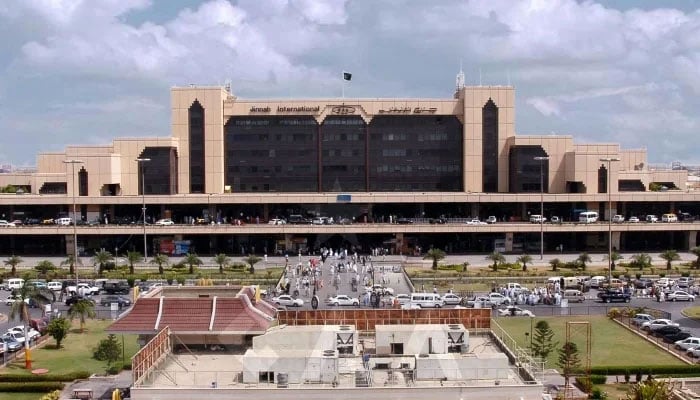
According to airport sources, five aircraft belonging to Air Arabia, Qatar Airways and Flydubai have been stuck at the Jinnah International Airport for the past two days.
At the Multan International Airport, one Flydubai aircraft is stranded, while two flights operated by Flydubai and Air Arabia are present at the Sialkot International Airport.
One Iranian aircraft is parked at the Allama Iqbal International Airport.
A Flydubai flight that had been stranded at Bacha Khan International Airport was shifted to Islamabad International Airport on Sunday. Additionally, one Gulf Air flight was already present at the Islamabad Airport.
Sources said passengers of these flights were sent home, while the crew members were shifted to hotels.
Airspace of 9 countries remains closed to flights
Meanwhile, Lebanon’s flight operations have partially resumed, while airspace of nine other Middle Eastern countries remains closed for the third consecutive day.
A total of 10,000 flights have been cancelled over the past three days. Flight operations between Pakistan and the Middle East will also remain suspended for the third day on Monday (today). The number of cancelled Pakistani flights has reached 500.
On Sunday, 3,400 flights were cancelled at seven major Middle Eastern airports, while on Saturday around 3,000 flights across the region were reported cancelled. According to FlightRadar, airspace of nine countries — Iran, UAE, Qatar, Bahrain, Kuwait, Iraq, Syria, Jordan, and Israel — will remain completely closed on Monday as well.
Around 3,500 flights scheduled for Monday in these countries have been cancelled.
Various airlines have announced Middle East flight operations will remain suspended on Monday, with further updates to be issued in the afternoon. According to FlightRadar, partial restoration of Lebanese airspace was observed on Sunday, and approximately 34 flights operated at Beirut Airport.
From Karachi, Lahore, Islamabad, Multan, Sialkot, Peshawar, Faisalabad, and Quetta, about 200 flights to destinations including Dubai, Sharjah, Doha, Najaf, Istanbul, Abu Dhabi, Muscat, Bahrain, Tehran, Dammam, Ras Al Khaimah, Kuwait, and Riyadh have been cancelled. The flight schedule shows 174 Middle East-bound flights from across Pakistan cancelled for Monday. On Saturday, 125 Middle East flights were cancelled.
Emirates has suspended all Dubai operations until 3:00pm Monday. Etihad Airways has also suspended flights and announced it will issue its next update at 3:00pm.
Qatar Airways has made resumption of operations conditional upon reopening of airspace and will announce its next update at 9:00am Monday.
Meanwhile, overflights through Pakistani and Afghan airspace have increased following their reopening. Millions of passengers in Middle East are facing a severe crisis for second consecutive day.
In contrast, Saudi Arabia’s airspace remains open and airport operations are normal. Turkiye and Saudi Arabia have restored flight operations, though Turkish Airlines is operating on longer alternative routes.
Millions of passengers are stranded at airports worldwide. A German airline has extended suspension of its regional flights until March 8. On Sunday, FlightRadar showed airspace over Iran, Iraq, Kuwait, Israel, Bahrain, UAE, and Qatar was nearly empty.
The UAE Civil Aviation Authority stated it assisted approximately 20,200 passengers on the first day of disruptions on Saturday.
Airlines across Europe, Asia and Middle East have begun cancelling or rerouting flights to avoid long alternative routes and increased fuel costs caused by closed or restricted airspace.