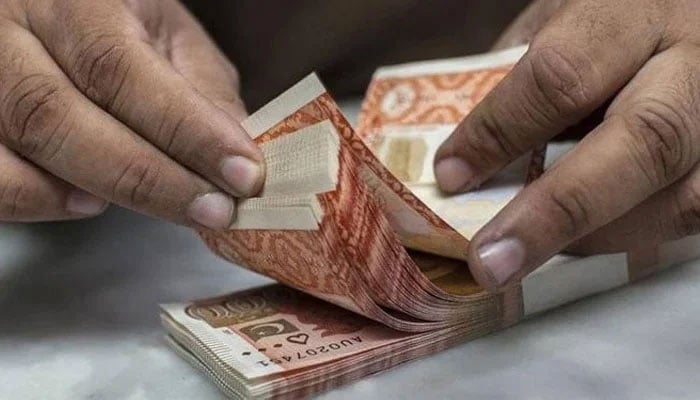
KARACHI: The government raised Rs492 billion (both competitive and non-competitive) from the auction of fixed-rate Pakistan Investment Bonds (PIBs) on Wednesday, with yields falling across all tenors.The target for this auction was Rs450 billion, with total participation reaching Rs2.06 trillion.
According to the auction result from the State Bank of Pakistan (SBP), the cut-off yield on the two-year PIB decreased by 59 basis points (bps) to 10.19 per cent. The yield on the three-year paper stood at 10.14 per cent, down 70bps from the previous auction. The yield on the five-year bond also dropped by 67bps to 10.525 per cent. The yield on the 10-year paper declined by 67bps 11 per cent. However, the government rejected bids for a 15-year PIB.
Pakistan’s latest PIB auction highlighted a clear shift in market expectations toward easier monetary conditions, with cut-off yields falling by 60-70bpsacross most tenors amid strong investor demand, said Saad Hanif, head of research at Ismail Iqbal Securities.
“Bidding was concentrated in the 3-10-year segment, where acceptances exceeded targets and yields cleared at or below PKRV, reflecting confidence in further policy easing supported by ample liquidity,” Hanif said.
“The two-year tenor remained anchored near the benchmark, reinforcing near-term rate-cut expectations, while the authorities stayed cautious on duration, rejecting 15-year bids and seeing no participation in ultra-long maturities,” he added.
In December, the SBP reduced its benchmark interest rate by 50 basis points, bringing it down to 10.5 percent. This decision ended a four-meeting pause and was made in light of a stable inflation outlook and the goal of supporting economic growth. The SBP’s next policy meeting is on January 26.
Pakistan’s consumer price inflation slowed to 5.6 per cent year-on-year (YoY) in December. That compares with 6.1 per cent in November.The SBP in the last monetary policy statement noted that inflation on average remained within the target range of 5-7 per cent during July-November FY26, though core inflation is proving to be relatively sticky. The headline inflation may temporarily increase toward the end of this fiscal year, which ends in June, due to base effects.