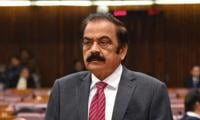
ISLAMABAD: Pakistan possesses two choices — either to continue seeking loans from the International Monetary Fund (IMF) and deposits from bilateral partners, or move towards increasing productivity and securing export-led growth — in order to say goodbye to the Washington-based global lender, said Minister for Planning Ahsan Iqbal on Monday.
“There is no other choice but to increase exports to $60 billion within four years and cross $100 billion by 2035. With a status quo approach, the country’s GDP will stand at $600 billion, but it needs to reach the $1 trillion mark. If our neighboring country’s economy can reach $9 trillion, then why can Pakistan not reach $1 trillion?” said Iqbal while launching the Monthly Development Update for December 2025 at a press conference.
He said the prime minister has constituted a high-powered committee led by the deputy prime minister with the mandate to prepare a roadmap for sustaining the economy without having to knock at the IMF door after the expiry of the existing $7 billion Extended Fund Facility deal.
Iqbal noted that he had presented a roadmap for export-led growth and proposed that the manufacturing sector continue operating even on national holidays to avoid disruption in supply chains. Exports could be increased to $60 billion over the medium term, he added, stating that there is potential to boost exports by $20 billion over the next few years.
Under the proposed plan, the minister said, the focus would shift from low-value to high-value-added products, with selected sectors targeted to generate multibillion-dollar exports. The government has consulted trade bodies to prepare a district-wise strategy for boosting exports, he added.
Pakistan requires “Arshad Nadeem-like players” in the export sector to achieve leapfrog growth, he remarked. Iqbal defended the country’s first-quarter (July–September) GDP growth of 3.7 percent, noting it had been authenticated and validated by the UN and IMF systems.
Responding to a query on China Pakistan Economic Corridor, he said the last Joint Cooperation Committee meeting was held in China and its official minutes have been signed by the Chinese side but have not yet been received. It is hoped that the minutes will be finalised soon, after which both sides will pursue the agreed agenda.
He added that Pakistan is pursuing knowledge corridors with the US and China to secure 10,000 scholarships from each country. Iqbal stated that there is ample opportunity to focus on reforms in energy, taxation and other structural bottlenecks over the next two years while the country remains under an IMF programme.
The government will also focus on olive production and commercialisation of tea to reduce import reliance, he said. On polio eradication, he mentioned Pakistan contributed $638 million while Bill Gates contributed $2 billion. Out of 120 countries, 118 are polio-free; only Pakistan and Afghanistan still have polio cases. Pakistan has devised a strategy to become polio-free within the next few years.
Regarding the utilisation of Public Sector Development Programmme funds, he said Rs356 billion has been authorised, with Rs314 billion sanctioned so far. Out of this, Rs210 billion has been utilised in the first half (July–December) of the current fiscal year, compared to Rs148 billion utilised in the same period last year.
Earlier, the Ministry of Planning released its Monthly Development Update report. According to it, in the first quarter (July to September) of the current financial year, Pakistan’s economic growth rate was recorded at 3.7 percent. The agriculture sector grew by 2.9 percent, industry by 9.4 percent, and the services sector by 2.4 percent.
The average inflation rate during the six months from July to December stood at 5.2 percent, compared to 7.2 percent in the same period last year. In December, however, inflation rose from 4.1 percent to 5.6 percent.
Tax revenue collected by the Federal Board of Revenue (FBR) increased by 9.5 percent over the six-month period, with a 7.3 percent rise recorded in December alone. The fiscal deficit during the first five months (July to November) widened to 0.8 percent of GDP, up from 0.03 percent during the same period last year.
On this occasion, Federal Minister for Planning Ahsan Iqbal stated that the government’s economic policies have led to a marked improvement in Pakistan’s economic indicators, with key sectors maintaining stability due to the government’s reforms.
He emphasised that the government is striving to ensure sustainable development without stepping outside the bounds of prudence. He noted that large-scale manufacturing has shown recovery, recording a 5 percent growth from July to October.
Despite challenges such as floods and supply chain disruptions, exports reached $16.6 billion. Additionally, remittances during July to December grew by 10.5 percent, amounting to $19.7 billion. This strong increase in remittances reflects the confidence of overseas Pakistanis in the government and improved economic stability, he added.