Venezuela had deployed JY-27, a mobile meter-wave early-warning radar developed by China Electronics Technology Group Corporation (CETC), designed for long-range surveillance and counter-stealth detection.
In response, the United States deployed the EA-18G Growler, built by Boeing, to conduct electronic attack—jamming radar frequencies, degrading sensor fusion, and suppressing Venezuela’s air-defense and early-warning network to achieve air-space dominance.
The EA-18G Growler suppressed and degraded the JY-27’s sensing and cueing, collapsing Venezuela’s early-warning picture. The United States blinded Venezuela. Remember, modern wars are decided not by who sees first—but by who blinds first. Venezuela had deployed the S-300 (export variant), a Russian-made long-range surface-to-air and anti-ballistic missile system designed for area air defense.
The United States Air Force (USAF) brought in the F-35 Lightning II, built by Lockheed Martin, leveraging stealth and networked targeting to penetrate Venezuelan airspace, neutralize command-and-control nodes, and render the S-300 batteries tactically ineffective without requiring large-scale kinetic strikes.
Question: What happened on the battlefield.
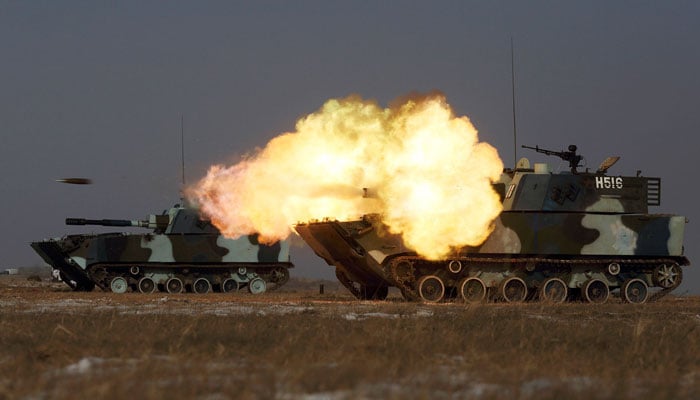
Answer: The air-defense shield existed—but it could not see, track, or engage decisively Remember, air defenses deter aircraft; they do not deter invisibility. Venezuela had deployed the VN-16, a Chinese-made amphibious armoured fighting vehicle. The USAF brought in the MQ-9 Reaper, a medium-altitude, long-endurance unmanned aerial vehicle, to establish persistent ISR (Intelligence, Surveillance, and Reconnaissance), target acquisition, and precision strike dominance. over the littoral battlespace.
Question: What happened on the battlefield?
Answer: The VN-16s could move—but they could not hide. Continuous overhead surveillance stripped maneuver of surprise, exposed formations in real time, and neutralized amphibious forces. Remember, mobility matters—but in modern war, visibility kills. Venezuela had deployed an integrated, mixed Chinese–Russian command-and-control (C2) architecture. The United States brought in JADC2 (Joint All-Domain Command and Control), linking every sensor to every shooter across air, land, sea, space, and cyber domains in near real time.
Here’s what happened on the battlefield: Venezuela’s C2 could collect data—but it could not keep pace. U.S. forces compressed the kill chain, bypassed centralized nodes, and turned decision speed into a weapon. Venezuelan commanders were out-cycled, coordination lagged, and the defensive network collapsed.
Remember, in modern war, the side that decides faster doesn’t just win—it overwhelms. Venezuela had deployed an Integrated Air Defense System (IADS)—linking sensors, shooters, and command nodes to deny airspace through layered surface-to-air coverage.
The United States responded with a SEAD campaign (Suppression of Enemy Air Defenses)—combining electronic attack, cyber effects, decoys, standoff munitions, and stealth platforms to dismantle the IADS systematically.
Question: What happened on the battlefield?
Answer: Venezuela’s radars were degraded, command links disrupted, and launch batteries isolated. Venezuela’s air-defense network stopped functioning as a system—unable to cue, track, or engage effectively. Airspace control shifted decisively to U.S. forces. Remember, air defences fail not when missiles run out—but when networks break. This operation opened a new chapter in regime-change warfare.
The deployment of USS Gerald R. Ford and its carrier strike group, alongside USS Iwo Jima and amphibious forces, was a deliberate deception—designed to fix attention on conventional escalation while masking a far narrower objective. The real mission was surgical extraction: isolate, locate, and extract the political centre of gravity-the president.
This was enabled by the fusion of imagery intelligence (IMINT), signals intelligence (SIGINT), and human intelligence (HUMINT) into a single operational picture. Satellites mapped movement, signals revealed patterns, and human sources closed the final gaps. Force posture created noise. Intelligence delivered precision. This was not invasion warfare. It was decapitation warfare—fast, quiet, and network-driven. Remember, the loudest movements often conceal the quietest missions. In this century, hardware fights battles. Networks decide wars. Weapons win engagements. Systems win wars. Steel moves forward. Data decides. In this century, victory is not loud. It is fast, fused, and invisible.
Red alert: Modern wars are no longer platform-versus-platform. The United States strikes the electromagnetic spectrum and command layer first; once those fail, individual systems—regardless of brochure claims—become isolated, brittle, and irrelevant.