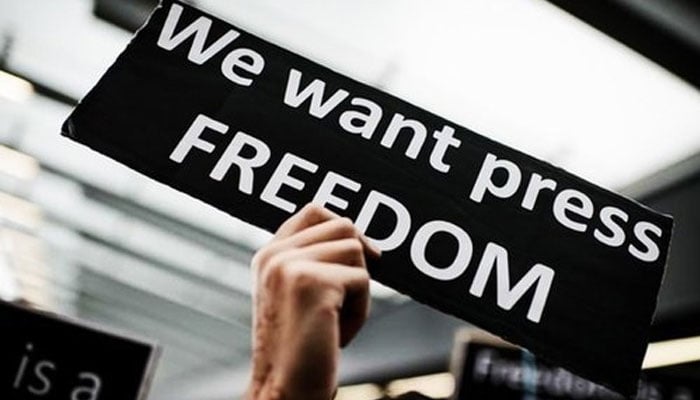
LAHORE: Journalists face pressure, intimidation, and violence from multiple sides in Balochistan, reveals a new Freedom Network research report.
Titled “Journalism in Balochistan: State of Media Freedoms, Access to Information and Safety of Journalists and Media Professionals in Balochistan -- Way Forward,” the report examined state of media, threat actors to free speech, service structure, gender in journalism, legal cases and legal challenge to journalism, censorship, harassment, intimidation and dismissals from services.
“Journalism is lost in Balochistan province where enforced and self-censorship prevail the most to stay safe and avoid any mishap. The findings of this report, I hope will, seek attention of all stakeholders to reverse the situation and get media practitioners and assistants safe to let citizens have access to credible information,” Freedom Network Executive Director Iqbal Khattak said in a press release while releasing the report on Sunday.
The report traces how security, governance, economics, and demography shaped the media ecosystem and journalists’ safety in Balochistan.
It finds a chronically constrained information environment in which local media are financially brittle, structurally peripheral to “national mainstream” agendas, digitally disadvantaged, and exposed to overlapping coercive pressures from state and non-state actors. “The cumulative effect is systematic under-coverage of public-interest issues, heightened self-censorship, and a steady erosion of citizens’ right to know,” the report said.
“Pakistan’s electronic media expanded rapidly after 2002 under Pakistan Electronic Media Regulatory Authority (Pemra), but Balochistan’s regional media footprint remained thin. National television channels and newspapers keep shrinking bureau presence in Quetta as digital distribution becomes the default; outside the capital, coverage is sparse to nonexistent.
The province lacks a terrestrial current affairs TV channel. State media outlets operate mainly from urban centers; their multilingual mandate complicates content and reach, and transmission into remote areas remains limited, it added.
On the private side, a Karachi-based Balochi-language outlet has positioned itself as a 24/7 satellite channel for Baloch audiences with national and diasporic reach. FM radio exists but is constrained by Pemra’s 35–40-km coverage caps — unworkable in a province defined by vast distances and difficult terrain. Print is concentrated in Quetta and hampered by cost, distance, and low literacy in rural areas.
“Of the 120-plus periodicals on the provincial DGPR list, only about a dozen dailies have real readership,” the report said.
According to the report, Pakistan counted 116 million internet users at the start of 2025 (45.7 per cent penetration), but Balochistan lags badly at 15 per cent penetration, with 60 per cent of the province lacking fibre connectivity. “Prolonged, localised shutdowns — sometimes weeks or months (e.g., Panjgur since May 2025; post-attack blackouts in Khuzdar) — compound isolation, impede reporting, and create two starkly different digital realities within one country. Social media has, paradoxically, become essential for newsgathering and distribution while exposing journalists and citizen reporters to surveillance, takedown demands, and retaliation,” it said.
The report says journalists face pressure, intimidation, and violence from multiple sides — separatist/militant groups, security apparatus, political and tribal elites, and mobs.
“Over two decades, 40 journalists have been killed in Balochistan; roughly 30 were target-killed, the rest collateral to bombings/attacks,” it said.
Khuzdar has been cited among the most dangerous districts for journalism. Journalists are frequently coerced to carry militant claims or assist in tracing callers; refusal or cooperation can each trigger threats. Compensation exists for terror victims (e.g., Rs4 million), but impunity persists — no convictions in journalist murders, despite repeated assurances, it added.
Women journalists remained very few, largely confined to Quetta, and face layered constraints —mobility, hostile field conditions, newsroom sexism, pay gaps, lack of basic facilities (transport, washrooms, childcare), and harassment, according to the report. “Editors often bar women from district assignments for ‘safety,’ reinforcing stereotypes while still expecting output without support. Women frequently work off-camera or have male colleagues voice their packages,” it added.