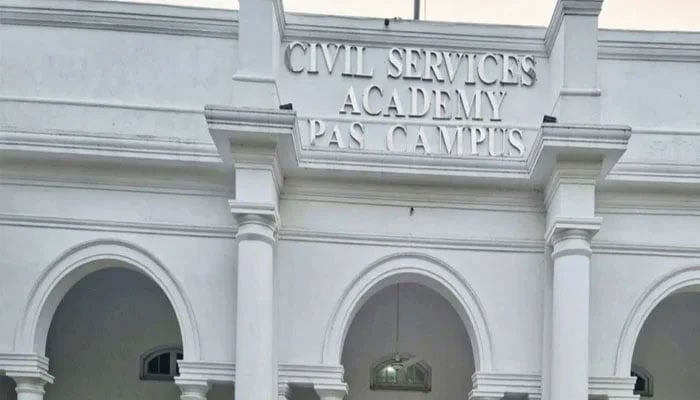
LAHORE: The Pakistan Civil Service Academy probationary officers of the 53rd Common Training Programme (CTP) were given practical exposure to national policymaking during a two-day National Tobacco Control Leadership Workshop held at a local hotel in Islamabad.
The participation was arranged by the Civil Services Academy (CSA), Lahore, as part of its effort to train policy-aware, socially responsible and effective civil servants. The initiative reflects the vision of Director General CSA Farhan Aziz Khawaja to move learning beyond classrooms and engage young officers with real governance challenges.
The exposure visit was supervised by Director Common Training Programme Dr Syed Shabbir Akbar Zaidi and aimed to familiarise future civil servants with cross-cutting policy issues involving health governance, regulation, enforcement and coordination between federal and provincial governments.
During the workshop, the probationary officers took part in policy discussions, technical sessions and practical exercises focused on Pakistan’s tobacco control framework. They studied national laws, enforcement systems and Pakistan’s commitments under the World Health Organization’s Framework Convention on Tobacco Control, gaining insight into how policies are implemented on the ground.
A key feature of CSA’s participation was the active role played by the officers, who delivered group presentations highlighting gaps in policy, weak coordination between governments and challenges faced by district administrations. They proposed measures such as introducing tobacco-control modules in training programmes, declaring government offices smoke-free, appointing young officers as awareness ambassadors and sensitising under-training officers at an early stage.
Addressing the participants, Dr Zaidi stressed that tobacco control should be seen as a leadership and governance issue rather than only a health concern. He said civil servants have a key role in closing the gap between legislation and enforcement and encouraged young officers to take initiative in preventive public policies.
The workshop was organised by the Ministry of National Health Services, Regulations and Coordination in collaboration with WHO Pakistan. It brought together policymakers, health experts, law-enforcement officials, civil administrators, training institutions and civil society groups, giving participants a whole-of-government learning experience.
Director General NHSRC Dr Abdul Wali Khan, in his opening remarks, described tobacco use as one of Pakistan’s most preventable causes of death and called for strong institutional leadership. Dr Nadia Noreen, Director of the Tobacco Control Cell, outlined Pakistan’s legal obligations under national law and international treaties, highlighting leadership as the key to effective implementation.