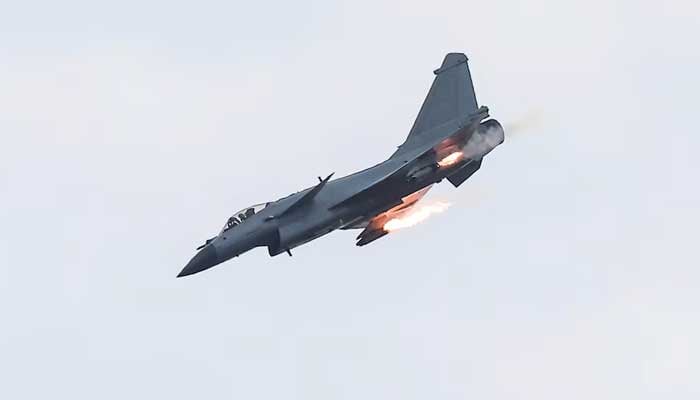
The Pakistan-India May 2025 war is referenced in the November 2025 report produced by the US-China Economic and Security Review Commission for the US Congress. The aforementioned is a congressional commission that monitors and reports on US-China relations and their national security impacts.
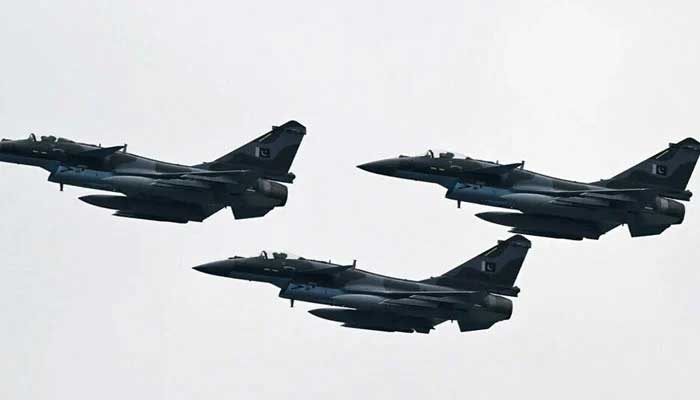
In the report, the focus is on the Chinese-produced weaponry by emphasising that Pakistan’s success in the May 2025 war was a product of the Chinese-supplied J-10C, PL-15 and HQ-9. Citing the Indian Army as its source, the report also alleged Pakistan’s use of Chinese intelligence during the war. These assertions undermine the basic essence of the PAF’s victory: its transformation into a forward-leaning, resilient and next-generation air force by the incumbent Air Chief Marshal Zaheer Ahmed Baber Sidhu.
Undoubtedly, the PAF’s victory came about through the use of Chinese-supplied weaponry, but the core argument is missing. It was the excellent deployment of these systems, coupled with rigorous training of the PAF pilots and indigenised systems developed by the NASTP, the brainchild of the current air chief, that the IAF was overwhelmed.
Pakistan demonstrated its ability to employ its air force in a very potent manner, yet this fact has been undermined and unacknowledged. The truth is that the PAF used the Chinese equipment, effectively employed them in Marka-e-Haq, a multi-domain operation (MDO), and successfully defeated the fourth most powerful air force in the world.
In my assessment, even if Chinese technology has come into the limelight and Beijing has come forward to try to share the credit for Pakistan’s indigenous capabilities, there is not much problem in it. This is because the end result of the May war, widely published and recognised by the world, was victory for Pakistan.
In another instance, the US Congress Report impassively acknowledges that Indian fighters were shot down by the PAF. The report admits, although with equivocation and without delving into details, that the IAF lost its aircraft. The number is capped at three and does not go into depth. This ambiguity obscures the truth, which has been acknowledged by US President Donald Trump.
According to President Trump’s latest statement, “Eight [Indian] planes, seven [Indian] planes were shot down, an eighth was really badly wounded”. Pakistan reports that it downed seven IAF fighters, a blow that grounded the Indian Air Force for two days. Despite IAF resistance during the largest night-time BVR engagement in modern history, the PAF shot down four Rafales, one Mig-29, one Mirage-2000 and one Sukoi-30. These numbers have been put forth after a stringent burden of proof for the kill criteria was met, including electronic proofs. The ultimate evidence came from ground confirmation, with locals identifying the wreckage of downed Indian aircraft. The Indian media also confirmed the downing of several IAF fighters.
The report also quotes French intelligence alleging that China used fake social media accounts to circulate AI-generated images of IAF aircraft debris, putatively aiming to undermine sales of French Rafales in favour of its J-35s. However, it is in France’s interest to emphasise the Rafales’ performance to avoid marketing challenges for its best fighter aircraft.
This propaganda against China is also unjustified and out of place given that Rafale is a 4.5 Generation aircraft and J-35 is a stealth fighter. In the report, Indonesia is cited as halting its Rafale purchase post-May 2025. While many factors may have had a role in Indonesia’s decision, especially the fact that Rafale is an expensive platform, the results observed during the May war might have given impetus to Jakarta’s decision.
In the case of a state coercing another to buy its platforms, the example of US-India is apt. The F-35, a cost-prohibitive aircraft, is being forced upon the Indians by President Trump in the backdrop of New Delhi’s trade deficit with Washington. In the past, the Indians have preferred European fighters over US fighters in the form of Mirage-2000, Rafale, followed by Russian Su-30 and Mig-29.
Nevertheless, a misnomer has been propagated that the Indians are not using any US equipment. This could not be far from the truth. The IAF equipment, sans its fighters, is American. For their strategic airlift capabilities, the Indians have the Lockheed C-17, supported by the C-130 Hercules. They also have top three US helicopters: Chinook, which provides them with heavy airlift capabilities; Apache, the attack helicopter; and Black Hawk for tactical airlift and special operations. The Indians also have acquired the US’s top strategic use UAV, the MQ-9B Predator which is used by all three of its services. Therefore, the IAF is using the US equipment in every aspect.
In the US Congress Report, the facts have not been fully stated, nor has a correct perspective been put forth. Rather, a biased tone has been adopted to project the PAF’s victory as solely dependent on Chinese machinery, overlooking the phenomenal performance of the PAF pilots and leadership.
The reality is that Pakistan’s victory was not simply imported; it was engineered through disciplined training, indigenous innovation and the effective orchestration of MDOs. South Asia’s skies became witness to the potency of an air force built on resilience, ingenuity and strategic mastery.
The writer is president at the Centre for Aerospace and Security Studies (CASS), Lahore. He can be reached at: [email protected]