ISLAMABAD: Director General Federal Investigation Agency (FIA) Riffat Mukhtar Raja Wednesday told the National Assembly’s Standing Committee on Overseas Pakistanis and Human Resource Development that 66,154 passengers were offloaded this year as against 35,000 offloaded the previous year.
The FIA clarified that 51,000 of those individuals were stopped due to questionable veracity of travel documents falling into three main categories: work visas, tourist visas and Umrah visas.
The committee meeting, chaired by Syed Rafiullah, examined the growing phenomenon of off-loadings, and the role and performance of the community welfare attaché network in protecting Pakistanis abroad.
Riffat informed the committee about operational realities at the ports of exit and explained that the spike in offloadings was multi-faceted. He highlighted that illegal migration and begging rings were severely damaging Pakistan’s international image. According to him, Saudi Arabia deported 24,000 Pakistanis this year for begging, while Dubai deported 6,000 and Azerbaijan sent back around 2,500 Pakistani beggars.
Additionally, illegal migration trends have been observed toward Africa, and even on tourist visas to countries like Cambodia and Thailand.
The FIA officials defended the stringent measures as necessary to curb human trafficking and protect Pakistan’s international standing. Riffat noted that the surge in offloading was a countermeasure against fraudulent migration rings, revealing that 56,000 Pakistanis involved in organized begging were recently deported from Saudi Arabia.
The FIA chief also highlighted concerns over missing Pakistanis abroad, informing the committee that 24,000 Pakistanis travelled to Cambodia this year, of whom 12,000 had yet to return. Similarly, 4,000 individuals went to Myanmar on tourist visas, with 2,500 still unaccounted for.
Briefing the committee on policy outcomes, the DG FIA said strict offloading measures had helped curb illegal migration, resulting in Pakistan’s passport ranking improving from 118 to 92.
The committee was also briefed on an unusual case involving a fake football club that sent a so-called team to Japan, including a physically disabled individual. The committee was told that investigations revealed that the same fake club had managed to send individuals to Japan as early as 2022.
He added that Pakistan previously ranked among the top five countries for illegal migration to Europe, but due to improved enforcement and policies, it had now exited that list. He said 8,000 Pakistanis travelled illegally to Europe last year, while the number was expected to drop to around 4,000 this year.
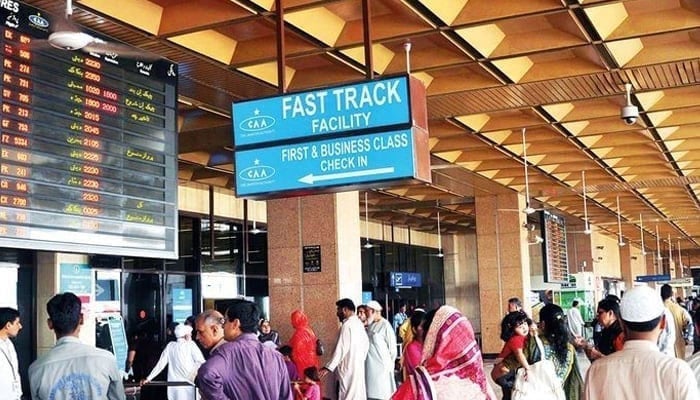
Riffat told the committee members that Islamabad airport had more FIA counters but faced a shortage of staff. To manage the workload, services of 30 female officers from the Islamabad Police were currently being utilised. He also disclosed that 180 FIA personnel involved in corruption had been dismissed from service.
Additionally, an e-immigration (EMI) application is set to be launched by mid-January. The system will allow travelers to obtain immigration clearance up to 24 hours prior to departure, aimed at improving transparency and curbing illegal migration.
The committee was also informed that Dubai and Germany had granted visa-free entry on Pakistan’s official passports, terming it a positive diplomatic development.
Furthermore, officials pointed to growing restrictions from the UAE and emerging illegal migration routes toward Africa and Europe as drivers for the heightened vigilance.
The members welcomed the enforcement work but emphasized that enforcement must be paired with an accessible redressal channel so that genuine travelers who were wrongly off-loaded may obtain rapid relief. The committee stressed the need for stricter monitoring, inter-agency coordination and public awareness to curb illegal migration and protect Pakistan’s international standing.The committee directed the FIA and Ministry of Interior to finalise, publish and operationalise a clear SOP for off-loading and an airport-visible complaint mechanism.
The committee also heard that a risk-analysis unit had been created and an “IMMI” mobile application was being developed to improve pre-departure screening and real-time monitoring of immigration counters.
The members urged immediate interoperability between FIA systems and Protectorate/E-Protector platform so that verification and “ok-to-board” checks were done before passengers could reach the airport counter.
The chair stressed that the public must be informed how a passenger may challenge an off-loading decision and that contact details and an online complaint form be displayed at all airports.
The ministry presented the CWA network briefing and members were given a full account of the legal basis for CWAs (Emigration Ordinance, 1979), merit-based selection process, KPIs and the ministry’s expansion plan to restore and add CWA wings at priority stations.
The committee took a detailed note of the Gulf-region returns: the CWAs reported collectively handling over 55,000 welfare cases in 2025, including more than 30,000 assisted repatriations/ETDs, 3,400+ death-related interventions and thousands of prison-visits and legal-aid interventions.
The committee welcomed these achievements but also recorded persistent operational constraints — passport confiscation by employers, employer resistance to dues recovery, host-country legal limitations, language barriers and weak outreach to remote labour camps — and stressed that these constraints must be addressed through bilateral engagement and strengthened in-mission capacity.
On the Gulf-region performance, the members highlighted noteworthy outcomes — rapid issuance of Emergency Travel Documents, targeted repatriations and coordinated legal support — while pressing for better prevention (pre-departure orientation and contract validation), improved employer engagement and a dedicated legal-aid panel in mission posts to speed judicial remedies.The committee, therefore, directed the ministry to provide full, station-wise performance returns for each CWA in the Gulf (including case-level summaries, staff rosters and resourcing requests) and to table a prioritised plan for the next 10 new stations envisaged in the presentation.In terms of institutional reforms, the committee recorded immediate recommendations: first, that an SOP and public complaint mechanism for off-loaded passengers be produced and displayed at all airports; and that the full list and performance returns of Gulf CWAs be submitted to the committee.