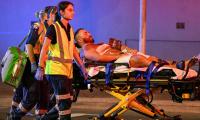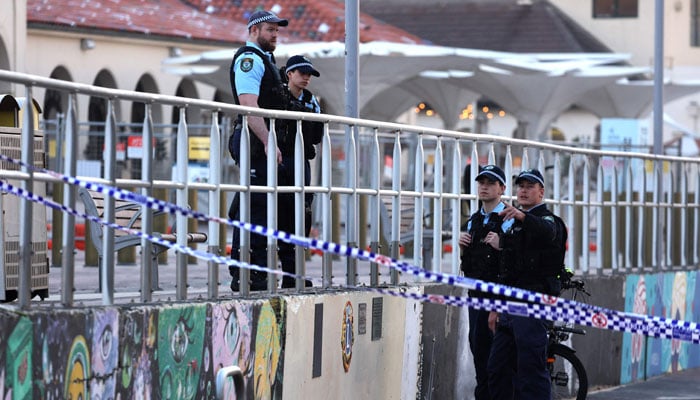
LAHORE: Described as a mass shooting targeting the Jewish Hanukkah celebrations, the killing of over a dozen people at Sydney’s iconic Bondi beach is one of the many acts of terror that have shocked Australia since 1971 at least, research shows.
But this is not the first attack targeting Israeli Jews in Australia where, according to the ‘Australian’ newspaper, 20pc Aussies harboured antiemetic views in 2025, up from 14pc in 2014.
In December 1982, the Israeli Consulate and Hakoah Club in Sydney were bombed. The two bombings occurred within five hours of each other. The case led to a single arrest, although charges were later dropped.
In 1991, at least five synagogues were attacked in Sydney alone. Research shows that between 2000 and 2023, there were at least 20 synagogue attacks across Australia. And then in 2024, an arson attack at the Adass Israel Synagogue in Melbourne led to one injury and significant damage to the building.
The ‘Reuters’ reported that Victoria state police said a worshipper had seen two people who appeared to be spreading an accelerant inside the building before setting it on fire. Dozens of firefighters doused the fire at the synagogue, built in the 1960s by Holocaust survivors. Australia has seen a rise in anti-Semitic incidents since Israel attacked Palestinian group Hamas in retaliation on Oct 7, 2023 with an assault on Gaza that left tens of thousands of people dead.
Some other noted terror attacks in Australia since 1971:
In January 1971, the Embassy of former USSR was bombed in Canberra.
In 1972, the Sydney Yugoslav General Trade and Tourist Agency bombing had injured 16 people. The perpetrators were believed to be Croatian separatists.
In 1978, the Sydney Hilton Hotel bombing led to the death of a cop and two garbage collectors. Hilton Sydney was hosting the first Commonwealth Heads of Government moot on that day.
The June 1980 attack shot dead a judge of the Family Court in Sydney.
In November 1980, the Iwasaki Resort bombing took place in Queensland on the state election day.
The Australian Broadcasting Corporation stated: “Tensions were high in Queensland, with some strongly opposing Japanese ownership of the 9,000-hectare property.”
The “Queensland Republican Army” was blamed.
In 1980, a Turkish Consul General and his security attaché were assassinated in Sydney by two people wielding firearms. The Consul General was gunned down despite having taken precautions by not travelling in his official Mercedes car and instead being chauffeured in the trailing security Attache’s vehicle.
In 2019, the reward for information leading to these murders was increased to one million Australian dollars. This was the first ever million-dollar reward offered in Australia for an act of terrorism.
In 1984, a bomb destroyed the Sydney home of another judge, who survived.
In July 1984, a judge’s wife was killed in Sydney with a bomb.
In 1985, a bomb killed a local Witness Minister, Graham Wykes, in Sydney.
In 2015, a man, John Warwick, was charged in New South Wales for 32 offences.
In September 2020, he was sentenced to life without parole, though he died in prison.
In 2004, three Chinese restaurants in Perth were firebombed. A man was found guilty, but was given a two-year suspended sentence on account of ill health. His accomplice was awarded a 28-month sentence.
In 1986, a Turkish consulate was bombed in Melbourne. The bomber got killed as he had failed to correctly set up the explosive device. A Sydney resident with links to the Armenian Revolutionary Federation was charged and served 10 years.
In 1995, the French Consulate bombing in Perth was firebombed.
In 2001, a man set ablaze an abortion clinic in Melbourne, killing a security guard before his arrest. He was convicted and sentenced to life with a non-parole period of 23 years.
In 2014, Victoria police killed a youth, Numan Haider, who had stabbed two cops.
In 2014, some 17 people were taken hostage inside a Sydney café. The culprit and two hostages died.
In 2015, an Iraqi-Kurdish youth shot dead an accountant of the New South Wales Police.
In 2017, a pair of 15 and 16-year-old boys entered a service station in New South Wales and stabbed attendant, 29-year-old Zeeshan Akbar of Pakistani descent, who died at the scene. In 2020, both boys were sentenced. The 16-year-old received a jail term of over 35 years, while 15-year-old received 18 years and 4 months.
In June 2017, a Somalian shot dead a receptionist at a residential complex in Melbourne. The assailant died in a shoot-out with three cops wounded.
In 2018, a Bangladeshi woman stabbed a man in Victoria. She was later sentenced to 42 years jail, with a non-parole period of 31 years.
In 2018, three pedestrians were stabbed in Melbourne. The attacker, Hassan Khalif, was shot dead by police. His brother, Ali Khalif, was earlier arrested in 2017 for planning terrorism at Melbourne’s New Year’s Eve celebrations. In May 2020, Ali Khalif was sentenced to 10 years.
During the 2020 Brisbane stabbing attack, a man killed two elderly people after storming their home and then attacked police. The attacker with mental health issues was shot dead by police.
The 2024 Sydney Church attack saw the bishop and priest being stabbed by a young attacker.