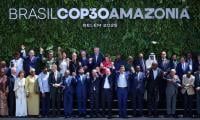
I experienced this fragility firsthand when the fire broke out inside the COP30 venue. Delegates who moments earlier were debating commas and brackets were suddenly united by vulnerability, coughing in the open air as talks came to an abrupt halt.
It was a visceral reminder that the climate crisis, much like that fire, doesn’t wait for perfect consensus. In that moment, the spirit of the Mutirao stopped being rhetoric and became a lived reality: when the house is burning, everyone must act together.
Coming back into the venue after the evacuation, with the countries’ pavilions cordoned off, the mood had palpably shifted. The fire had revealed, quite literally, how thin the line is between order and chaos, and how quickly global diplomacy can be derailed by forces beyond anyone’s control. It sharpened a question that had been quietly following the negotiations all week: were we once again kicking the can down the road, or finally ready to hit the nail on the head? COP30, heralded by the Presidency as the much-anticipated “implementation COP”, was supposed to be the moment when global climate politics graduated from lofty promises to actual delivery.
With climate impacts accelerating and financial needs skyrocketing, negotiators arrived with a mandate to sharpen tools, formalise indicators and lay down credible processes fit for a world running out of time. Yet, as the week unfolded, it became painfully clear that, while ambition was in the air, agreement was not. Deep divisions on finance, trade measures, fossil fuel pathways and equitable burden-sharing kept resurfacing, stalling progress until the eleventh hour.
More than 80 countries, led by Colombia, pushing relentlessly for a roadmap to transition away from fossil fuels, left the Amazon determined yet disheartened. Meanwhile, those advocating for stronger climate finance commitments found themselves wrestling with political headwinds that threatened to turn the conference into yet another exercise in deferred decisions.
And yet, amid the stalemates and softened language, one idea rose above the noise: the Presidency’s invocation of a Global Mutirao, a collective mobilisation rooted in solidarity and shared effort. The Mutirao reframes climate action not as an elite diplomatic ritual but as a cooperative, society-wide endeavour where everyone, from states to cities, and from communities to consumers, must pull their weight. It was, in many ways, the conference’s quiet answer to the question of whether we are still kicking the can: a call to pick it up together and finally move forward with purpose.
In doing so, the Mutirao introduced a moral and political compass that demands participation across the board: governments, communities, businesses, youth, Indigenous Peoples and local authorities alike. The Paris Agreement may have provided the scaffolding of ambition, but COP30 insisted that now is the moment to ‘walk the walk, and walk together’.
And in doing so, it invites countries such as Pakistan to find their own Mutirao, their own national blueprint for climate cooperation that extends from the marble corridors of Islamabad down to the last-mile municipal alleyways.
For Pakistan, this is no time to sit on the fence. Our vulnerabilities are now well-worn stories. But Pakistan has spent far too long stating the problem without redesigning the machinery that could solve it. The real test of leadership lies not in lamenting climate risks but in rewiring the country’s institutional backbone.
In this regard, the single most important, yet astonishingly overlooked, instrument is the National Finance Commission (NFC) Award. Let’s consider the NFC as a New Collective Quantified Goal (NCQG). Well, the NFC is the fiscal compact that decides who gets what and why within the federation. While the world is moving mountains to embed climate ambition across governance systems, Pakistan’s NFC still treats climate as an afterthought.
The truth is unavoidable: Pakistan cannot implement its Nationally Determined Contributions (NDCs) by leaving provinces out in the cold. Almost every sector central to climate action – energy, water, agriculture, forests, land use, waste, transport – falls under provincial mandate. Yet provincial governments face a perverse landscape in which climate leadership brings no fiscal reward, while environmental neglect carries no financial consequences.
A province that improves air quality is treated the same as one that lets its citizens breathe toxic air; a city that curbs waste burning gains no financial edge over one that suffocates itself; a province that enables renewable energy investments receives no more support than one blocking the clean transition. Simply put, you cannot expect provinces to pull their weight when the fiscal weightlifting platform itself is uneven. COP30’s Mutirao ethos – shared effort, shared responsibility – cannot be built on such lopsided foundations.
A Climate-Smart NFC Award is Pakistan’s clearest opportunity to turn the tide. By embedding climate performance indicators directly into the NFC formula, the federation can finally ensure that climate action pays dividends rather than remaining a moral plea. Provinces expanding solar and wind penetration, fast-tracking grid integration for renewables, or enabling distributed rooftop solar should receive greater fiscal transfers.
Cities that demonstrate verifiable reductions in PM2.5 should be rewarded for bringing cleaner air, quite literally, into the lungs of the nation. Forest-rich provinces such as Khyber Pakhtunkhwa should be compensated for protecting ecosystems instead of being left to carry the can alone. Investments in flood resilience, drainage systems, mangrove restoration, and glacier monitoring should create greater fiscal space. This approach speaks directly to COP30’s call for “accelerating implementation”, “strengthening enabling environments” and enhancing cooperation across the federation to achieve NDCs.
In essence, Pakistan must stop treating climate results as side notes and start writing them into the very ledger of national resource distribution.
Yet fiscal incentives require a reliable domestic revenue stream. This is where the idea of a carbon tax with recycling becomes indispensable. A carefully designed carbon levy, starting modestly with coal, furnace oil, low-efficiency vehicles and industrial emissions, can generate the fiscal oxygen Pakistan desperately needs. But the real innovation lies not in imposing the tax, but in how the revenue is used. Rather than diverting it into the general treasury, where competing demands swallow it, Pakistan can recycle carbon tax revenues back to provinces through the NFC, tied directly to climate performance.
A province that cuts emissions, reduces smog, expands EV infrastructure, regulates waste burning or accelerates renewable uptake would receive proportionally larger fiscal support. This creates a virtuous cycle in which good behaviour is rewarded, aligning incentives with outcomes. It becomes Pakistan’s own domestic version of results-based climate finance, except that the country controls the steering wheel.
This architecture also positions Pakistan to thrive in the fast-changing global economy. With Europe enforcing the Carbon Border Adjustment Mechanism (CBAM), the days of exporting high-emission goods are numbered. Pakistani manufacturers cannot afford to be caught flat-footed. Similarly, participation in Article 6 carbon markets, the Coal-to-Clean Credit Initiative and early coal retirement pathways requires synchronised federal-provincial coordination. A climate-smart NFC, backed by recycled carbon tax revenues, gives Pakistan not only the tools but the teeth to meet these challenges head-on. It ensures that provinces become partners in decarbonisation, not silent spectators waiting on federal instructions.
And so we return to the spirit of the Mutirao. In its essence, a Mutirao is not simply collective labour; it is a shared purpose. It is the understanding that when the house is on fire, everyone must grab a bucket. Pakistan needs its own Mutirão, but unlike Brazil, where community cooperation rises naturally, Pakistan’s political economy demands structured incentives. A climate-smart NFC and carbon tax recycling create the institutional plumbing for such cooperation. They convert political goodwill into measurable action, turn provincial competition into climate ambition, and transform federal transfers into instruments of resilience. They allow Pakistan to replace isolated efforts with a “whole-of-federation” approach.
COP30’s global Mutirao calls on humanity to mobilise collectively, equitably and urgently. Pakistan has a rare chance to turn that international call into a domestic transformation. We have spent too long treating climate action as a luxury; now it is the backbone of economic survival, trade competitiveness and public welfare.
By adopting a climate-smart NFC and a recycled carbon tax, Pakistan can align its fiscal DNA with the demands of a warming world. It can finally shift from crisis storytelling to strategic statecraft. It can ensure that every rupee flowing from Islamabad carries not only monetary value but a climate purpose. If Pakistan chooses this path, it will not simply follow the global Mutirao; it will stand as a country that refused to let climate change dictate its destiny and instead rewrote its fiscal and environmental future by grasping the nettle when it mattered most.
The writer has a doctorate in energy economics and serves as a research fellow at the Sustainable Development Policy Institute (SDPI).
Twitter/X: @Khalidwaleed_ Email: [email protected]