The story of Pakistan’s education is no longer about what is broken, it is about what is collapsing. It is a tale of two crises entwined: the children who never make it to school, and the children who do, only to emerge barely literate. Together, they form a portrait of a state that has not just neglected education but has normalised its decay.
At the heart of the first crisis lies poverty. The cost of keeping a family just above subsistence has far outpaced wages. As economist Dr Hafiz Pasha notes, a six-member family now needs at least Rs39,200 a month to stay above the poverty line, while the minimum wage stands at Rs37,000, below that threshold. Over 40 per cent of workers earn less than even this minimum, and unemployment exceeds 22 per cent. The arithmetic is cruel but simple: when food, rent and survival itself cost more than income, school fees, uniforms and transport are luxuries.
Fueling the fire, private schools, which educate over 46 per cent of enrolled students, exploit the poor quality of state schools, knowing families will prioritise them, even as the Senate Standing Committee on Education notes that many are raising fees beyond the legal 5.0 per cent limit, axing the middle class who wants quality education for their children but cannot keep up with escalating costs. Then, for millions, sending a child to school is a choice between education and eating, leaving nearly 26 million Pakistani children aged five to sixteen out of school, most of them girls, despite the constitutional guarantee of free and compulsory education.
Provincial disparities deepen the crisis: the District Vulnerability Index for Pakistan (DVIP) shows that Balochistan and KP suffer from weak health facilities, fewer schools, long travel distances, and poor transport links, all of which reinforce the cycle of vulnerability. Further, in rural areas, poverty intersects with gender norms and religious conservatism, while the absence of female teachers, safe transport and boundary walls deepens exclusion. Every girl kept from school is a loss to the nation’s future; educating girls drives productivity, reduces poverty and improves health, yet Pakistan still treats it as an afterthought.
Governments, to their credit, have begun to react, if not quite respond. The prime minister’s declaration of an ‘education emergency’ earlier this year signals a renewed urgency, and provinces have rolled out schemes aimed at inclusion. Punjab has outsourced over 14,000 schools, Khyber Pakhtunkhwa has placed more than 1,400 under public–private partnerships, and Sindh’s Education Foundation and School Education and Literacy Department are developing PPP frameworks to integrate out-of-school children and improve literacy. But access without quality is a hollow victory and outsourcing without oversight risks deepening inequality.
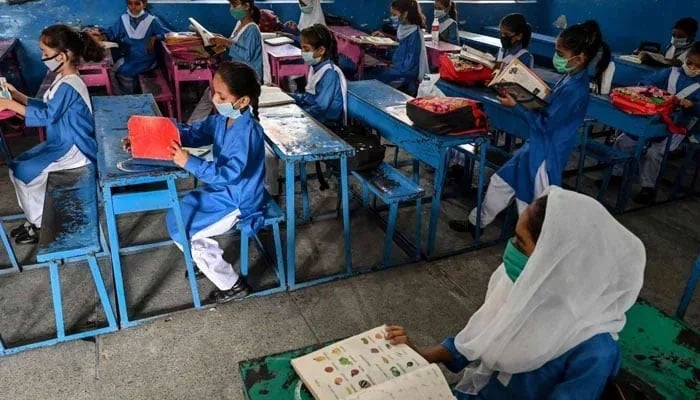
The second crisis – within schools – is no less dire. Pakistan’s learning poverty stands at an alarming 77 per cent, meaning three out of four children aged ten cannot read and understand a simple story. Overcrowded classrooms, with student–teacher ratios worsening from 56:1 in 2016 to 67:1 in 2022, are plagued by severe infrastructural crises – often lacking electricity, safe drinking water, toilets, boundary walls and functional libraries – reducing education to mere supervision rather than meaningful learning.
Teachers, overburdened and often underqualified, rely on rote drills instead of fostering comprehension or curiosity. Adding to the crisis, there is no national framework for pedagogical, psychological or even criminal screening of teachers, resulting in inconsistent hiring standards, unchecked misconduct and serious risks to student safety.
Sindh’s experiment with teacher licensing offers a glimpse of what real reform could look like. While Pakistan announced various national education policies for licensing schemes, these were never implemented. Sindh became the first province to introduce teacher licensing through the autonomous Sindh Teacher Education Development Authority (STEDA), and of those who applied, only a small fraction qualified – a damning yet necessary revelation. For decades, teaching in Pakistan has been treated as a welfare posting rather than a profession. If teacher licensing is scaled up nationally and linked to better training and pay, it could restore both dignity to the profession and learning to the classroom.
Beyond physical infrastructure, the intellectual infrastructure of learning – the diversity of subjects that cultivate thought and imagination – is glaringly absent. Activities in drama, poetry, creative writing, music, visual arts, debate, geography, sociology, languages and critical thinking exercises are almost absent in public schools, surviving mainly in elite classrooms where creativity and holistic learning are still nurtured.
For most Pakistani children, schooling means little more than memorising texts and taking endless tests, draining the mind rather than developing it. This obsession with standardisation has turned schools into factories of compliance, where children are ranked, labelled, and shamed for failing to fit a narrow mould.
In contrast, the world’s best education systems – from Finland to Montessori schools – use child-centred, creative curricula with hands-on activities and life-skill exercises, recognising that curiosity, not competition, drives meaningful learning. This unnecessary burden leads to poor emotional well-being among children. Few elite schools provide counselling, even as exam anxiety and depression rise, and the system continues to celebrate high scorers rather than true learners.
Historically, after the 18th Amendment in 2010, provinces assumed control over school curricula. Over the next 15 years, all provinces struggled to build adequate indigenous capacity for curriculum development, resulting in a decade of stagnation in school curricula. The much-touted Single National Curriculum (SNC) of 2019-2020, later rebranded as the National Curriculum of Pakistan (NCP), was intended to eliminate class-based disparities. In practice, however, it replicated longstanding problems under a new label. Academic reviews have shown that SNC textbooks were pedagogically incoherent, ideologically loaded, and frequently disconnected from how children actually learn.
Meanwhile, public spending on education remains abysmal; hovering around less than 2.0 per cent of GDP, far below Unesco’s recommendation of 4.0 to 6.0 per cent of GDP or 15-20 per cent of public expenditure. Development expenditure has also been repeatedly slashed, leaving little room for building new schools, upgrading facilities or improving teacher training. Most of the education budget merely keeps the system breathing, not improving.
Reform in Pakistan’s education system must be comprehensive and child-centred. Learning should prioritise curiosity, creativity and social-emotional development over rote memorisation and high-stakes exams. To address poverty and access, programmes like BISP should be expanded to support more families, particularly as slow economic growth and the rising cost of basic public services make schooling increasingly unaffordable. Performance-linked public–private partnerships can also help poor students attend private schools without further burdening their parents.
Nationwide teacher licensing, training, and accountability for all parties (government, teachers, and both public and private schools) are essential to ensure quality instruction and safety, while schools must provide safe transport, boundary walls, and female teachers to reduce exclusion, particularly in Balochistan and KP. Urgent investment is also needed to fix infrastructure gaps, including electricity, clean water, toilets, libraries, laboratories, classrooms, and technology-facilitated learning tools, especially in light of the AI boom.
Equally important is curriculum reform, shifting the focus to coherent learning outcomes and integrating arts, humanities, and sciences while eliminating rote and ideologically loaded content. In reality, post-18th Amendment, provinces have treated education as politically charged HR management rather than a developmental priority. They must take it seriously, beyond politics, to ensure meaningful learning for all children. The cost of inaction is immense: children denied education lose dignity, opportunity and voice, while poverty and weak schooling perpetuate national stagnation.
The writer is a Peshawar-based researcher who works in the financial sector. He can be reached at: [email protected]