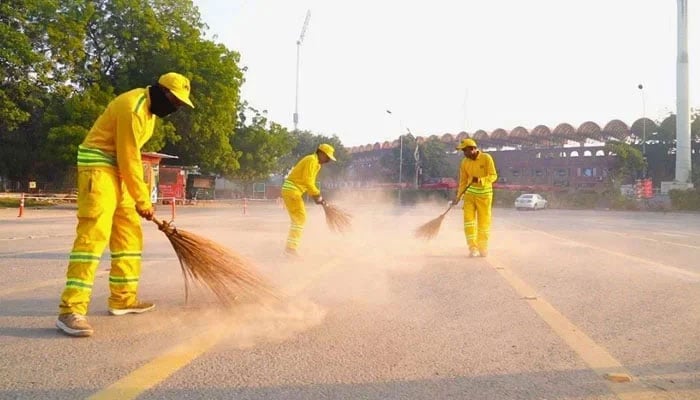
LAHORE: International business magazine Forbes has lauded the Punjab government’s flagship Suthra Punjab initiative, describing it as an “extraordinary, encouraging and highly successful” waste management model and the largest of its kind in the world.
In a detailed report, Forbes noted that in just eight months the province has established a coordinated system that collects and processes 50,000 tonnes of waste daily across urban centres and 25,000 villages, serving nearly 130 million people. According to the report, modern IoT sensors, GPS and RFID technologies are deployed across more than 200,000 square kilometres, while AI-based tools help manage operations and monitor cleanliness.
The magazine credited the provincial government’s political commitment, the leadership of the Lahore Waste Management Company (LWMC), and effective public-private partnerships for the project’s rapid implementation.
Speaking to Jang on the Forbes report, Punjab Secretary for Local Government and Rural Development Mian Shakeel Ahmad said Suthra Punjab is the largest decentralised waste-management operation in the world, supported by a centralised monitoring system. He added that the programme, once limited to urban centres, has now been extended to rural areas on the instructions of Chief Minister Maryam Nawaz.
According to the secretary, 141 tehsils were outsourced last year, each with separate sanitation contracts covering both city and village areas. Around 14,000 sanitary workers have been hired and 30,000 units of machinery—including tractors, loaders, dumpers and waste containers—operate daily. Monitoring is carried out through a combined digital and physical system. Citizens can lodge complaints via the government’s “Shehri App” by uploading geo-tagged photos; the response time ranges from one hour to a maximum of 24 hours.
He said a facial-recognition attendance system ensures workers can only mark attendance from their assigned locations. All waste-collection vehicles are equipped with trackers and follow designated routes, with payments tied to route completion and the weight of waste delivered at dumping stations. Contractor payments and worker salaries are fully digitised, eliminating discrepancies in wage distribution.
Forbes reported that the project was made possible through a three-tier financing model combining public and private investment. Citizens pay a nominal fee to encourage ownership, the government provides funding for public services such as street cleaning, and additional revenue is generated through carbon credits and the sale of energy from waste-to-energy projects. Funds are maintained in third-party escrow accounts to ensure transparency, enabling the province to secure bank financing for new machinery, bins and vehicles.
With daily waste-collection stabilised, Punjab has entered the next phase: converting refuse into usable energy. A specialised unit has been formed for recycling plastic, paper and metal; producing organic fertiliser from food and crop waste; generating biogas from landfill methane; and using black soldier fly larvae to convert organic waste into animal feed and soil nutrients. Punjab is also launching its first industrial-scale “trash-to-electricity” plant in Lahore. The 25MW facility will power around 50,000 homes, cut methane emissions by an estimated 75%, and generate roughly 275,000 carbon credits annually. Overall, these efforts are expected to prevent the emission of nearly two million tonnes of CO per year.
Forbes highlighted that millions of residents now enjoy cleaner streets and regular waste collection for the first time, reducing disease spread and water contamination. More than 100,000 green jobs have been created, including roles for women and youth. Clearing illegal dumping sites and drains has improved the environment and established Punjab as a regional model for climate-resilient waste management—an achievement also recognised at the recent UN Climate Conference (COP30).
LWMC head Babar Sahib Din told Forbes that strong political will, government support, private-sector efficiency and data-driven management were key to achieving results in record time. He said nearly 30 per cent of the original design was reworked after six months of field experience, underscoring the importance of flexibility. Strategic partner Faraz Khan said Punjab’s leadership, the use of carbon credits, and business-style management practices played a crucial role in the programme’s success.
Welcoming the global recognition, Lahore Chamber of Commerce and Industry President Faheem-ur-Rehman Sehgal said Suthra Punjab has transformed the concept of sanitation not only in cities but also in rural areas. He said acknowledgment from Forbes enhances Pakistan’s global image and strengthens the investment climate. Former FPCCI president Mian Anjum Nisar praised the transparency and pace of implementation, noting that waste-to-energy and recycling initiatives will create thousands of green jobs.
According to the Punjab government, the programme is expected to become revenue-positive in the coming years, with carbon credits and energy projects generating new financial resources for the province.