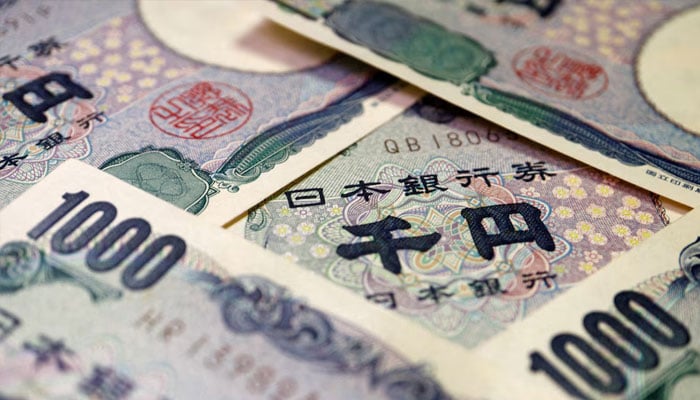
LONDON: The yen headed for its biggest one-day rally in almost two months on Monday after Bank of Japan Governor Kazuo Ueda gave the clearest hint so far that a December rate hike may be on the table.
Meanwhile the dollar struggled as investors ramped up bets of a US rate cut this month.Ueda said on Monday the BOJ would consider the “pros and cons” of raising interest rates at its next policy meeting in December, offering the strongest hint so far that a hike may materialise this month.
He subsequently told a press conference that he would elaborate on the central bank’s future rate hike path once rates are raised to 0.75 per cent, adding that December’s policy decision would take into account wage information and other data.
That helped a rally in the Japanese currency, which pushed the dollar down by as much as 0.76 per cent on the day to 155 yen, heading for its largest one-day drop since October.“It seems to be game-prep ahead of a potential rate hike, making a hike at the December or January meeting highly plausible,” said OCBC currency strategist Christopher Wong, who expects the BOJ to raise rates this month.
“But the question is if this is one hike and another long wait. A yen recovery would likely need the BOJ to follow through with stronger guidance.”Traders have priced in a growing chance of a December hike from the BOJ, with the yen’s slide to 10-month lows last month adding to the case for raising rates.
“The comments send the strongest signal yet the BOJ is preparing to resume rate hikes this month in line with our forecast. Market participants have remained wary over pricing in an earlier rate hike given uncertainty over whether the government would push back against it,” MUFG currency strategist Lee Hardman said.
Finance Minister Satsuki Katayama said on Sunday that recent erratic swings in the foreign exchange market and rapid yen weakening are “clearly not driven by fundamentals”.
The yen rallied against a range of currencies, leaving the euro down 0.4 per cent, and the pound and Australian dollar both down 0.7 per cent.
DOLLAR DOWNBEAT
In the broader market, the dollar eased as investors braced for a pivotal month that could bring the Fed’s final rate cut of the year and the confirmation of a dovish successor to Chair Jerome Powell.
The euro rose to a three-week high of $1.1635, while sterling pared earlier losses to trade up 0.1 per cent at $1.325, having logged its best week in over three months in a relief rally after British Finance Minister Rachel Reeves’ budget revelations.
Traders are now pricing in an 88 per cent chance the Fed will cut by 25 basis points when it convenes next week, according to the CME FedWatch tool.
What is less clear cut is what happens after December.
Money markets right now show very little chance of another cut much before the spring and some analysts believe December might even yield a “hawkish cut” — trader-speak for a cut accompanied by indications from policymakers that another near-term fall in borrowing costs may not be forthcoming.
Either way, with investors assuming a December cut is close to a done deal, alongside a report that White House economic adviser Kevin Hassett could be the next Fed chair, the dollar is struggling, having clocked its worst weekly performance against a basket of major currencies in four months last week.
“With December FOMC now closer to fully pricing a 25bp cut, we think the market will increasingly focus on the pricing of subsequent meetings,” Goldman Sachs economists said in a note.“Division on the committee is restraining more dovish pricing, but with a large amount of labour market data due before the January meeting we think too little is priced in Q1.”
Trading on the foreign exchange market was back to normal on Monday following an hours-long outage at the world’s largest exchange operator CME Group last week, which upended transactions across stocks, bonds, commodities and currencies.Bitcoin fell nearly 6.0 per cent to $85,780, while ether lost 6.7 per cent to trade at $2,819.