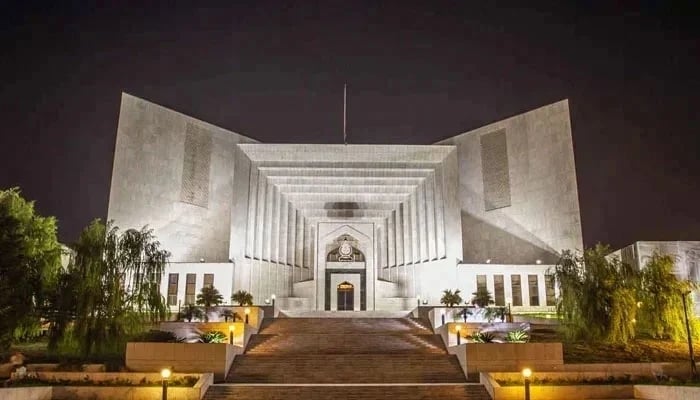
ISLAMABAD: The Supreme Court has held that the Constitution imposes a duty upon the State to protect the right to live of every citizen and to prevent custodial violence and killings.
A three-member bench of the apex court headed by Justice Amin-ud-Din Khan and comprising Justice Jamal Khan Mandokhail and Justice Naeem Akhtar Afghan heard the appeals of three police personnel against their dismissal from service on charge of murdering a detainee.
“Torture leads to extrajudicial killings by police, presuming de facto impunity and as a means of bringing alleged criminal to justice,”, says a seven-page judgment, authored by Justice Jamal Khan Mandokhail.
The court dismissed the appeals of police officials, holding that their counsel has not been able to point out any substantial question of law of public importance in the petitions, warranting interference.
The petitioners, Khalid Mehmood, Riaz Hussain and Safdar Ali were Head Constable and Constables in District Police, Dera Ghazi Khan and were posted at the FIA. There was an allegation against them that they had unlawfully detained one Zaryab Khan and subsequently, committed his murder. They had filed an appeal against the verdict of Punjab Service Tribunal, Lahore, dismissing them from service on the said allegations.
“Torture leads to extrajudicial killings by police, presuming de facto impunity and as a means of bringing alleged criminal to justice,” stated the seven-page judgment, authored by Justice Jamal Khan Mandokhail.
The apex court had heard the instant appeals of the police officials on August 21, 2025. The court held that there is no denial of the fact that the police has authority to arrest any person who violates the law, but any such actions without adopting the due process provided by the Constitution and law, and treating such person inhumanly, cruelly and subjecting that person to torture, constitutes not only a criminal act, but also amounts to a misconduct.
In the present case, the court noted that the allegations against the petitioners in their capacity as police officials of unlawful confinement, maltreatment and torture of Zaryab Khan have been established during the inquiry through evidence and material described in the report of the inquiry officer as well as available on the record.
An FIR under section 302 of the Pakistan Penal Code (‘PPC’) was registered against the petitioners and others, and they were tried by the Criminal Court for their criminal act. Simultaneously, a departmental inquiry and disciplinary proceedings were also initiated against them under the Punjab Police (E&D) Rules, 1975 (‘Rules of 1975’).
They were charge sheeted on June 24, 2020 with an allegation of committing gross misconduct.
During the pendency of the departmental proceedings, the petitioners were acquitted of the criminal charge under section 302 PPC, by the Court of Sessions Judge, based on the benefit of doubt.
Whereas, on conclusion of the departmental inquiry, a report was submitted by the Inquiry Officer before the authorised officer/DPO on September 25, 2020, holding the petitioners guilty of misconduct.
“By detaining Zaryab Khan illegally and subjecting him to torture, the petitioners have acted in violation of their duty to act in accordance with law”, the court held adding that the act of the petitioners amounts to misuse of authority, falling within the definition of grave misconduct, defined in sub-rule (iii) of Rule 2 of the Rules of 1975.
The court noted that the penalty proposed by the authorised officer did not commensurate with the gravity of the misconduct committed by the petitioners adding that the RPO, being the competent authority, provided opportunity to the petitioners to defend themselves.
The court declared that after adopting due process, the competent authority was justified in enhancing the penalty, from reduction in pay by one stage for a period of two years, recommended by the inquiry officer, to that of dismissal from their service.
“Such departmental proceedings are necessary to uphold the rule of law and maintain public confidence in State’s institutions”, says the judgment. The court held that Article 10 of the Constitution provides safeguards as to arrest and detention of a person.
“It mandates that no person who is arrested shall be detained in custody without being informed of the grounds of such arrest and shall be produced before the Magistrate within a period of 24 hours of such arrest”, says the judgment.
The court noted that as per Article 14 of the Constitution, the dignity of a man, and subject to law, privacy of home shall be inviolable.
“Sometimes, torture leads to extrajudicial killings by the Police, presuming de facto impunity and as a means of brining alleged criminal to justice”, the court noted, suggesting that to stop this practice, an effective, dedicated, external oversight of the Police force is a need of the hour.
The court held that the right to life has been categorized as the supreme human right, which is codified in every major human rights treaty therefore, the Constitution imposes a duty upon the State to protect the right to life of every citizen and to prevent custodial violence and killings.
“These Constitutional guarantees against illegal detention, arrest, brutality, torture and extrajudicial killings in any form, are bedrock legal and fundamental principles enshrined in the Constitution, therefore, illegal detention and torture are neither encouraged nor justified under any circumstances”, says the judgment.