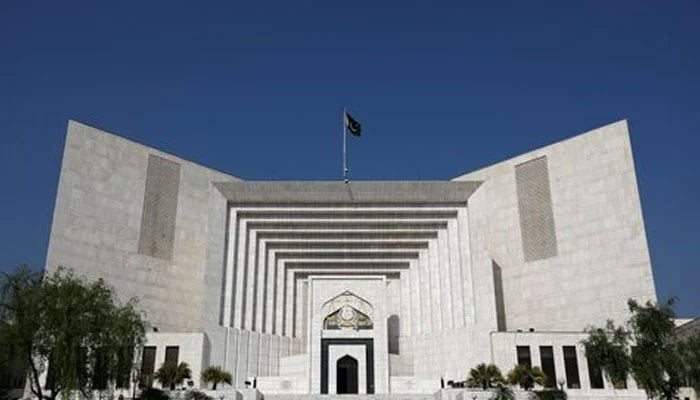
ISLAMABAD: The Federal Constitutional Court (FCC) Thursday declared that the matters related to quota allocation was the executive’s domain, and courts could not interfere in the process.
This ruling from a three-member bench — headed by Chief Justice Aminuddin Khan — came during the hearing of an appeal filed by the Sindh government against a Sindh High Court (SHC) judgment related to the allocation of wheat quota to a flour mill.
The court set aside the SHC judgment, making it amply clear that policy formulation was primarily the administration’s job and the courts could not interfere in this regard.
Additional Advocate General Sindh Sibtain Mahmood argued that the SHC guidelines were beyond its constitutional limits.
Additional Attorney General Mr. Dogal told the court that policy formulation and its implementation fell entirely within the administrative domain.
Justice Ali Baqar Najafi remarked that it was the administration that formulated policies and was empowered to formally announce them.
After hearing the detailed arguments, the court accepted the Sindh government’s appeal and set aside the Sindh High Court Sukkur Bench’s May 31, 2023 decision.
LHCBA, LBA urge FCC to return ICA: Meanwhile, the Lahore High Court Bar Association (LHCBA) and Lahore Bar Association (LBA) Thursday urged the Federal Constitutional Court (FCC) to return to the Supreme Court an intra-court appeal (ICA) filed against the transfer of three judges to the Islamabad High Court (IHC).
The applications were filed under Order XXXV Rule 6 of the Supreme Court Rules, 2025.
The petitioners contended that the subject appeal was duly instituted before the Supreme Court; however, it was fixed for hearing before the FCC, apparently pursuant to the Constitution (Twenty Seventh Amendment) Act, 2025, which introduced Article 175F(2), which states, “All petitions for leave to appeal, appeal or review applications, filed or pending with the Supreme Court prior to the commencement of the Constitution (Twenty Seventh Amendment) Act, 2025, stand transferred to the Federal Constitutional Court.”
The LHCBA, however, submitted that the appeal ought to be returned to its original forum i.e. the Supreme Court, as both the purported transfer and the 27th Amendment itself were without lawful authority, unconstitutional, and non-est, for the reasons set out herein.
Both the associations contended that the FCC could not adjudicate upon its own validity.
It was contended that a judicial or quasi-judicial forum cannot adjudicate upon the constitutional vires of the legislative provision that creates it.
The LHCBA and LBA further contended that the Federal Constitutional Court was a creation solely of the 27th Amendment. It is therefore legally precluded from pronouncing upon the validity of the said Amendment, for such adjudication would determine the legality of its own existence.
It further submitted that the subject appeal did not fall within Articles 175E or 175F, adding that the appeal was filed under Section 5 of the Supreme Court (Practice and Procedure) Act, 2023.
The 27th Amendment, however, neither amends the said statute nor addresses statutory appeals filed thereunder.
Both the associations contended that Article 175F(2) applies only to proceedings “falling under this Article”. Since the present appeal was not instituted under Articles 175E or 175F, its transfer to the FCC was without legal effect.
It prayed that the applications be allowed and the subject intra-court appeal be returned to the Supreme Court of Pakistan for adjudication in accordance with law.
27th Amendment challenged: Meanwhile, the 27th Constitutional Amendment was challenged in the Federal Constitutional Court on Thursday.
Muhammad Shoaib Advocate filed the petition under Article 184(3) of the Constitution, making the Federation of Pakistan, National Assembly speaker, Senate chairman, secretary defense, and secretary law and Justice respondents.
The petitioner prayed the court to grant his petition and strike down the 27th Amendment in the larger interest of justice. He questioned whether the amendment will empower the judicial system where pendency of case was more than 2.5 million.
He further questioned whether having two parallel systems will dispense justice in accordance with the law and there would be no clash of institutions while exercising their majestic authority.
Whether this amendment is not based on malicious designs to undermine the independence of the judiciary,” the petitioner further questioned.
He submitted that the malicious purpose of the 27th Amendment was to impose indirect martial law in the country.
He further submitted that the country was going through the constitutional crisis as well as law and order situation and in the meantime, the government tabled 27th Amendment in the parliament to undermine the independence of the judiciary just for the sake of malicious design and to protect their favorite blue eyed persons.
“This amendment will create institutional incoherence that will amount to constitutional crisis as well as the law and order situation in the country will go into the hands of one man,” the petitioner submitted
Similarly, he submitted that under Article 227 of the Constitution no law could be enacted against the injunctions of Holy Quran and Sunnah adding that granting immunity to the highest official from all criminal liability was a flagrant violation of Article 227.
“Granting immunity to an individual is against the basic principle of Islam, which shall create imbalance in the dispensation of justice,” the petitioner added.