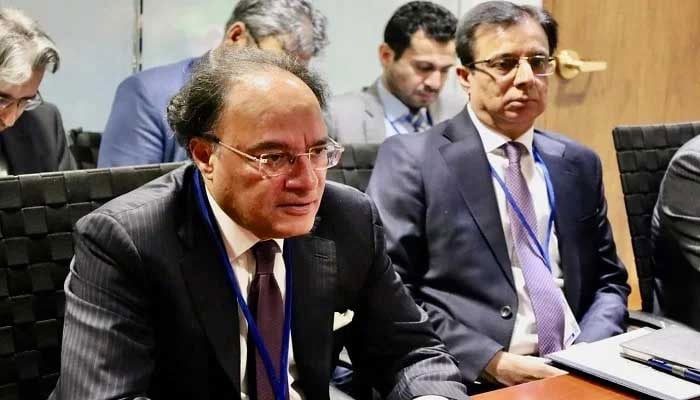
ISLAMABAD: Federal Finance Minister Mohammad Aurangzeb has said Pakistan will address all gaps identified in the International Monetary Fund (IMF) report and take steps to resolve the issues highlighted.
“These are points identified by the IMF that require action, and we will work to resolve them,” the finance czar told ‘Geo News’ on Thursday.
“God willing, an agreement with the IMF will be reached. The IMF board’s upcoming decisions will show the way forward.”
The Washington-based lender’s Governance and Corruption Diagnostic Assessment (GCDA) on Pakistan, which was released last week, warned that persistent corruption and weak institutions continue to undermine the country’s economic development even as it stabilises under an Extended Fund Facility (EFF).
“Corruption is a persistent challenge in Pakistan, with significant adverse implications for economic development,” the report states. It said indicators reflect weak control of corruption over time, with negative consequences for the effectiveness of public spending, revenue collection and trust in the legal system.
The publication of the report is a precondition for the IMF executive board’s approval of a $1.2 billion disbursement next month under the $7 billion programme.
The IMF said policy efforts under the EFF have already delivered “significant progress” in stabilising the economy and rebuilding confidence.
It notes that Pakistanis are often compelled to make continuous payments to officials to obtain basic services, while funds lost to corruption could otherwise support higher production and development.
While vulnerabilities exist at all levels of government, the IMF finds that the most economically damaging manifestations involve “privileged entities” that exert influence over key economic sectors, including those owned by or affiliated with the State.
The report says political and economic elites have obstructed economic development by seizing control of policies and capturing public benefits for their own gain.
In the judicial sector, the report cites organisational complexity, large case backlogs, antiquated laws and questions over the integrity and independence of judges and judicial personnel as factors undermining reliable enforcement of contracts and protection of property rights.
It describes Pakistan’s judicial sector as structurally complex and says the complexity and delays in the system affect economic activity. Reliance on courts to enforce economic rights is discouraged, it says, by delays and concerns over institutional integrity.
The report sets out a series of recommendations ranging from immediate and short-term steps to medium- and long-term structural reforms aimed at strengthening governance, reducing corruption vulnerabilities and supporting sustainable, private sector-led growth.
The IMF calls for the immediate initiation of a 15-point reform agenda and says improving governance, accountability and integrity along the lines recommended would yield significant economic benefits.
Key recommendations include ending special privileges granted to major public institutions in government contracts, shifting all government procurement to an e-governance system within 12 months, and establishing strict parliamentary oversight of the government’s financial powers. The report also urges greater transparency and accountability in policymaking and implementation, including more open access to fiscal information.
Meanwhile, at a session on ‘SIFC Update on FDI & Economy’ organised by the Pakistan Business Council (PBC), Special Investment Facilitation Council’s National Coordinator Lt Gen Sarfraz Ahmed called for a national consensus on economic policies. He emphasised the need to slash tax and interest rates and abandon the artificially-managed exchange rate to attract investment.
He stated that despite achieving macroeconomic stability, a real growth plan is missing. If the country continues on its current path of consumption-led growth, he warned, the result will be the same, forcing Pakistan to seek bailout packages from the US, EU, or Gulf countries.
“Unless domestic investors move ahead with new investments, foreign investors cannot be lured,” he said. The SIFC’s mandate is to identify potential projects, tweak policies to create an enabling environment, and facilitate foreign investors.
Lt Gen Ahmed highlighted that fiscal constraints have led to difficult choices, and exorbitant tax rates must be addressed. He called for the abolition of the Super Tax and a reduction in the Corporate Income Tax from 29 percent to 25 percent. He noted that the effective tax rate for the corporate sector stands at 50 percent, which needs rationalisation. The government is convinced of this need, he added, but a lack of fiscal space prevents action. The current high taxation discourages companies from growing, often leading them to split into smaller entities. He affirmed a government consensus that the existing tax format cannot lead to growth.
He also advocated for deregulating the power sector and reducing tariffs, supported a lower policy rate, and criticised the maintenance of an artificial exchange rate.
The SIFC national coordinator pointed out that capital earned in Pakistan often finds its way to destinations like the UAE, London, Singapore and New York, with little reinvested domestically. Pakistan has missed benchmarks in infrastructure, education and skills over the last few decades, leading to a situation where qualified youth cannot find jobs, which in turn creates security challenges.
He revealed that Pakistan currently attracts a meager $1.2 billion in foreign investment; even doubling this would only bring it to around $2.5 billion. He differentiated between “good” and “bad” FDI, defining any investment that cannot generate dollars as “bad,” unless it is in strategic projects. He observed that foreign investors are often only interested in the consumption sector or assets like airports, while showing hesitation when asked to invest in export-led growth sectors.
“Till the time domestic investors do not start investing in Pakistan, no foreign investment can be attracted,” he stated, while conceding that capital naturally flows to where it gets better returns.
He identified frequent policy distortions and changes as major setbacks for Pakistan, which can only be stopped by building a consensus on economic policies. The SIFC, he noted, was initially created to facilitate investment from Saudi Arabia, but its role has since expanded to include the GCC and all other regions.
Despite Pakistan’s central location in connectivity routes, its economy has suffered from boom-and-bust cycles. While the country recently faced default risks, the situation has now significantly improved and stabilised.
The current debate, he said, is whether to pursue export-led growth or import substitution, and a consensus is needed to devise a clear roadmap. Citing examples from Vietnam, Bangladesh and India, he contrasted their paths with Pakistan’s industry, which is reliant on production for domestic consumption. A phased tariff rationalisation is needed to change course.
“We will have to evolve consensus on the roadmap on the economic front in consultation with all stakeholders,” he concluded, stressing that the government must implement this tariff rationalisation.
Separately, during the session on ‘Unlocking Pakistan’s Untapped Mining Resources for National Wealth,’ held on the second day of the Pakistan Business Council (PBC) conference, Minister for Petroleum Ali Pervez Malik said that with a potential $7 trillion in precious mines and minerals in Pakistan, the country must develop bankable projects and wait at least 8 to 10 years to see real dividends from this sector. He also said that as the country is under an IMF programme, fiscal risks would pose a challenge.
The government and private sector experts unanimously agreed that laws and regulations must be harmonised, as mining and minerals fall under provincial jurisdiction.
Zarrar Jamali, Country Manager for the Reko Diq project, said that Phase-I will see an investment of $5.6 to $6 billion. Financing of $3.5 billion has been secured from 11 international banks from the US, Canada, Japan and other countries, so the overall cost, including interest, will rise to $7 billion. He mentioned that the first export consignment is expected in 2029. Barrick Gold, he said, has invested in Africa and Pakistan, and despite Board decisions, the company is committed to staying in Pakistan. He emphasised their significant investment as a sign of commitment, adding that they have received support from the government and establishment, and will move ahead.
Ali Pervez Malik said that an ongoing advanced mapping exercise will achieve 100 percent coverage by June 2026, putting the government in a better position to identify potential bankable projects. He noted that the $7 trillion mineral potential is hypothetical and should be considered an indicated value. The financial close for the first phase of Reko Diq, amounting to $3.5 billion, has been achieved out of a total of $7 billion. Rather than celebrating “magical numbers,” he stressed the need to create an enabling environment. Over the past year, the government has progressed on a harmonised regulatory framework to clarify resource ownership. Additionally, a fiscal regime must be established, as experts believe it can take 20 years to materialise mineral projects, or at least 8 to 10 years at an accelerated pace.
Muhammad Ali Tabba, CEO of Lucky Cement, highlighted challenges in the sector, including risks, large financing requirements, and the need for long-term vision. He drew inspiration from Congo, where minerals are transported 2,500 km for export. He suggested that Pakistan could boost value-added services and address power sector issues by tapping into this sector’s potential.
In the session on privatisation, Advisor to the PM on Privatisation Muhammad Ali emphasised the need to reduce the government’s footprint and questioned why PSO could not be privatised. He proposed that, if maintaining strategic reserves is a concern, that portion could be retained while distribution and retail operations are sold to the private sector.
The PBC concluded the 4th Dialogue on the Economy 2025. The final day featured focused discussions on Pakistan’s investment climate, energy reform, mining potential, privatisation, institutional transformation and tax administration reform.
In her closing remarks, PBC Chairperson Dr Zeelaf Munir stated, “Pakistan’s economic future depends on resilience, reform and responsible partnership. No institution can deliver progress alone; all stakeholders need to believe in business. Our strength lies in collective responsibility and coordinated action. Documentation of the economy is necessary, and tax reform is essential for sustained growth.”
She added, “At PBC, we bring evidence, solutions and partnership, working with the government to create growth-focused policies.”