ISLAMABAD: A new book “Beyond the Bomb -- Munir Ahmad Khan & Pakistan’s Nuclear Odyssey”, authored by ex-senator Farhatullah Babar on Pakistan’s nuclear programme paying tributes to a towering but unsung nuclear hero Munir Ahmad Khan on the one hand and raising unspoken issues in command, control & civilian oversight on the other, was launched on the first day of the tenth Adab Festival in Karachi on Saturday evening.
The book is published by Ameena Saiyid of the Lightstone Publishers, which also published Farhatullah Babar’s book “Zardari Presidency (2008-13) --Now It Must be Told” in May last.
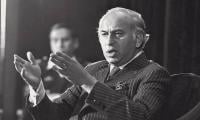
Starting with President Bhutto summoning cream of scientists and engineers to a secret conference in Multan a month after the dismemberment of the country in December 1971, to task them to build the bomb ‘no matter what the cost’, the 350-page book describes how Bhutto’s vision was transformed into reality by Munir Ahmad Khan who led the PAEC for nearly two decades from 1972 to 1991 but remained unsung.
Farhatullah Babar served as director public information in the PAEC during the decade of 1970’s. It is a firsthand account of how Munir Khan worked in the shadows and the international media accused Pakistan of pursuing a policy of ‘beg, borrow and steal’ to acquire nuclear technology.
A decade later cold nuclear tests were conducted in 1983 -- a feat kept outside the public domain until the actual atomic tests in May 1998 in the wake of India’s nuclear tests at Pokhran a few weeks before.
In cover endorsement ex-senator Mushahid Hussain has described the book as “an informed insider’s insight into Pakistan’s nuclear odyssey, focusing on the key role of Munir Ahmad Khan in building an enabling environment for its eventual success”.
Eminent physicist Professor Fayyazuddin, who worked both at the Quaid-e-Azam University, Islamabad, and in the PAEC has called it “a gripping chronicle of Pakistan’s nuclear journey through the life of its unsung architect.”
Scientist Emeritus Dr Abdullah Sadiq, who served as rector, Pakistan Institute of Engineering and Applied Sciences (PIEAS) and GIK Institute, describes the book as “a belated tribute to the unsung hero of Pakistan’s nuclear programme”, while another eminent physicist Dr A H Nayyar calls it “a much-needed portrait of the true architect of Pakistan’s nuclear programme, by an intimate observer.”
Another former head of PIAES and Scientist Emeritus, PAEC, Dr Inam Ur Rahman, calls it “a profound tribute to Munir Ahmad Khan’s achievements in the nuclear field, working in the shadows.”
Journalists Azaz Syed and Mazhar Abbas talked about the book followed by an interactive session while the session was moderated by Omar Aziz Saiyid.
“Beyond the Bomb— Munir Ahmad Khan & Pakistan’s Nuclear Odyssey” is a deeply personal account of a brilliant yet overlooked figure in Pakistan’s nuclear history.
Through 49 compelling chapters, the book tells a story not just of uranium and reactors, but also of the systematic loss of civilian control, the intrigues within the nuclear establishment, the mysterious elaborate nuclear proliferation network operating from Pakistan blamed on a lone individual and Benazir Bhutto’s vision of accountability in the realm of strategic nuclear domain. The book also details in a separate section the nuclear world views of Munir Khan and Benazir Bhutto’s vision about the nuclear command and control.
The book is divided into five sections and each section deals with specific aspect. Section 1 ‘The Scientist & the State’ explores Munir Khan’s pivotal entry into Pakistan’s nuclear programme, aligning with the vision of Zulfikar Ali Bhutto and synthesis of political commitment with the technical expertise sowing the seeds of a legacy that would outlast both men.
Section 2 ‘Character, Conflict and Collaboration’ examines Munir Ahmad Khan’s persona, the rivalries he faced, loyalties he commanded, and intellectual camaraderie that shaped Pakistan’s atomic ecosystem while Munir Ahmad Khan played as master of the nuclear orchestra
Section 3 ‘Technology, Power and Policy’ dissect the core technical and policy debates that dominated the discourse at the time. It throws light on the enrichment efforts, pursuit of the reprocessing plant, international pressure resulting in breaking of solemn contracts compounded by the nuclear bravado of some who wanted to milk the nuclear cow for personal advancement.
Section 4 ‘Secrecy, Oversight, and civil military imbalance critically evaluate the structural absence of civilian oversight and legislative clarity in the nuclear command hierarchy. It reveals the tensions between scientists, generals, and statesmen in a militarised policy space. This section examines how behind the façade of national security lies a deeper contest—over who decides, who knows, and who is accountable. It describes Munir Ahmad Khan’s nuclear world view extending beyond bombs encompassing civilian oversight, responsibility, non-proliferation and moral restraint. This section also raises questions about the weakening of civilian oversight & control and the need for balancing secrecy with oversight— issues close to the heart of Munir Khan. Can a nuclear programme serve democracy, not dominate it?
Section 5 ‘Reflections, tributes and Warnings’ distil the philosophical and strategic legacies of Munir Ahmad Khan. It discusses profound nuclear issues, the heroes and villains becoming indistinguishable and the need for introspection and a rational, national debate.
Beyond the Bomb offers a rare, insider tribute to Munir Ahmad Khan—the architect of Pakistan’s nuclear programme who remained in the shadows even as others claimed the limelight. Through vivid storytelling, institutional memory, and personal insight, the author traces the life of a technological manager who believed that the atom, when handled wisely, could illuminate more than it could destroy.
This is not just a biography. It is a meditation on ethics, secrecy, and the civil-military fault lines that continue to define South Asia’s nuclear posture. A timely and essential account for researchers, policymakers and academia seeking to understand the further tilt in the civil-military equation towards the military after the Pak-Saudi defence pact and the 27th Constitutional Amendment and its implications for peace and security in the region and the world.
The book not only restores Munir Ahmad Khan to his rightful place in history but also issues a quiet plea for civilian supremacy, democratic oversight, and a science rooted in public good—not political survival through irresponsible bravado.
The last chapter of the book “Multiple Ironies, Paradoxes, Lessons” is a poetic lament by the author of the fate of all civilian leaders in the nuclear field: from Zulfikar Ali Bhutto hanged to Nawaz Sharif exiled, to Benazir Bhutto vilified as security risk, AQ Khan made to fall on his sword, ‘a hero once at dusk displaced’ and Munir Khan ‘championing restraint, foreseeing the peril’ but remained ‘uncelebrated, shunned, passed by’. While General Musharraf was ‘no builder of atomic dreams, state conferred dignity on him and gave him ‘a burial draped in ceremonial hue’.