ISLAMABAD/LAHORE: The Federal Ministry of Law and Justice Friday issued a notification announcing the appointment of six judges to the newly established Federal Constitutional Court (FCC).
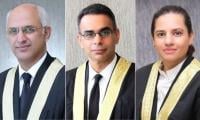
Those appointed include Justice Hassan Azhar Rizvi, Justice Aamer Farooq, Justice Ali Baqar Najafi, Justice Muhammad Karim Agha, Justice Rozi Khan Barrech and Justice Arshad Hussain Shah. President Asif Ali Zardari made the appointments under Clause (3) of Article 175-A, read with Article 175-C of the Constitution.
Earlier, Justice Aminuddin Khan took oath as the first chief justice of the FCC, established under the 27th Constitutional Amendment after its approval by both houses of Parliament and subsequent presidential assent. President Zardari administered the oath to Justice Aminuddin Khan at a ceremony held at Aiwan-e-Sadr, attended by Prime Minister Shehbaz Sharif, Chief Justice of Pakistan Yahya Afridi, Deputy Prime Minister Ishaq Dar, Senate Chairman Yusuf Raza Gilani, National Assembly Speaker Sardar Ayaz Sadiq, Chief of Army Staff Field Marshal Asim Munir, CJCSC General Sahir Shamshad Mirza, First Lady Aseefa Bhutto Zardari, federal ministers, PPP Chairman Bilawal Bhutto Zardari, and members of the legal community.
Following his oath, Chief Justice Aminuddin Khan administered the oath to three of the newly appointed judges — Justice Aamer Farooq, Justice Ali Baqar Najafi and Justice Hassan Azhar Rizvi — at a ceremony held at the Islamabad High Court. The remaining judges will take oath in the next phase.
Only five IHC judges attended the swearing-in ceremony, and none of the SC judges were present. IHC Chief Justice Sardar Muhammad Sarfraz Dogar and IHC judges Justice Arbab Tahir, Justice Khadim Soomro, Justice Muhammad Azam Khan, Justice Muhammad Asif and Justice Enamul Amin Minhas were present at the ceremony. Five judges of the Islamabad High Court (IHC) - Justice Tariq Mehmood Jahangiri, Justice Babar Sattar, Justice Sardar Ejaz Ishaq and Justice Samman Rifat - did not attend the oath-taking ceremony.
According to officials, the FCC will comprise 13 judges, including the chief justice. It was learnt that Justice Musarat Hilali, judge of the Supreme Court, has recused herself from becoming part of the FCC due to health issues. Although sources revealed that her name was considered for the FCC, she expressed reluctance to join the new court. It was learnt her bench also delisted recently due to ill health.
Earlier, sources said consultations were held among President Zardari, Prime Minister Shehbaz Sharif and Chief Justice Aminuddin Khan regarding the appointments.
Justice Aminuddin Khan will administer the oath of office to Justice Muhammad Karim Agha as a judge of the Federal Constitutional Court on Saturday (today) at the IHC.
Justice Aminuddin also appointed former District and Sessions Judge Muhammad Hafeez as the FCC Registrar. He appointed Mazhar Bhatti as Secretary to FCC chief justice. It was learnt that the FCC chief justice will use Room No 1 of Islamabad High Court while Chief Justice Islamabad High Court Justice Sardar Sarfraz Dogar will be shifted to Court Room No 2.
Meanwhile, President Asif Zardari accepted the resignations of SC judges -- Justice Mansoor Ali Shah and Justice Athar Minallah. According to a one-line announcement from Aiwan-e-Sadr on Friday, “President Asif Ali Zardari has accepted the resignations of Supreme Court judges -- Justice Mansoor Ali Shah and Justice Athar Minallah.”
On Thursday, in the wake of developments surrounding the 27th Constitutional Amendment, these two judges had resigned from the Supreme Court and sent their resignations to the president.
According to a related development, the Supreme Court on Friday unanimously approved updated Supreme Court Rules, 2025, in a Full Court meeting, aimed at improving service delivery and ensuring inexpensive and expeditious administration of justice.
The meeting, presided over by CJP Justice Yahya Afridi, adopted the new rules on the recommendation of a committee constituted under Rule 1(4) of Order I of the Supreme Court Rules, 2025. The committee — comprising Justice Shahid Waheed, Justice Irfan Saadat Khan, Justice Naeem Akhtar Afghan and Justice Aqeel Ahmed Abbasi — was tasked with identifying and addressing difficulties in implementing the updated framework.
According to a statement issued by the SC Public Relations Department, the Full Court expressed appreciation for the committee’s extensive work in reviewing the 1980 Rules, drafting the 2025 Rules, and refining them further to remove procedural hurdles.
The court also unanimously approved the conferment of the title of Senior Advocate Supreme Court on Muhammad Munir Paracha under Rule 5 of Order IV of the new rules.
A total of 17 judges attended the meeting. Justice Munib Akhtar and Justice Ayesha Malik were not present. The Supreme Court’s sanctioned strength had earlier been 24 judges, but three were transferred to the Federal Shariat Court and two resigned, leaving the current strength at 19.
The updated rules are intended to streamline judicial processes and reinforce the court’s commitment to timely and affordable justice delivery.
Separately, Defence Minister Khawaja Muhammad Asif Friday sharply criticised the two SC judges who recently resigned in protest against the 27th Constitutional Amendment, questioning why their “conscience” had not been stirred when former prime minister Nawaz Sharif was disqualified in the Panama Papers case.
Speaking on a point of order in the National Assembly, he said the judges were now “doing politics and poetry”, adding that one had served in a provincial cabinet during Gen Pervez Musharraf’s regime while his mother had been a member of Gen Ziaul Haq’s Majlis-e-Shura.
He recalled that the then chief justice Saqib Nisar had formed two separate benches: one to disqualify Nawaz Sharif and another to determine the duration of the disqualification. “The bench decided disqualification would be for life and that a disqualified politician could not head a political party,” he said. Naming former judges Saqib Nisar, Ejazul Ahsan, Faisal Arab and others, he alleged that they delivered politically motivated verdicts to victimise Nawaz Sharif as part of a “conspiracy”. He questioned why the “conscience” of the two recently resigned judges had not awakened “when kangaroo courts were handing down decisions against Nawaz Sharif.”
Khawaja Asif said that with the passage of the 27th Amendment, the Constitution had now been “put on the right path,” adding that it would ensure justice for citizens and provide constitutional protection to state institutions. “Parliament’s supremacy has been established, and no encroachment on its authority will be tolerated,” he remarked.
He condemned the opposition’s failure to denounce recent terrorist attacks, asking whether they “stood with the country or with militants.” He accused opposition leaders of prioritising personal interests over loyalty to Pakistan’s Constitution and institutions and alleged that some were sympathetic to militants involved in cross-border violence.
The minister also praised Pakistan’s armed forces for “writing a new chapter” in defending the country’s borders, airspace and maritime domain. He further accused former prime minister Imran Khan and his associates of unprecedented corruption, claiming: “In Pakistan’s 78-year history, no one has committed robberies of this scale.”
Meanwhile, Punjab Assembly Speaker Malik Ahmad Khan has predicted more judicial resignations and termed the ongoing division within the judiciary a part of a larger struggle over becoming the next chief justice.
“More resignations will come. This tug of war and division is all about who becomes the chief justice” said the PA Speaker while addressing a ceremony in Lahore here on Friday.
Malik Ahmad Khan said the country urgently needed educated young lot adding that educated women form the backbone of a progressive society.
“The authority should lie with Parliament to decide how appointments will be made and how High Courts will be formed,” said Malik Muhammad Ahmad Khan. “There was a division within the courts over becoming chief justice, these doors must now be closed,” said Malik Muhammad Ahmad Khan.
He emphasised that with changing times, the importance of women’s education has increased significantly.
The Speaker PA further said outdated mindsets must be discarded, and young girls must be empowered to take charge of their own bright futures. He also urged the government to provide facilities in public schools and colleges comparable to private institutions, asking why 97 percent of the country’s children studying in government schools are being deprived.
Malik Muhammad Ahmad Khan noted that Pakistan is currently facing multiple challenges and stressed the need for a Constitutional Court.
He said Parliament must be empowered, particularly with regard to appointments, stating that the authority to determine how appointments are made and how High Courts are formed should rest with Parliament.
He added that judicial decisions had previously restricted Parliament’s powers and sidelined the institution, to the extent that Parliament became fearful of even speaking about its own rights. Malik Ahmad Khan further said that Pakistan’s military and government officials had acted with bravery and wisdom in giving India a decisive response.