ISLAMABAD: Foreign ministers of the Arab and non-Arab Muslim countries on Sunday welcomed the latest developments over Gaza, affirming that these represented a real opportunity to achieve a comprehensive and sustainable ceasefire and to address the critical humanitarian conditions facing people in Gaza Strip.
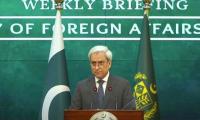
“The Hashemite Kingdom of Jordan, the United Arab Emirates, the Republic of Indonesia, the Islamic Republic of Pakistan, the Republic of Turkiye, the Kingdom of Saudi Arabia, the State of Qatar and the Arab Republic of Egypt, welcomed the steps taken by Hamas regarding US President Donald Trump’s proposal to end the war on Gaza, release all hostages, alive or deceased, and the immediate launch of negotiations on implementation mechanisms,” a joint statement of the foreign ministers, shared by Foreign Office spokesperson with media, said.
The foreign ministers also welcomed President Trump’s call on Israel to immediately stop the bombing and to begin implementation of the exchange agreement and they expressed appreciation for his commitment to establishing peace in the region.
They also welcomed the announcement by Hamas of its readiness to hand over the administration of Gaza to a transitional Palestinian Administrative Committee of independent technocrats.
They emphasised the need for the immediate launch of negotiations to agree on mechanisms to implement the proposal, and address all of its aspects.
The foreign ministers reiterated their joint commitment to support efforts towards the implementation of the proposal; to work for the immediate end of the war on Gaza and achieve a comprehensive agreement that ensured unrestricted delivery of humanitarian aid to Gaza, no displacement of the Palestinian people, and that no measures are taken that threaten the security and safety of civilians, the release of hostages, the return of the Palestinian Authority to Gaza, unifying Gaza and the West Bank, and reaching a security mechanism that guarantees the security of all sides, in a manner that leads to the full Israeli withdrawal, and to the rebuilding of Gaza, and that creates a path for a just peace on the basis of the two-state solution.
Meanwhile, Israeli and Hamas negotiators were converging on Cairo for talks to end nearly two years of war in Gaza, with Israel’s leader expressing hope that hostages held in the devastated territory could be released within days. An Israeli delegation led by Strategic Affairs Minister Ron Dermer will fly to Egypt today (Monday) to take part in talks on Donald Trump’s Gaza plan, Prime Minister Benjamin Netanyahu’s office said on Sunday. The negotiations will be held in Egypt’s Red Sea resort of Sharm el-Sheikh, Netanyahu’s office added in a statement.
The diplomatic push follows Palestinian group Hamas’ positive response to US President Donald Trump’s roadmap for the release of captives in exchange for hundreds of Palestinians held in Israeli jails.
Israeli Prime Minister Benjamin Netanyahu said Saturday he had instructed negotiators to go to Egypt “to finalise the technical details”, while Cairo confirmed it would also be hosting a delegation from Hamas for talks on “the ground conditions and details of the exchange of all Israeli detainees and Palestinian prisoners”.
Egyptian state-linked media said the warring parties would hold indirect talks on Sunday and Monday, just before the second anniversary of the October 7 Hamas attack that sparked the war.
The White House said Trump had sent two envoys to Egypt -- his son-in-law Jared Kushner and Middle East negotiator Steve Witkoff.
The US president warned he would “not tolerate delay” from Hamas, urging the Islamist group to move quickly towards a deal “or else all bets will be off”.
Trump said on Truth Social that Israel had agreed to an initial line of withdrawal in Gaza and that this had been shared with Hamas.
“When Hamas confirms, the Ceasefire will be immediately effective, the hostages and prisoner exchange will begin, and we will create the conditions for the next phase of withdrawal,” he posted, alongside a map of the proposed line.
In his televised statement, Netanyahu said that “in the coming days we will be able to bring back all our hostages during the Sukkot holidays,” referring to the week-long Jewish festival that begins on Monday.
On Friday night, Hamas had announced “its approval for the release of all hostages -- living and remains -- according to the exchange formula included in President Trump’s proposal”.
Trump immediately hailed the statement as evidence the group was “ready for a lasting peace”, calling on Israel to stop its bombing.
AFPTV footage showed thick smoke billowing into the skyline over the coastal territory on Sunday.
Gaza civil defence agency, a rescue force operating under Hamas authority, said Israeli strikes killed at least five people were killed in Gaza City in the morning, adding there were several attacks through the night.
On Saturday, nearly 60 people were killed in Israeli strikes, including 40 in Gaza City alone, the agency reported.
Israeli forces have carried out a sweeping air and ground assault in recent weeks around the city.
Mahmud al-Ghazi, 39, a resident of Al-Rimal neighbourhood in Gaza City, said “Israel has actually escalated its attacks” since Trump’s call for a pause.
“Who will stop Israel now? We need the negotiations to move faster to stop this genocide and the ongoing bloodshed,” he said.
The Israeli military said it was still operating in Gaza City and warned residents not to return there, adding that doing so would be “extremely dangerous”.
- No role for Hamas - In its response to the Trump plan, Hamas had insisted it should have a say in the territory’s future.
Trump’s roadmap stipulates that Hamas and other factions “not have any role in the governance of Gaza”, while also calling for a halt to hostilities, the release of hostages within 72 hours, a gradual Israeli withdrawal from Gaza and Hamas’s disarmament.
Under the proposal, administration of the territory would be taken up by a technocratic body overseen by a post-war transitional authority headed by Trump himself.
Meanwhile, the Foreign Office on Sunday said that Pakistan was actively engaged with international partners to ensure the safety and repatriation of its citizens detained by Israel in the Gaza aid flotilla interception.
“Through the diplomatic channels of a friendly European country, we have confirmed that former senator Mushtaq Ahmad is in the custody of the Israeli occupying forces and is safe and in good health,” read the press release issued by the FO.
It further added that Pakistan authorities have been advised that the ex-senator will be presented before a court and, upon the issuance of deportation orders, his repatriation will be facilitated on a fast-track basis.
The ministry’s remarks come after the former lawmaker was detained by Israeli forces while taking part in the Global Sumud Flotilla on October 2, whose multiple vessels were carrying aid to the war-torn territory currently under Israeli blockade.
The ex-senator, who was leading a five-member Pakistani delegation, joined the flotilla alongside international activists and humanitarian aid groups.
However, the Israeli military intercepted more than 40 flotilla vessels, some 42.5 nautical miles (79 km) from Gaza and detained more than 450 activists aboard the vessels.
Tel Aviv has since faced widespread criticism from countries around the world.
Meanwhile, the FO recalled that the ministry “had previously coordinated the safe return of individuals who disembarked earlier. In this context, we express our profound gratitude to the brotherly countries that assisted in the repatriation of our citizens”.
It further reaffirmed the government’s commitment to the protection of all its citizens abroad and anticipates the completion of this repatriation process within the coming days.
It is pertinent to know that negotiators are set to meet in Cairo today ahead of talks aimed at ending nearly two years of war in Gaza.
The diplomatic moves came after the Palestinian group Hamas responded positively to US President Donald Trump’s roadmap for freeing the captives and administering post-war Gaza.
As many as 137 of these activists arrived in Turkey a day earlier after their deportation, with two alleging that Swedish campaigner Greta Thunberg was mistreated during her detention.
The activists who landed at Istanbul Airport included 36 Turkish nationals, as well as citizens from the United States, the United Arab Emirates, Algeria, Morocco, Italy, Kuwait, Libya, Malaysia, Mauritania, Switzerland, Tunisia and Jordan, Turkish foreign ministry sources said.
Two of them, Hazwani Helmi, a Malaysian citizen, and Windfield Beaver, an American citizen, told Reuters at the airport that they had witnessed Thunberg being mistreated, saying she was shoved and forced to wear an Israeli flag.
“It was a disaster. They treated us like animals,” said Helmi, 28, adding that detainees were not provided with clean food or water and that medication and belongings were confiscated.
Beaver, 43, said Thunberg was “treated terribly” and “used as propaganda”, describing how she was pushed into a room as Israel’s far-right National Security Minister Itamar Ben-Gvir arrived.
Italy’s Foreign Minister Antonio Tajani said 26 Italians were on board the Turkish Airlines flight, with another 15 still held in Israel and set to be expelled over the next few days — along with activists from other nations.
“I have once again given instructions to the Italian Embassy in Tel Aviv to ensure that the remaining compatriots are treated with respect for their rights”, Tajani wrote on X.
A first group of Italians from the flotilla — four parliamentarians — arrived in Rome on Friday.
“Those who were acting legally were the people aboard those boats; those who acted illegally were those who prevented them from reaching Gaza”, Arturo Scotto, one of the Italian lawmakers who took part in the mission, told a press conference in Rome.
“We were brutally stopped [...] brutally taken hostage”, said Benedetta Scuderi, another Italian parliamentarian.
According to Adalah, an Israeli group offering legal assistance to flotilla members, some detainees were denied access to lawyers, water, medications, and toilets.
They were also “forced to kneel with their hands zip-tied for at least five hours, after some participants chanted ‘Free Palestine,’” Adalah said.