Once again, I have an excuse to revisit an issue that has bothered me for a long time. And I also see this as an example of how pointless it is to write these columns. Or how futile are the assertions of learned experts and thinkers who have continuously spoken in public about these matters.
Because it seems the policymakers do not listen, think or have the capability to change the system that hangs around their neck like an albatross. There is hardly a new beginning in any sphere or an inclination to learn the lessons that have been learnt in other countries. Those are countries that have made progress. We, on the contrary, have regressed.
Anyhow, I am referring to the enigma of the English language in our system of education and in our lives. Obviously, I cannot deal with the complexities of our relationship with English, which is essentially a foreign language, in this brief presentation.
The paradox here is that I am arguing against the imposition of English as a means of empowerment in our society in an English newspaper. My first love remains Urdu, and I have been faithful in my passion. But when I decided to become a journalist, ages ago, the option was obvious, for reasons I need not bring up here.
Now, the excuse that I spoke about. The peg I needed was provided by Thursday’s session of the Art Council’s Writers & Readers Café, conducted with great dedication by Dr Tanvir Anjum. The topic this time was the role played by SPELT in the context of the teaching of English in Pakistan. SPELT, of course, is the Society of Pakistan English Language Teachers, and it was launched in 1984.
SPELT’s mission is to provide a professional forum for English language teachers and to serve as a centre for the dissemination of emerging ideas and developments in the teaching of English as a second language. They have been doing this in Pakistan, which has no first language.
As an aside, let me repeat a Christopher Morley quotation: “Life is a foreign language; all men mispronounce it”. For a part of the ruling elite, English is not a foreign language, though they mispronounce their lives all the more.
Coming back to SPELT, I was happy to attend Thursday’s session because my wife Sadiqa and I have been close friends with its founder and Patron-in-Chief, Prof Zakia Sarwar, for way before the founding of this Society. Hence, we have been associated with SPELT’s activities in some ways and we belong in the extended SPELT family – a large gang of lively, committed and passionate individuals. Many of them were there at the Arts Council on Thursday.
With this focus on SPELT, the panel consisted of its prominent faces. In addition to Zakia, there were Dr Fauzia Shamim, Prof Abbas Husain and Ms Fariha Khalil. Mohsin Tejani, SPELT’s current president, moderated the session.
Actually, the session was meant to celebrate the work of SPELT and to illustrate its journey of 41 years. There was an element of joy in recalling the challenges that were faced and the victories that were won. But underneath this commemoration of a collective effort, there was considerable mourning about the state of education in the country. And yes, the proceedings were mostly conducted in Urdu, which seemed very appropriate.
It so happens that I had also taken up this issue last week, while paying tribute to Zubeida Mustafa, the journalist and writer who had devoted particular attention to the education of underprivileged children, mainly girls. She argued strongly for the use of mother tongue or the language of the environment as he medium in early childhood.
Her book on the "tyranny of language” in education was very well received in academic circles, but it obviously did not ruffle policymakers' minds. It is possible that the policy of using English as a divider between the rich and the poor is willfully designed to protect the power of a small elite.
As I have said, the celebration of SPELT on Thursday was laced with ample criticism of the entire system and ambivalence about the teaching of English. One panellist said that it was not just English that was taught poorly. It was the same with Urdu. I had some validation of this observation when I met this week a person who claimed to have done her Masters in Urdu literature from a public university. The ignorance I encountered was mind-boggling.
A mention was made of the absence of a reading culture. This has been my abiding sorrow. I see a lack of reading habits as a major indicator of our moral and intellectual decline. It begins at the beginning. No forward movement is possible without universal literacy. But is English responsible for all these deficits?
These are matters that only experts can decipher. However, some of our learned educationists have provided enough evidence to show that the present arrangement is in a state of collapse, and not just for lack of resources. Education has lost its credibility and the 26 million out-of-school children have become a burden we can hardly carry.
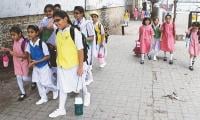
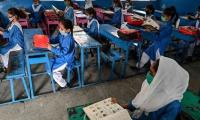
One problem is that there is a great popular demand for English education because of the well-founded belief that proficiency in English is a means of advancement. But there are not enough teachers and the overall environment is not conducive to learning the language.
Still, it is my observation that children in backward areas and in the rural sector desperately struggle to improve their English and, in the process, become deficient in other subjects. This is a dire situation and appears to contribute to a collective decline in creativity and excellence at the national level. The other side of the coin is the linguistic glory that belongs to a very small number of students of elite private schools.
It is this situation that makes English a high wall of the citadel for the multitude and a secret, golden door for the chosen ones.
The writer is a senior journalist. He can be reached at: [email protected]