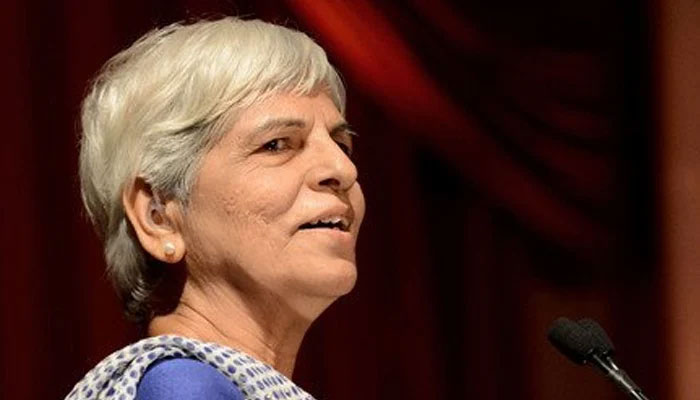
We had packed our bags and were all set to leave for the airport on Sunday last when Sadiqa, my wife, went to see Zubeida Mustafa, who lived in the same apartment complex, but in another block.
Mrs Mustafa had been very unwell for many days and Sadiqa had also seen her in a condition that was quite worrying. But on Sunday, Sadiqa found her sitting on the bed and making some conversation. The general mood, in the company of some relatives, was a bit cheery. Her sister said that she had been in a worse condition a day earlier. It deceptively seemed that she was getting better.
Anyhow, Sadiqa and I arrived in Jakarta around noon on Monday, excited about the week-long visit that included a visit to a small town near Bandung because Sadiqa was part of a delegation of the Sindh People’s Housing for Flood Affectees (SPHF). The idea was to learn from Indonesia’s SANIMAS programme. It constitutes a model of an approach for providing decentralised sanitation in small communities. A relatable experience was travelling in a ‘bullet’ train that touched the speed of 340 kilometres an hour.
I had accompanied Sadiqa because we had planned to stay in Indonesia after her formal engagements for three days. It was also an opportunity for me to become familiar, as a journalist, with the work that SPHF is doing in Sindh and to discuss certain issues with SPHF’s dynamic CEO Khalid Mehmood Shaikh.
In addition, I wanted this column to be a kind of travelogue of Jakarta, against the backdrop of what we have in Karachi. But this was not to be. On Wednesday evening, we were shocked to learn that Mrs Mustafa had passed away.
Here was a person who was truly exceptional. And those of us who knew her as a friend would bear witness to her stature as a wonderful and precious human being. Quite simply, she was incomparable.
How does one sum up the journey of Mrs Mustafa’s life in a brief column or an obituary that would soon be lost in the tumultuous rush of the media? In an immediate response, the Human Rights Commission of Pakistan said that she had “championed social, cultural and language rights like few. She was a comrade-in-arms and stood by the disadvantaged and the oppressed”.
Expand these thoughts and illustrate them with glimpses from a life of social activism and commitment to the welfare of the people who are poor and in need and you have a portrait of a woman who pursued her mission even in the most difficult and daunting circumstances. The image of Mrs Mustafa in the minds of those who are familiar with her work would be of a person who braved physical infirmities with so much dignity and grace. Her eyesight had gradually failed but she did not let her vision get blurred or allow her intellectual pursuits to weaken in any way. She was a living embodiment of hope and human endurance.
Incidentally, it is a younger woman that I see in my memories because of how long ago it was that we knew each other. She joined journalism – with a job in ‘Dawn’ newspaper – in 1975. That is fifty years ago. And I was already an assistant editor in the newspaper. We worked together and collaborated with each other in our respective assignments, until I left the newspaper in 1989.
Mrs Mustafa had moved from the Institute of International Affairs where she worked as a researcher. In a sense she belonged there because she had done her masters in international affairs However, it was a very astute decision of the then editor of the newspaper, Ahmed Ali Khan, to hire her for a senior position.
This point I have often elaborated in my remarks about her when she was alive and was often honoured for her work. Our journalism has generally suffered from a lack of an academic approach. Similarly, it lacked the perseverance that a researcher applies to their task. One could say that she brought a new perspective to print journalism.
We remained in touch while Mrs Mustafa’s interest in education, particularly of girls and children of the poor, deepened. That is how she came closer to Sadiqa, who heads an NGO that has a focus on girls’ education in the villages and small towns of Sindh. Even when she had to be assisted in her physical mobility, she travelled to Khairpur to see some schools run by Sadiqa’s Indus Resource Centre.
Mrs Mustafa and I shared our views about the state of education. Her book titled ‘Tyranny of Language in Education: The Problem and Its Solution’ has highlighted a paradox in our system that our authorities are unwilling to seriously think about. It will be an appropriate tribute to her memory if our government functionaries are able to consider why English has long been a divider between the rich and the poor. It is an agonising fact that no initiative has yet been taken to change an ambivalent language policy.
Mrs Mustafa believed that because of imposition of English at the primary level, in the absence of teachers who can teach English, we are regressing. She argued that if the mother tongue or the language of the environment is used in early schooling, children would find school as a friendly and welcome place.
This would appear to be a diversion. I have lapsed into it because this is almost an obsession for me. Mrs Mustafa had a much larger canvas for her intellectual as well as emotional involvements. We were also together in our association with the Sindh Institute of Urology and Transplantation (SIUT) of Dr Adibul Hasan Rizvi.
In that domain too, Mrs Mustafa took the lead and authored an excellent publication: ‘The SIUT Story: Making the ‘Impossible’ Possible’. I would think that this would put Mrs Mustafa in the company of those who want to follow in the footsteps of Dr Adibul Hasan Rizvi.
Ah, if only we had just a few more of them in this country.
The writer is a senior journalist. He can be reached at: [email protected]