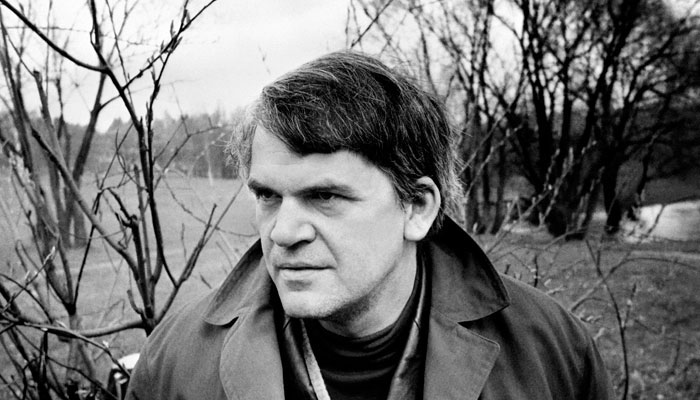
With so many thoughts jostling in my mind, I want to begin with a favourite Milan Kundera quote: “Man’s struggle against power is memory’s struggle against forgetting”.
Why am I reminded of these words this week? There are more reasons than one, and I will come to that. Actually, my main peg is the book Farhatullah Babar wrote about the first Zardari presidency. However, there are a few incidental distractions that I think are somewhat relevant.
First, it was just by chance that I found the column where I had first quoted Kundera while wading through a dusty pile of my old papers on Tuesday night. I had heard it in a lecture in Karachi delivered, yes, by Salman Rushdie. This column – ‘Karachi Diary’ – was published in Dawn in April 1983, more than forty years ago. So far as I remember, he was invited by the British Council. He was speaking on the use of history in creative writing. This was obviously before he had become a pariah in the Muslim world.
Besides Kundera, the Czech-French novelist, Rushdie had also referred to German writer Gunter Grass to show how the living past is sought to be obliterated in a totalitarian society and how committed creative writers can help in a struggle against the distortion of that past. I might add that he was speaking rather in the context of Eastern Europe at that time.
That column was a long time ago. Now, there is so much at hand to deal with, and what should be on our minds also relates to issues of history, how it is rewritten and changed, and how this mysterious process of remembering and forgetting influences our national sense of direction.
By the way, Kundera also profoundly observed that rulers' real power is to change the past. He said that rulers’ control over the future is ultimately less significant than their ability to manipulate or rewrite the past.
While these thoughts may have some relevance to how we define ourselves as a nation and resolve our crisis of identity, we do not seem to have sufficient intellectual capacity or inclination to contend with our history in an objective and rational manner. It often seems that we are playing hide-and-seek with the history of our times. Even as a subject, general history is not taught in all universities. There is very little interest as well in the social sciences and humanities. In addition to this, we gravely lack academic freedom in our educational institutions
So, how do we make sense of what is happening to us? In these circumstances, the initiative that Farhatullah Babar has taken becomes more important. The title of his memoirs is: ‘The Zardari Presidency (2008-2013): Now it must be told’.
This book should be more valuable as an eyewitness account of a very critical period of our recent history because, as an individual and as a writer, Farhatullah Babar is so much more credible and professionally capable than many other retired bureaucrats, diplomats, and politicians. Irrespective of all this, its central character evokes very strong emotions about who he is and how he has played the game.
Speaking at the ‘curtain raiser’ of the book at the Karachi Press Club on Monday, Farhatullah Babor sought to curb some expectations or apprehensions by proclaiming that the book was neither an account of ‘aik Zardari, sub per bhari’ or ‘ajab corruption ke ghazab kahani’. Essentially, the book explores the major events that unfolded during that period and how Zardari dealt with those crises. There were too many of them to be listed in this space.
This is not a review of the book. I am only emphasising the significance of a memoir of this kind. It may contribute positively to our struggle to not forget the past or allow someone to change it. I was happy to be present at the Press Club at the invitation of Ameena Saiyid, the publisher. Under her Lightstone imprint, she is ready with a few more memoirs and promises that the next one will have some really hot stuff.
Journalism, they say, is the first draft of history. But our journalism, print or broadcast or digital, cannot play that role because of the restrictions imposed on this profession. If you go back to what the media was reporting, say, during the December of 1971, what will you find?
In that sense, I think that memoirs such as the one Farhatullah Babar has penned may be taken as the first draft of history. But we will still require efficient and committed historians to preserve the past and interpret it truthfully.
To conclude, let me briefly refer to two reports from the international media to point out some aspects of what the rulers can do with the past. The first is from a comment in The New York Times, with this heading: ‘Trump’s attack on Black history betray America’. The opening paragraph says: “The Trump administration is in a hurry to bury not only America’s future but also its past. Burying futures usually involves burying the truths of history”.
The second report is much longer and more interesting. I saw it on BBC World. The video shows a brand new statue of Soviet dictator Josef Stalin in a Moscow metro station. BBC’s Russia editor tells us that in Russia, people do not know what the past will hold because the past is constantly changing. He explains how Russia is trying to reshape its past to justify its present. The new Stalin statue certifies that attempt, against the backdrop of the war with Ukraine.
I have quoted Kundera about the power that rulers may have to change the past. Do our rulers have that power, and have they exercised it? We should certainly try to answer this question, but let us leave it for some other time.
The writer is a senior journalist. He can be reached at: [email protected]