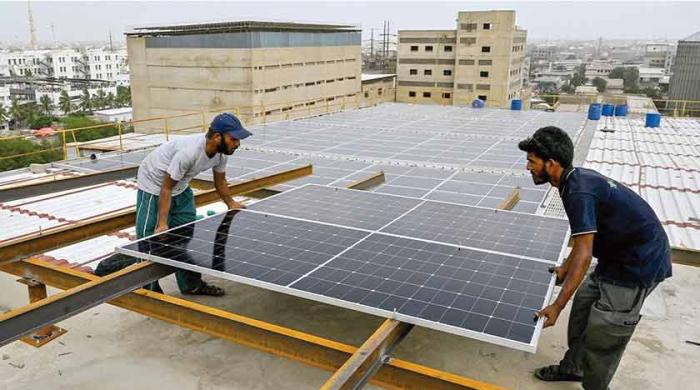
As the government moves ahead with plans to boost electricity generation capacity through new Independent Power Producer (IPP) schemes, Pakistan's energy sector is back in the spotlight.
ENERGY SECTOR

As the government moves ahead with plans to boost electricity generation capacity through new Independent Power Producer (IPP) schemes, Pakistan's energy sector is back in the spotlight.
The Private Power and Infrastructure Board listed the projects on June 30, 2026, showing an investment of around 6,494MW in IPP capacity, but the projects are pending in the least-cost Indicative Generation Capacity Expansion Plan (IGCEP) and on the resolution of contractual issues.
This proposal is offered at a challenging time for Pakistan's power industry, when the country has been experiencing a structural problem on two fronts: one was that it was facing the problem of a growing demand for power while still under-producing it, and now it is facing the other problem of being unable to pay for the generation capacity that has been under construction and is not getting the required efficiency to operate. Further expansion of capacity raises questions about affordability, capacity utilisation, circular debt and the long-term financial sustainability of the power sector.
Some background is necessary to appreciate the present. In 1985, the World Bank helped the government of Pakistan formulate a long-term plan to expand the power sector. Pakistan was in the throes of rapid industrialisation, urbanisation, agricultural expansion and increased energy demand, with strong demand in the irrigation sector. Demand rose 12 per cent per year, while supply grew 7.0 per cent. The resulting shortage was not just a nuisance but a direct constraint on Pakistan's productive capacity and economic development.
The government, by contrast, had little institutional and financial capacity to invest in large-scale power projects. The country needed to invest large sums in new generation capacity and its electricity needs were urgent. So, attracting private investment seemed like a practical solution. This would allow the government to quickly build up power generation without having to fund it on its own.
This eventually led to the IPP framework in the 1990s. The policy proved successful in attracting investment in Pakistan's power sector and has significantly increased generation capacity. The Economic Survey of Pakistan 2024-2025 reports that a total of 101 projects with a combined capacity of 25,841MW are already commissioned by the Private Power and Infrastructure Board (IPPB), which received about $35 billion of international investment. In this context, the IPP policy solved a pressing problem: Pakistan needed more power, and the private sector was offering it.
Pakistan's power sector problem has changed significantly since then. Pakistan's installed generation capacity has increased significantly since then, with a current total of around 49,651MW as per the State of Industry Report 2024 presented by Nepra. However, demand-side indicators are more complex. Electricity sales through the grid have increased only marginally and the deployment of rooftop solar in urban and peri-urban contexts has led to a less clear reduction in grid purchases. Peak demand, grid sales and total electricity consumption can tell different stories, and the gap between installed capacity and actual grid utilisation has widened. Paper solutions in megawatts are no longer enough to solve Pakistan's electricity woes.
If the country is to invest in more generation capacity to support future growth, it must first address the underlying issues of financial instability, inefficient electricity distribution, poor cost recovery and underuse of the current system
This is critical because even if a power plant is not operating fully, there are still financial obligations in electricity generating contracts. Capacity payments incentivise generators to keep generation capacity on standby to provide electricity when needed. These payments add to the sector's costs and must be borne regardless of output when demand for grid supply is low or capacity is underutilised. Nepra's annual reports have also highlighted that the proportion of capacity payment obligations in the total cost of the power sector has been increasing over time, alongside high distribution losses, low recovery rates and tariff distortions, which have led to the increasing accumulation of circular debt in Pakistan.
Against this background, the proposed pipeline of around 6,494MW of new IPP capacity is highly important. In September 2024, an analysis by the Institute of Policy Studies (IPS) highlighted the potential for additional capacity releases to further strain an already stressed sector, especially in the wake of the gap between the estimated capacity required to meet peak demand of about 30,000MW and installed generation capacity, which already stands at more than 45,000MW. The key issue, then, is not whether Pakistan needs more generation in the future, but whether it is better to install more capacity now, before demand growth and system-level reforms are proven.
This also has a broader economic opportunity cost. Funding for financial commitments in the power sector is not readily available for other uses. Pakistan has urgent investment needs in education, health, infrastructure, water management and productive industries. This can negatively affect the overall economy when the electricity sector is already financially stressed, as it may not be able to afford investments in other development priorities.
This is not to say Pakistan should discontinue investments in electricity generation. Instead, future investments should be based on a detailed examination of real demand data, system needs, technology costs, fuel supply and the financial aspects of generation contracts. It is necessary to distinguish between a real lack of generation capacity and a lack due to inefficient distribution lines, energy losses, low demand or affordability issues.
Improving the efficiency of the present power system must be given much greater attention by Pakistan. Reducing transmission and distribution losses, increasing electricity recovery, upgrading the distribution network, improving energy efficiency, expanding competitive electricity markets and deploying cost-effective renewable energy can all help make the sector financially sustainable. Where legally and economically practicable, regulators could also review existing contractual requirements, provided policy adjustments maintain investor confidence and the credibility of future energy commitments.
The proposed IPP pipeline therefore confronts Pakistan with a genuine policy dilemma. The country may eventually need additional generation capacity to support future economic growth, but that investment will only make sense if it first addresses the foundational problems of the existing system: financial instability, inefficient distribution, poor cost recovery and chronic underutilisation. A power sector that cannot afford to run what it has built cannot take on more.
This proposed IPP pipeline thus poses a true policy dilemma for Pakistan. If the country is to invest in more generation capacity to support future growth, it must first address the underlying issues of financial instability, inefficient electricity distribution, poor cost recovery and underuse of the current system. A power sector can't sustain itself if it can't afford the power it produces.
The writer is an MPhil scholar at the Pakistan Institute of Development Economics (PIDE), Islamabad.