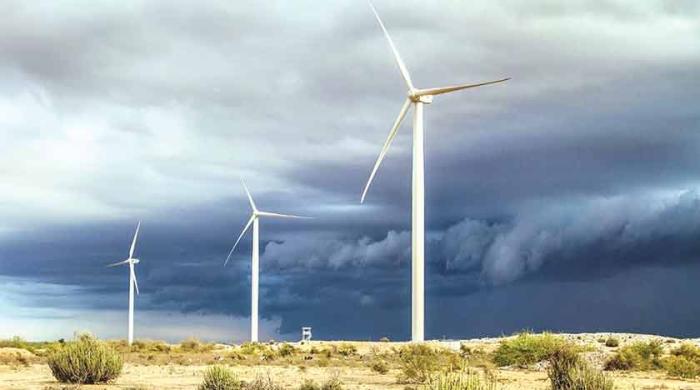
Wind turbines are one of the most innovative clean energy solutions working day in and day out to reduce our reliance on fossil fuels and to bend the greenhouse gas emissions curve.
CLEAN ENERGY

Wind turbines are one of the most innovative clean energy solutions working day in and day out to reduce our reliance on fossil fuels and to bend the greenhouse gas emissions curve.
When it comes to combating climate change, wind power has played a crucial role by moving our economies away from fossil fuels and towards clean sources of electricity generation. According to energy think tank Ember, a typical 3MW wind turbine with an operational time of 25 years generates enough electricity to offset the emission of 400,000 tonnes of carbon dioxide into the atmosphere.
Here is another way to describe the same thing: we need to burn 154,484 tonnes of coal to produce the same amount of electricity that a single wind turbine with an installed capacity of 3 MW would generate in its 25-year operational lifespan. Thus, choosing wind turbines over coal makes more economic sense, plus it's equally good for our society and environment. Australian Conservation Foundation points out that coal power utilises 120 times more water than wind or solar to generate the same amount of electricity. Do you know that a conventional 1000MW coal-fired power plant utilises enough water each year to satisfy the basic needs of roughly 700,000 people?
From an energy policy perspective, prioritising wind power over coal creates a win-win situation for all. We save water, reduce greenhouse gas emissions, and make our societies and economies more resilient to climate change. However, a question that we can ask ourselves is what happens to a wind turbine once it completes its operational lifespan. Can we dispose of a wind turbine in a sustainable fashion?
According to Orsted, a Danish clean energy company and one of the global leaders when it comes to developing, constructing and operating offshore wind farms, we can recycle 95 per cent of the materials that were used to construct wind turbines; however, recycling the remaining 5.0 per cent poses a challenge to the wind industry.
Wind turbine blades are very difficult to recycle and consequently pose a potential challenge to achieving a 100 per cent recycling rate for a decommissioned wind turbine. However, several companies and stakeholders are working round the clock to find solutions to reuse decommissioned wind turbine blades and prevent them from ending up in landfills.
Blade-Made BV is a Dutch startup working to find solutions for decommissioned wind turbine blades. To reuse the end-of-life wind turbine blades, Blade-Made has developed a product portfolio based on products made entirely from end-of-life wind turbine blades. One excellent example is a bench made entirely from a discarded wind turbine blade. Another example is a sound barrier made entirely from end-of-life blades. Blade-Made points out that when the end-of-life blades are used horizontally to construct a sound barrier, they can use up to 45 wind turbine blades per kilometre. On the contrary, when installed vertically, Blade-Made uses up to 200 blades per kilometre to construct a noise barrier.
Reusing end-of-life blades in urban and rural infrastructure can really help the government of Pakistan in implementing sustainability in every walk of life in Pakistan. Imagine if all the universities, institutes, schools and parks in Pakistan had benches made entirely from discarded wind turbine blades. Similarly, imagine if we installed discarded wind turbine blades as noise barriers across all major highways in Pakistan. Doing so would reduce noise levels for nearby housing societies, businesses and hospitals. This would help improve the quality of life of people living close to major highways in Pakistan. Last but not least, what if all communities in Pakistan had children's playgrounds made entirely from discarded wind turbine blades?
Incorporating end-of-life wind turbine blades in urban and rural infrastructure in Pakistan would also help us create a positive global image for Pakistan. It will also help our society understand that sustainability is at the heart of urban and rural infrastructure in Pakistan. To create a sustainable Pakistan for all, we must reuse waste in every walk of life in our country.
Offsetting 800 kilograms of carbon dioxide gas by replacing conventional steel girders with wind turbine blades in bridge construction is an excellent example in this regard. Each of these small choices we make can create a significant difference for all
Researchers at University College Cork (Ireland) have used the blades of a decommissioned wind turbine from a wind farm in Belfast to create a blade bridge. The blades were installed horizontally and were used as an alternative to steel girders in the construction of the bridge. Doing so helped the researchers avoid emitting 800 kilograms of carbon dioxide gas that would have been emitted otherwise if steel girders had been used in bridge construction. This serves as an excellent example of preventing blades from ending up in landfill as waste and instead using them in bridge construction to avoid emitting carbon dioxide gas.
We can certainly implement this innovative idea in Pakistan as well to build infrastructure and to reduce carbon dioxide gas emissions from the construction sector. In Aalborg, Denmark, one can find a bicycle shelter made from blades of decommissioned wind turbines. In Pakistan, we can also replicate this idea by making bicycle shelters made completely out of decommissioned wind turbine blades. If Denmark and Ireland can, so can Pakistan too. We have what it takes to adopt a circular approach and to reuse material that would otherwise be considered as waste.
To achieve our full social and economic potential, we must put sustainability at the core of whatever we do. In fact, when it comes to public policy-making, we should consider Sustainable Development as our point of departure. Every action we take has some consequences. Thus, even in infrastructure development projects, we should try to reduce negative effects on the environment and reuse materials as much as we can.
To conclude, the European Commission points out that wind turbines installed close to the end of the 20th century are now nearing the end of their life. The EU alone is expected to produce an estimated 570 million tonnes of blade waste by 2030. This represents an excellent opportunity for Pakistan to turn blade waste into meaningful products for its economy and people. Doing so will increase the implementation of a circular approach and resource reuse and will help us do more with fewer resources.
Whether it is a bench, sound barriers or a whole playground made from wind turbine blades, the availability of crucial infrastructure will improve the quality of life of our masses, especially our coming generations. As already discussed, a blade bridge prevents the emission of roughly 800 kilograms of carbon dioxide gas that would have been emitted otherwise if conventional steel girders had been used in bridge construction. Thus, end-of-life blades are a useful infrastructural resource, and all we need to do is shift our perspective on these and start seeing them as a valuable resource.
Researchers from Columbia University point out that the steel and cement industries altogether emit roughly 16 per cent of global greenhouse gases. In fact, if the steel and cement industries were considered a country, it would have been the third-largest emitter of greenhouse gases in the world. Thus, every kilogram of carbon dioxide gas that we can offset by using end-of-life wind turbine blades in construction projects will help us bend the greenhouse gas emissions curve.
Offsetting 800 kilograms of carbon dioxide gas by replacing conventional steel girders with wind turbine blades in bridge construction is an excellent example in this regard. Each of these small choices we make can create a significant difference for all. Together we can bend the greenhouse gas emission curve and can create a sustainable Pakistan for us and our coming generations.
The writer is a Stockholm-based policy analyst and the founder of Project Green Earth (www.projectge.org). He can be reached at: [email protected]