Print Story
X




War is not only a political or security concern, but also an environmental crisis
| W |
ars have traditionally been analysed through political, strategic and humanitarian lenses. Their profound and often irreversible impact on the natural environment remains insufficiently emphasised. From the Gulf War to the ongoing conflicts involving Russia, Ukraine, Israel, US, India and Pakistan, it is clear that wars are a major driver of environmental degradation, climate change and unsustainable resource depletion. Conflicts not only devastate human societies but also inflict long-term damage on ecosystems, thereby threatening the very foundations of life on Earth.
At its core, war is an ecologically destructive enterprise. Military operations are heavily dependent on fossil fuels, making armed forces the largest institutional contributors to greenhouse gas emissions. Estimates suggest that global military activities account for approximately 5.5 per cent of total greenhouse gas emissions, an alarming figure that is often excluded from national climate reporting frameworks. The Iraq war produced an estimated 141 million tonnes of CO2. More than 5 million tonnes was produced in the first two weeks of the Iran-Israel War. Such figures underscore how warfare accelerates climate change at a time when the global community is striving to reduce emissions and achieve sustainability.
Recent conflicts further illustrate this trend. The Russia-Ukraine war has not only caused widespread human suffering but also caused severe environmental damage. Industrial facilities, oil depots and chemical plants have been targeted, releasing toxic substances into the air, soil and water systems. Within the first two years, the conflict generated emissions exceeding those of many countries, exacerbating the global climate crisis. Forest fires triggered by military activity have further intensified carbon release. The destruction of ecosystems has reduced natural carbon sinks.
Conflicts in the Middle East, including Israel’s military operations in Gaza, Iran, Lebanon, Syria and Yemen, have demonstrated the immediate and long-term environmental costs of war. Bombardments destroy infrastructure, releasing particulate matter and hazardous materials into the atmosphere. The destruction of energy facilities leads to large-scale fires, smoke and GHG emissions. In recent escalations involving Iran, millions of tonnes of CO2 are being emitted from explosions, fuel combustion and infrastructure destruction. These emissions not only worsen global warming but also contribute to local air pollution, causing respiratory illnesses and long-term health risks.
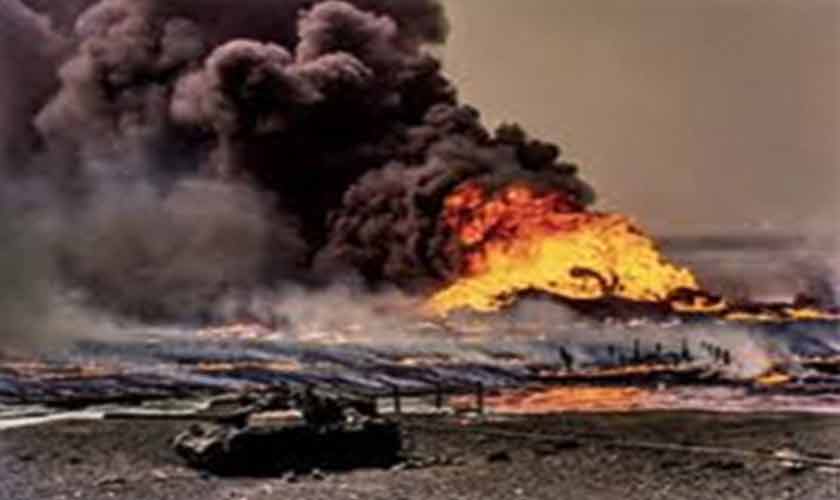
Historically, the environmental consequences of war have been catastrophic. During the 1991 Gulf War, the deliberate burning of Kuwaiti oil wells and massive oil spills in the Persian Gulf created one of the worst environmental disasters in history, severely damaging marine ecosystems and air quality. Prolonged conflicts in Syria, Yemen and Lebanon have led to deforestation, contamination of resources and the collapse of environmental governance systems. In Afghanistan, decades of war have left a legacy of land degradation, destroyed irrigation systems and caused toxic pollution from burn pits, affecting both human health and agricultural sustainability.
One of the most insidious impacts of war is the contamination of natural resources. Military activities release heavy metals, toxic chemicals and unexploded ordnance into the environment, creating long-term “legacy pollution.” These pollutants persist in soil and water for decades, posing chronic health risks and hindering ecological recovery. Water systems are particularly vulnerable, as oil spills, chemical leaks and destruction of sanitation infrastructure render water unsafe for human consumption and agricultural use. This not only exacerbates public health crises but also undermines food security.
In an era defined by climate change and environmental limits, the continuation of large-scale warfare is fundamentally incompatible with the goals of sustainability and human survival. Peace is no longer just a political ideal; it is an environmental necessity.
War also accelerates biodiversity loss and ecosystem collapse. Bombings, deforestation and habitat destruction displace human populations as well as wildlife and disrupt ecological balance. Landmines and unexploded ordnance render vast areas uninhabitable for both humans and animals, effectively removing them from productive use. The loss of biodiversity weakens ecosystem resilience, reducing the capacity of natural systems to recover from disturbances and to provide essential services such as pollination, water purification and climate regulation.
Beyond direct environmental damage, war undermines global sustainability efforts by diverting resources away from climate action. Military expenditures consume vast financial and technological resources that could otherwise be invested in renewable energy, conservation and sustainable development. Increase in global military spending in response to conflicts such as Russia-Ukraine has led to a corresponding rise in emissions, further distancing the world from its climate goals. Moreover, geopolitical instability often leads to increased reliance on fossil fuels, reversing progress toward clean energy transitions.
Another critical dimension is the post-war reconstruction phase that itself carries a heavy environmental footprint. Rebuilding destroyed cities, infrastructure and industries requires enormous quantities of energy, raw materials and cement. Cement production is one of the most carbon-intensive industries. In some cases, reconstruction emissions may exceed those generated during the conflict itself. Thus, the environmental cost of war extends far beyond the battlefield, locking affected regions into cycles of unsustainable development.
The cumulative effect of these factors is a profound threat to global sustainability. War not only accelerates climate change but also erodes the natural systems upon which human survival depends. It disrupts the delicate balance between human activity and ecological limits, pushing the planet closer to irreversible tipping points. As environmental degradation intensifies, it can also catalyse further conflict, creating a vicious cycle of resource scarcity, instability and violence.
It is imperative to reframe war not merely as a political or security issue but also as a fundamental environmental crisis. The environment, as former UN Secretary General Ban Ki-moon aptly observed, is often the “silent casualty” of war. Yet, unlike human casualties, environmental damage is frequently invisible, long-term and trans-boundary, affecting generations to come.
The case for an anti-war stance is not only moral and humanitarian but also ecological and existential. In an era defined by climate change and environmental limits, the continuation of large-scale warfare is fundamentally incompatible with the goals of sustainability and human survival. Peace is no longer just a political ideal; it is an environmental necessity.
Redirecting global priorities from militarisation to sustainability can yield a “peace dividend” for the planet. Investments in renewable energy, ecosystem restoration and climate resilience can create more secure and stable societies than military buildup ever could. International cooperation, rather than conflict, is essential to address shared challenges such as climate change, biodiversity loss and resource scarcity.
If humanity is to secure a sustainable future, it must confront the environmental cost of war and embrace peace as a prerequisite for survival. The urgency of the climate crisis leaves no room for continued ecological destruction through armed conflict; the path forward must be one of cooperation, restraint and a collective commitment to preserving the Earth for future generations.
The writer was associated with the Department of Environmental Sciences at the University of Peshawar. He can be reached at [email protected]