Print Story
X




He leaves behind a legacy of leadership, a reminder that greatness does not always arrive adorned in glamour
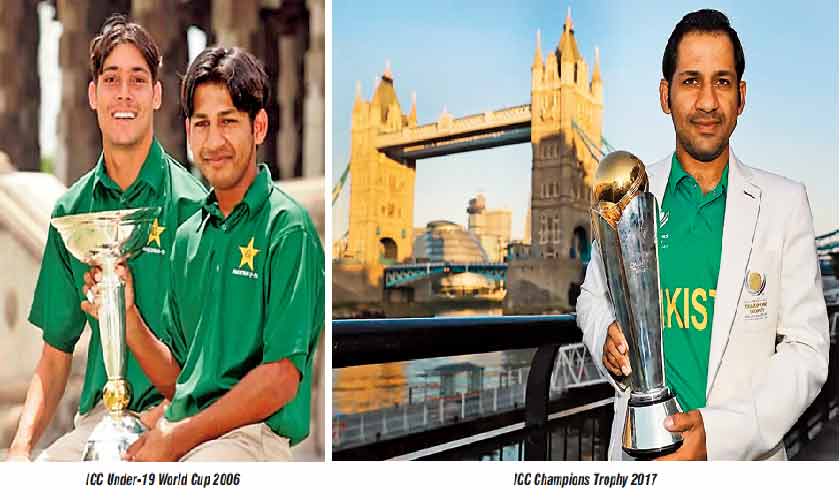
Former Pakistan captain Sarfraz Ahmed has announced his retirement from international cricket. His retirement is not merely the quiet exit of a cricketer; it is the closing of a fiercely contested, often misunderstood, yet undeniably triumphant chapter in Pakistan’s cricketing history.
His journey was never cushioned by admiration or prolonged indulgence. Instead, it unfolded against a backdrop of scrutiny and skepticism; conditions under which only the most resilient endure. Sarfraz did more than endure; he prevailed.
He was never fashioned in the mould of conventional cricketing heartthrobs. There was no carefully curated aura of stardom. However, what he possessed instead was something far rarer, an instinctive understanding of the game, an unrelenting competitive spirit, and the ability to lead men with conviction rather than rhetoric. He was, in essence, a cricketer forged in adversity. He was a born captain material who could lead from front. Long before he ascended to the national captaincy, Sarfraz had already demonstrated his leadership pedigree by guiding Pakistan to victory in the ICC Under-19 World Cup in 2006. It was an early glimpse of a mind that thrived under pressure and a temperament that refused to yield.
Years later, on the grandest stage of all, he would script an even more remarkable chapter in 2017 lifting Champions Trophy with a young inexperienced side on seaming English wickets defeating India in the final.
Under his captaincy, Pakistan achieved what few had deemed possible. The team rose to become the number one ranked side in T20 Internationals, a testament to his consistency and clarity of purpose. But rankings, though significant, pale in comparison to what followed.
This was Sarfraz, leading a young un-fancied Pakistan side, to a historic triumph in the ICC Champions Trophy, dismantling arch-rivals India in a final that remains etched in cricketing folklore. It was not just a victory, it was domination under pressure, orchestrated by a Captain who understood both the psychology of his players and the magnitude of the occasion.
To pair that with an Under-19 World Cup triumph earlier in his career places Sarfraz in a rare bracket of leaders who have conquered both junior and senior global stages. Few in world cricket can claim such a dual distinction of being twice a champion.
Beyond the silverware lies a career of substance. Sarfraz represented Pakistan across formats with distinction, amassing over 6,000 international runs while performing the demanding dual role of wicketkeeper-batsman. His Test record, in particular, stands as a testament to his grit, averaging in the 30s in a format that exposes every technical and mental frailty.
In One Day Internationals, he maintained an average above 30, often anchoring innings in conditions that demanded composure. In T20 Internationals, he brought both stability and tactical awareness, crucial to Pakistan’s rise in the format.
It is the profile of a cricketer to be backed, protected, and honored. Yet, what followed the 2019 World Cup was not decline but displacement. Sarfraz was removed with a swiftness that defied logic. No transition, no patience, no acknowledgment of past achievement. A captain who had delivered on the biggest stage was stripped of authority and pushed aside as though his contributions carried no weight. This was not cricketing evolution. This was intervention.
At the time, the Pakistan Cricket Board operated under a structure deeply influenced by the then Prime Minister Imran Khan, whose involvement in cricketing affairs was both direct and decisive. Ironically in spite of being a great cricketer Imran ruined cricket by banning departmental teams.
Sarfraz, independent by nature and straight forward in presentation, did not align with the preferred mould. His reluctance to follow external direction, particularly from powerful quarters, placed him at odds with the system.
Simultaneously, internal ambitions and shifting loyalties within the set-up ensured that he stood increasingly isolated. There were ambitious Babar Azam and Muhammad Rizwan waiting in the wings to replace him as captain and wicketkeeper. In Pakistan cricket, once alignment is lost, removal is rarely far behind. This one untimely move destroyed Pakistan Cricket to such an extent that it has till today become a laughing stock gasping for breath. Subsequent changes in captaincy also never worked, yet Sarfraz was ostracised forever from captaincy.
Stripped of captaincy, dropped from the side, and denied the extended backing routinely granted to others, he was treated not as a proven leader, but as a dispensable figure, often embarrassed as a 12th man under Babar’s captaincy. Two ICC titles offered him no protection. There was a time when cricket was run on merit and no one noted that Miandad, Sikander Bakht, Asif Iqbal and three others were all in the team from same city Karachi; but now things were different.
Sarfraz, however, chose a rare dignity. No public accusations. No attempts to settle scores. No bitterness displayed for public consumption. He continued to perform in domestic cricket, carrying himself with restraint and professionalism. In doing so, he exposed the system more effectively than any outburst ever could.
There was also, late in his career, a stirring reminder of his enduring class, one that should have settled all lingering doubts. After a prolonged and inexplicable absence from the Test side, Sarfraz was recalled against New Zealand. What followed was nothing short of a statement. In just four innings, he compiled a commanding century, two authoritative scores in the eighties, and a resolute fifty; performances that not only reaffirmed his mettle but quite literally pulled Pakistan back from the brink of certain defeat. It was a comeback defined by character, composure, and defiance. Yet, in a move that baffled many, he was once again eased out of the Test set-up, his resurgence acknowledged but not rewarded with continuity.
Yet, numbers and moments alone cannot encapsulate his value. Sarfraz was a captain who animated the field, constantly engaged, urging, thinking, recalibrating. His energy was infectious, his belief unwavering. He backed players when they faltered, persisted with combinations when others demanded abrupt change and instilled a sense of unity in a side often accused of fragmentation.
And still, his career unfolded under a cloud of relentless criticism. His batting was dissected, his fitness questioned, his place perpetually debated. What remained largely unquestioned within the dressing room, however, was his leadership. Players responded to him, not out of obligation, but out of trust.
It is this contrast between achievement and acknowledgment that renders his story both compelling and, at times, unsettling. Few captains have delivered Pakistan such emphatic success in ICC tournaments, yet few have been so readily cast aside. It speaks as much about the system as it does about the individual. The same treatment was meted out to Younis Khan after his T20 World cup win.
As Sarfraz Ahmed steps away from international cricket, he leaves behind more than a statistical record or a cabinet of trophies. He leaves behind a legacy of leadership, a reminder that greatness does not always arrive adorned in glamour. Sometimes, it emerges in grit, in resilience, in the refusal to bow to circumstance.
History, stripped of the noise and immediacy of public opinion, will judge him more fairly. And when it does, it will recognise Sarfraz Ahmed not merely as a capable cricketer, but as one of Pakistan’s most significant captains, one who conquered the world twice, revived a drifting team, and even in his final chapters, proved that class, once forged, never truly fades. He was a legend in true sense.
– (The writer is a former first‑class cricketer Convener PCB’s ad hoc committee,
and former IG Police)