Print Story
X

| I |
see him now as I saw him then: a broad, bespectacled, grey-suited man with a pockmarked face, slicked-back hair and a tidy beard. Seated in the front row, he listened intently to every word that tumbled from my mouth as I spoke about Echoes of Doom, my debut novel from a few years earlier. Despite the sticky Karachi evening in October, throngs of book lovers had gathered at the literary festival where I had been invited to discuss my work.
He was the only one who caught my attention amid the crowd. Even on stage, I felt the weight of his gaze – steady but not threatening, attentive but not intrusive. As he sat with his right ankle propped on his left knee, his polished black boot quivered, betraying a hint of unease.
Then, as the moderator opened the floor to questions, the suited man’s radiant smile momentarily faded, replaced by a frown that startled me. He immediately raised his hand and rose from his chair.
“Samira Ma’am, are you working on a new book?” he asked in a business-like tone.
What I had taken for nervous energy revealed itself as measured composure. For a moment, the rest of the audience in the claustrophobic hall seemed to fall away and my gaze was fixed on him.
“I suppose I am,” I replied after a pause.
He nodded compassionately, and that smile returned, though now it seemed to mask an unspoken derision.
After the session, I was surrounded by people eager to ask me about my creative process. Yet, I have no recollection of those conversations. What lingers in my memory is the scent of his woody perfume as it pierced its way through the crowd before he did.
“I’m Rizwan Sheikh,” he said, extending his hand. “Could I have a word with you outside? I have a proposition.”
Contrary to my wildest assumptions, the man hadn’t come bearing a marriage proposal.
“I own a two-storey house in Defence,” Rizwan told me as we sipped coffee from paper cups in the cafeteria. “I live in the downstairs portion. For the last year or so, I have offered the upper portion free of charge to writers for two or three weeks. It’s my way of encouraging them. I’m looking for serious professionals who are interested in buckling down to write a story.”
“That’s interesting,” I said, nodding slowly. “I’m sure you attract a lot of struggling writers who need a place to live.”
“Oh no,” Rizwan said, wagging his finger. “I have a rigorous vetting process.”
He then calmly outlined the criteria for the writing residency, as though reading from a script. “I’d prefer writers who’ve been published to acclaim in the past, but aren’t currently working on a manuscript. Writers seeking fresh material.”
“Oh,” I blurted. “Why is that?”
“I want them to write a story set in my house,” he said. “It’s my only condition.”
“Is that right?” I asked, peering at him sceptically. “And the writers you host… are comfortable with the condition? Don’t they see it as somewhat restrictive?”
“The three writers who’ve stayed at my house so far have been fine with the condition,” he said. “In fact, they found it intriguing.”
He drew in a deep breath and stared at me, impassive. “All homes have an aura,” he continued. “We continue to live in the homes we once inhabited long after we’ve left them. A house always remembers.”
Softening his tone, he then asked: “But the real question is, are you interested? Your delayed response to my question during the session told me that you’re not writing anything these days.”
I might have taken offence at the insinuation that I had lied on stage, had it not been the naked truth. Ashamed of my own inadequacies as a writer, I could not bring myself to admit that I hadn’t put pen to paper ever since my husband, Sahir, died. A complete stranger had no claim to the private contours of my grief, yet Rizwan had flouted all boundaries, exposing my vulnerabilities.
“Ah, you caught me,” I said, feigning nonchalance as he saw through my deception.
“I know these things,” he said.
| A |
After all these months, I still don’t know what possessed me to forsake the familiar comfort of my apartment in Clifton to spend three weeks in a strange man’s house. Even the burning desire for creative solitude doesn’t justify a decision this unusual. In a past life, I was a journalist, always wary of security risks. Women like me weren’t meant to be this reckless. Then again, women like me weren’t meant to be widowed so young either. Sahir’s death had released me from polite society and its constraints. Widowhood was both a reminder of my loneliness and a ticket to new adventures. Besides, I was fascinated by the notion of writing about Rizwan’s house, viewing it as an artistic constraint, an opportunity for creative rebirth.
A week later, I arrived at his two-storey house with a gabled roof, carrying a suitcase crammed with clothes and a brown bag for my laptop. Clad in a white T-shirt and skinny jeans, Rizwan greeted me at the entrance, the fragrance of his perfume surrounding him like a halo. The scent followed us as he escorted me up a winding staircase that ran through a narrow alley outside the house. When he opened the door to the upper floor, the whiff of his perfume mingled with the heavy, stale air of the enclosed space.
The space comprised two rooms: a windowless, sparsely furnished study, with a writing desk and a nondescript en-suite bedroom with an oblong window facing the sea. The lounge held two red settees arranged around a glass-topped wooden table. Three of its walls were adorned with framed frescoes; the fourth featured a large window overlooking a lush garden. A makeshift kitchen, with a well-stocked refrigerator, made the upper floor seem almost homely.
“Don’t worry about your meals,” Rizwan said. “I’ll leave them outside the door and knock gently so as not to disturb you. The maid comes in at 6 am every day. She’ll clean the space before you wake up. Don’t worry about anything. Just focus on writing.”
I nodded graciously and leaned forward to embrace him, but Rizwan quickly held out his hand, flashing an awkward smile. Puzzled by his timidity, I shook his hand and lugged my suitcase into the bedroom. Sensing the unease in the air, Rizwan moved toward the exit. At the door, he paused and turned to study me with a mix of anxiety and expectation.
“After dinner, I’ll send you a special qahwa,” he said. “The other three authors said it helped them write better.”
Stung by the rejection of my overture of friendship, I continued unpacking in silence. A few minutes later, when I heard the door click shut behind him, it dawned on me that the upper floor was mine to inhabit for the next three weeks.
As promised, the qahwa arrived at my doorstep after dinner, amber-hued and laced with the subtle aroma of camphor. After a cautious sip, I found myself drawn to its earthy, minty taste. Like a gentle balm, the concoction erased the restlessness I had carried within me for years. Soothed by the beverage, I don’t remember when I slipped into sleep.
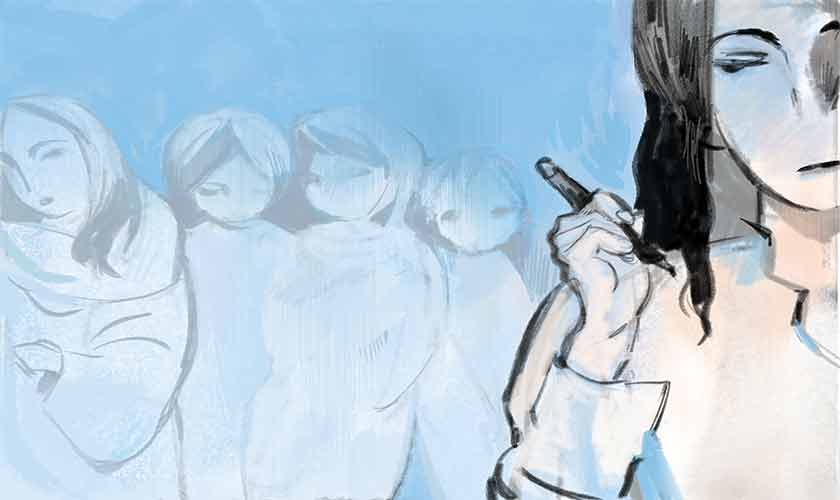
Then I saw them: a woman in a white shalwar qamees seated on one of the settees in the upper-floor lounge, three girls beside her.
“Who are you?” I asked.
“Refika,” she said, pointing to the girls. “These are my daughters.”
“How did you manage to get inside?”
The woman placed a finger on her lower lip and vigorously blew on it. Her face contorted with panic.
“Listen to our story,” she pleaded, wiping a tear from her cheek. The children, garbed in red-and-blue overalls, wailed and shrieked until I reassured their mother that I would hear her story.
Once her children had fallen silent, Refika recounted the quiet ache of her confinement during the long months of the coronavirus pandemic. Her husband, an overworked entrepreneur in Oman, couldn’t return home. With tear-soaked eyes, Refika spoke of loneliness and the suffocating monotony that had become her prison. I listened to her quietly, even sympathetically, until a loud, inexplicable thud cut through her words. In an instant, Refika, the children and the lounge dissolved into nothingness. I awoke in my new bedroom to birdsong and sunlight shifting across the marble floor.
Instinctively, I dashed into the lounge, hoping to see the woman and her children there, only to be greeted by a deafening silence. Though I was disappointed by their absence, Refika’s story clung to my mind, gnawing at me until I opened my laptop and began typing. The hours passed in a fevered haze, as her narrative flickered across the screen, like a mirage in a parched desert. It seemed like a miracle. After many months of creative drought, the words flowed freely, as though summoned from a dark chamber of my mind that had long been sealed.
It was a story like no other, gruesome and grim.
For reasons I couldn’t fathom, her story felt unfinished. What I’d typed seemed only a prelude to a darker, more distressing chapter. Possessed by the irresistible urge to probe further, I returned to sleep, hoping to reconnect with Refika in my dream. But my slumber was dreamless and the desired reunion didn’t materialise. It didn’t take long for me to realise that it was the qahwa that had transported me into her hallowed realm. The amber-coloured drink was my elixir, my only link to her story. In utter desperation, I considered asking Rizwan to send me a cup. But I wasn’t sure how he might react to this request. I waited for nightfall, eager to take a sip of the concoction.
When it arrived, I gulped it down. As expected, sleep enveloped me in its benevolence, reuniting me with the woman and her children. What followed became a routine. Every night after dinner, I’d drink the qahwa and return to the now-familiar dreamscape. During the day, I hammered away on my laptop, documenting Refika’s tale with a peculiar delight.
It was a story like no other – gruesome and grim.
Emotionally devastated after months of isolation, Refika came to see her husband’s inability to return home as betrayal. In a violent fit of rage and desperation, she killed her children before taking her own life.
I recorded her tale with steely determination, undaunted by the fact that it was relayed to me by a ghost.
| T |
The rhythm was undisturbed until the fateful night when I forgot to drink the qahwa. That night, my muse did not come to me. The next morning, I felt no despair. The restlessness that would beckon me back to Refika eluded me entirely. It was almost as if I’d been released from captivity.
I turned again to the story with a fresh set of eyes and found it lacking and a little clichéd. As I read through it, I felt ashamed of my foolishness in having transcribed the narrative without pausing to reflect on significant details. The journalist in me had been instinctively sceptical; had the sceptic within me died?
For the next few days, I devoted myself to the painstaking task of supplying and refining key details in Refika’s narrative. She didn’t need to have three children standing silently beside her as she spoke; one would suffice. At one point, Refika’s reaction to her husband’s absence struck me as excessive, yet I couldn’t imagine a different ending.
At the same time, my thoughts kept returning to her husband and how he must have felt about losing his family. My grief over Sahir’s death became the compass through which I navigated Refika’s story. I recalled how a jolt had ripped through me when I caught sight of my husband’s lifeless body after he died of Covid. Refika’s husband must have felt something similar.
Driven by an earnest impulse, I began rewriting the story from his perspective. With each revision, transforming from a scribe to a storyteller, I wove my perceptions into the tale revealed to me in my dreams. I found myself slowly becoming, once again, the person I had abandoned when Sahir died.
I remained in this pleasurable state, until one morning, stepping out of the bathroom after a shower, I heard movement in the study. I rushed in to find Rizwan sifting through the papers on my desk and reaching for my laptop.
“Hey. When did you come in?”
Startled, he leapt away from the desk, hand clutching his chest, and edged toward me cautiously.
“Oh, I just wanted to see how you were,” he stammered. “Routine check.”
I nodded, seeing through his deception. In the two weeks I’d been living at his house, Rizwan hadn’t once checked in on me. What could have prompted this unexpected visit upstairs?
“The maid tells me you have not been drinking the qahwa,” he said, pointing to the desk where the previous night’s cup rested on a coaster. “Why is that? The other writers seemed to love it.”
I detected a note of impatience in his voice, but I didn’t confront him.
“I’m good without it,” I replied. “I must admit the qahwa did give me the motivation I needed, but my writing is flowing perfectly now. Thank you, though – for the qahwa and the solitude. It’s just what I had needed.”
Rizwan’s face twisted into a scowl.
“I hope you’re writing about the house,” he said, his eyes boring into mine. “Otherwise, the house will be displeased.”
Realising that he’d said too much, he rushed to the door and scurried down the staircase.
At first, I dismissed his words. Later, I began to realise their sinister implication. That night, I heard a loud chatter echoing through the study and the kitchen and thumping outside my bedroom door. Yet when I went outside, no one was there. For the next few days, the toilet taps would turn on by themselves, and peals of laughter emanated from the lounge. These mysterious sounds irked at me, disrupting the flow of my writing. I am not superstitious, but it felt like the house was protesting on Refika’s behalf, chastising me for changing the direction of her story.
Half-convinced that Rizwan was behind these occurrences, I forced myself to type out the rest of my story exactly as I’d envisioned it. As I wrote, the sounds stopped. I convinced myself that I had defeated whatever force had been trying to deter me.
Then, it happened: a severe shaking, a reminder to me that the house had only given me a reprieve before it struck again. That evening, after completing my story, I packed my suitcase, satisfied that I’d fulfilled my purpose for the residency two days ahead of my scheduled departure. Fatigued after a long day of work, I lay down in bed with the lights switched on. As I drifted into sleep, I was jolted awake by tremors. This was no earthquake; an invisible force was violently rocking my bed.
My heart pounding heavily, I closed my eyes and muttered a prayer. The tremors subsided and I summoned the courage to rise from my bed, grab my suitcase and laptop bag and slip out of the house in the murky stillness of night.
For weeks, my thoughts circled back to the unusual sequence of events. I couldn’t comprehend how I’d come to calmly accept visitations from a spectre in my dreams. Had the house, or the qahwa, dulled my inhibitions? What troubled me more was the cold, unsettling realisation that the house – that vile, overpowering presence – had let me escape without drawing me back into it.
A few hours earlier, a brown package was delivered to my doorstep. Inside was a spiral-bound manuscript with the title, Refika: A Woman’s Story Through Many Narrators, emblazoned across the cover in bold.
As I browsed through it, I realised that the manuscript opened with a preface by Rizwan Sheikh, the editor of the volume. In his note, he recounted the story of his late wife, Refika, a tale I’d heard first-hand from the apparition in my dream. Rizwan explained that he invited four writers to chronicle his wife’s story, his way of fully understanding his wife’s psychosis.
I felt a pang of compassion for Rizwan, a man who, like me, was still grieving the loss of his partner. Upon reading the first three stories, I marvelled at how their authors had remained faithful to the account revealed to me in my dreams. For a brief moment, I felt ashamed of my rebellion and wondered if I’d let Refika, Rizwan and their house down.
As I flipped the pages to read the final story, I saw my name on the page, but there was no story beneath it. A tremor tore through my heart as the letters of my name began to fade one by one before my eyes, dissolving entirely from the page.
The air grew heavy with an earthy fragrance – the lingering scent of Rizwan’s perfume.
Taha Kehar is the critically acclaimed author of No Funeral for Nazia (2023) and Typically Tanya (2018). No Funeral for Nazia has been translated into Russian. In 2025, he co-authored Story Circle: Letters on Creativity and Friendship. Kehar’s first short story collection, Matchmaker and Other Stories, will be released this year.