Print Story
X




A longing to revive the past glory of Peshawar’s literary culture continues to manifest itself
| L |
ike a crown set with precious jewels, Peshawar of the 1960s shone with its scholars and literati.
There was Daud Kamal, the Cambridge-educated teacher of English at the University of Peshawar who wrote English poetry so finely wrought that it could be mistaken for that of Yeats or Eliot. For Urdu lovers, there was Farigh Bukhari, a professor who wrote poetry, prose and fiction, and helped lay the foundations of progressive literary thought in the region. Bukhari wrote on biography, literature, social issues and politics in Hindko, Pashto and Urdu.
In the field of history and archaeology stood a man of luminous presence. Having served as a research fellow at the School of Oriental and African Studies in London, he came to Peshawar and established the Department of Archaeology at the University of Peshawar, becoming its first professor. A polymath of classical stature, he had earlier worked alongside Sir Mortimer Wheeler, excavating the 4,500-year-old settlement of Mohenjo Daro. He went on to author nearly thirty books on history and archaeology. Proficient in 15 languages and regarded as one of the foremost authorities on Central Asian and South Asian archaeology, Ahmad Hasan Dani introduced archaeology as an academic discipline in higher education in Pakistan and what is now Bangladesh. He taught at Peshawar University from 1962 to 1971, raising a generation of historians. In the ’70s, he went on to found the Faculty of Social Sciences at Quaid-i-Azam University in Islamabad.
Closer in passion and potential to Dani was Dr Waheed-uz-Zaman, a historian of the first generation of the nation. He was considered an authority on the life and thought of MA Jinnah and on the formation of Pakistan. Like Dani, Dr Zaman went to QAU, established the Department of History there and served as its first chairman.
Women, too, were making no small strides. Zaitoon Bano, always prolific, wrote fiction and poetry, earning her place as the First Lady of Pashto Literature.
Apart from the intellectual stature and scholarship, there were teachers who did not merely lecture but also inspired their students with the brilliance of their character.
Among them was Prof Syed Zia-ul Qamar, who taught English at the historic Edwardes College while also performing in Pashto plays on Pakistan Television. An archetypal Pashtun from Nowshera, he was known for his impeccable dress, elegant haircut, gentle fragrance and the refined manners of a thorough gentleman. His brilliance lay not just in the classroom but also in acting. He could recite from memory entire poems of Byron, Browning, Coleridge and Keats. Students recall that he taught in a way that made them fall in love with English language. After teaching at Edwardes College for four decades, he briefly joined the Institute of Management Sciences, Hayatabad. In the final days of his life, while hospitalised in Peshawar, he reportedly asked a nurse to bring him the latest Agatha Christie diary and Raza Rumi’s book, Delhi by Heart: Impressions of a Pakistani Traveller.
Today, much of that legacy lingers in a fading memory.
Aasra Mir, a BS English student at the very institute where Prof Qamar once taught, said she had never heard his name. Nor was she familiar with the scholars who once defined Peshawar’s intellectual life. Their books are seldom found in local bookstores. Their stories rarely circulate among the young.
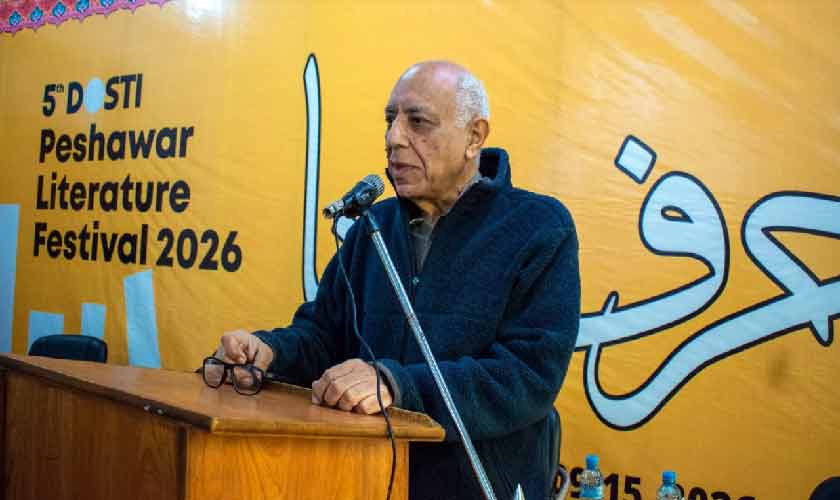
“Revival is not just looking back; it is taking the fire from the past, not the ashes.”
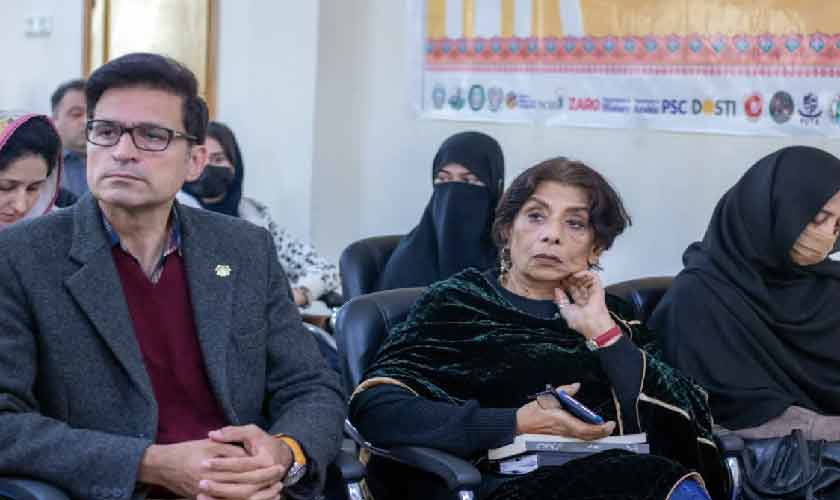
For the first time, she encountered the faces of these scholars at the Dosti Peshawar Literature Festival. Enlarged photographs of these scholars stood on tall display boards, titled in Urdu Mashaheer-i-Ilm-o-Adab (luminaries of knowledge and Urdu literature).
Like Aasra, many girls and boys had come to listen to authors, public intellectuals and academics on many issues facing our society today. The curious youth aspire, as the organisers of DPLF also wish, to revive the literary and intellectual milieu of Peshawar, as it was in the 1960s.
The festival had started off with a keynote address by Dr Ravish Nadeem, the poet and intellectual, who mused on how literature and books define a society and shape the present and future of a nation.
Dr Anjum Altaf, one of the rare polymaths in our country today, shared his thoughtful reflections on several issues our education system faces and how it can be fixed. He was particularly passionate about the medium in which education is delivered to the children.
Dr Salma Shaheen, the former director of the Pashto Academy, shared her wisdom on the need and purpose of literature for our society.
Taking her argument forward, Dr Shaheen Umar deliberated on how women can transform a society by spreading awareness through various forms of literature.
Dr Muhammad Naeem, a computer scientist, concluded the festival with his talk on a topic that felt so complex that many would not recommend it for a bachelor’s class, let alone a public event. However, those who attended it felt as if he was telling a fairytale.
Speaking without any notes and prompts, Dr Naeem started off by defining philosophy, discussed the purpose and need for a philosophy of science, mentioned its various schools of thought and dwelt over some of its problems.
When I first saw the title of Dr Naeem’s talk, I was curious. So I had come early and occupied a seat in the front row. I was keen to see how he would crack this hard nut. After his ‘talk’ was over, I felt like I had been listening to EH Gombrich narrating his A Little History of the World.
There were many sessions - around 10 a day for a whole week, with four sessions happening simultaneously in different halls. Like many literature festivals, most of the sessions consisted of panel discussions, book talks, author talks, translators’ talks and book launches.
The message the festival tries to send can be summed up like this: “Revival is not just looking back; it is taking the fire from the past, not the ashes.”
The writer has a background in English literature, history and politics. He can be reached at [email protected]