Print Story
X




The first semifinal will be held in Colombo on March 4 if Pakistan progress otherwise, that match will take place in Kolkata.
Pakistan secured a place in the Super Eight stage of the ICC T20 World Cup 2026 with a commanding 102-run victory over Namibia in their final Group A match last week.
The win completed the Super Eight line-up: India and Pakistan from Group A; Sri Lanka and Zimbabwe from Group B; West Indies and England from Group C; and South Africa and New Zealand from Group D.
The Super Eight will be contested in two groups of four. Group 1 comprises India, Zimbabwe, West Indies and South Africa, while Group 2 contains England, New Zealand, Pakistan and Sri Lanka. Each team will play the others in its group once, starting on zero points; net run rates from the initial group stage will not be carried forward.
The first semi-final will be held in Colombo on March 4 if Pakistan progress; otherwise, that match will take place in Kolkata. The second semi-final is set for March 5 at Mumbai’s Wankhede Stadium, with India occupying that slot should they qualify.
The final will be staged in Colombo if Pakistan reach it, and in Ahmedabad if they do not.
Reserve days have been scheduled for both the semi-finals and the final.
Aside from their fixture against India, Pakistan’s group-stage path was comparatively straightforward, with three lower-ranked opponents. The true challenge begins in the Super Eight, notably with a strong South African side in Group 1. Pakistan will need at least two wins in the Super Eight to secure a semi-final berth.
Pakistan’s cricket team suffered its fourth defeat to India in the past four months following their Group-stage loss in Colombo on February 15, intensifying concerns over the national side’s performance in limited-overs cricket.
The recent result extends a troubling run for the Green Shirts against their traditional rivals.
Pakistan have lost 13 of their last 16 limited-overs meetings with India, leaving supporters disillusioned and fuelling fresh scrutiny of the country’s cricketing structures and development pathways.
India’s dominance in T20 internationals over Pakistan is stark. In T20 World Cup history the sides have met nine times, India winning eight of those encounters (including a bowl-out victory in 2007); Pakistan’s sole tournament win came in Dubai in 2021. Pakistan’s last T20 victory over India remains the Asia Cup win in Dubai on September 4, 2022. Since then the teams have met six times in T20Is, with India victorious on each occasion, bringing India’s current streak in men’s T20Is against Pakistan to six consecutive wins.
The Colombo match underlined Pakistan’s problems with both bat and ball. India posted 175-7 - the highest India total in India-Pakistan T20 World Cup meetings, surpassing the previous mark of 160-6 at the MCG in 2022. Pakistan were bowled out for 114, their third-lowest T20I total against India (only 83 all out in the 2016 Asia Cup and 113-7 in the 2024 World Cup are lower).
Bowling figures in Colombo were particularly costly. Four frontline bowlers - Salman Agha, Usman Tariq, Mohammad Nawaz and Saim Ayub - conceded 87 runs in 14 overs, while Shaheen Shah Afridi, Abrar Ahmed and Shadab Khan leaked 86 runs in just six overs, a combination that proved decisive.
Looking at a broader sample, since Pakistan’s famous win over India in the 2017 ICC Champions Trophy final at The Oval, the sides have contested 16 white-ball matches (ODIs and T20Is): India have won 13, Pakistan two, with one match abandoned.
Recent high-profile defeats include the 2022 T20 World Cup loss in Melbourne and the narrow six-run defeat in New York in June 2024, when Pakistan failed to chase a modest 120. The pattern of results has prompted calls for an urgent review of talent pathways, coaching structures and strategic planning if Pakistan are to reverse the trend against their fiercest rivals.
India’s margin of victory 61 runs was their biggest by runs against Pakistan in men's T20Is. Their previous three wins while batting first were by margins of 11, 6 and 5 runs respectively.
The 61-run defeat was also Pakistan's second-heaviest at the men’s T20 World Cup, having lost to West Indies by 84 runs back in 2014.
Abhishek Sharma became the first batter from India who out on duck in first two matches of T20 World Cups. Abhishek has been dismissed four times for ducks, including three times on the first ball in 2026, in just seven T20I innings.
After defeating Pakistan in the T20 Cricket World Cup, the Indian cricket team created a new record for the most consecutive victories in ICC white-ball events. Previously, this record was held by Australian cricket team, who won 15 matches in ICC events between 2006 and 2007.
However, India have now set a new benchmark by winning 16 consecutive matches in limited- overs International Cricket Council events.
Pakistan’s struggles in the ICC Men’s T20 World Cup 2026 intensified after a 61run Groupstage defeat to India, prompting fresh scrutiny of the team’s batting, bowling and selection policy.
Babar Azam, the side’s talismanic batter, has not hit a single six in T20 World Cup matches versus Full Member nations since facing India in Dubai in 2021 - a statistic that underlines concerns about his strikepower in the shortest format. In Colombo, Pakistan’s top order again crumbled under pressure: seven batsmen failed to reach double figures as the innings folded cheaply.
Individual performers in the opening stage were limited. Opener Sahibzada Farhan led Pakistan’s run-scoring with 220 runs at an average of 73.33 and a strike rate of 164, registering a century and a fifty in four matches and finishing as the only Pakistani to pass 200 in the initial phase.
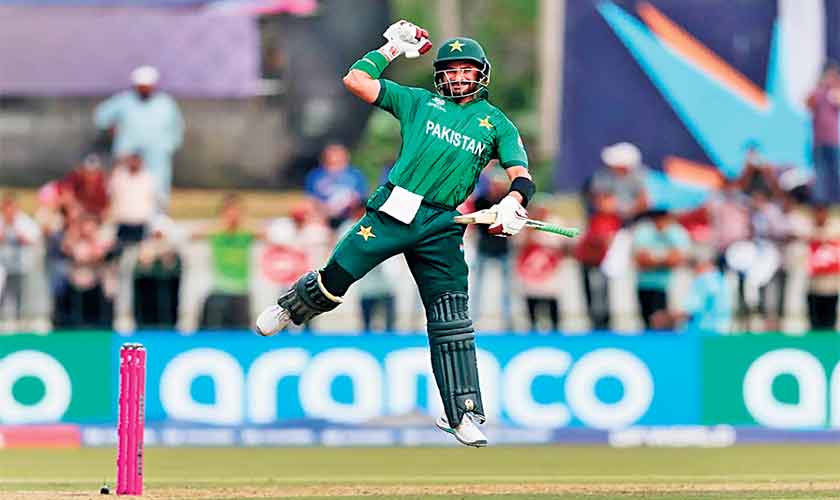
Sahibzada Farhan etched his name into Pakistan’s T20 folklore with a commanding unbeaten century against Namibia national cricket team in the final group-stage clash.
The 29-year-old opener became only the second Pakistani batter to register a hundred in the ICC Men’s T20 World Cup, joining Ahmed Shehzad, who achieved the milestone during the 2014 edition against Bangladesh national cricket team.
Farhan is now just the 13th batter overall to score a century in the tournament’s history, placing him alongside elite names such as Chris Gayle, Brendon McCullum, Mahela Jayawardene, and Alex Hales.
In the broader T20I context, Babar Azam leads Pakistan’s century tally with three tons, while Mohammad Rizwan, Hasan Ali, Ahmed Shehzad, Haris Rauf, and Farhan each have one to their credit.
On the bowling front Usman Tariq claimed eight wickets in three games at an average of 8.37 and an economy of 5.82. Saim Ayub and Shadab Khan shared five wickets between them, averaging 10.60 and 17.80 respectively.
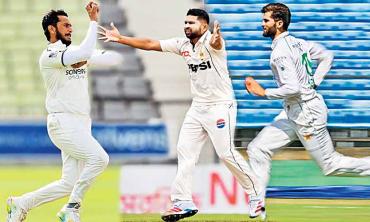
By contrast, ace paceman Shaheen Shah Afridi endured a poor first round, taking just three wickets in three matches at an average of 33.66 and an elevated economy of 11.22. Across his last four outings versus India over five months, he has conceded 114 runs in 11.5 overs - figures that have amplified calls for change.
Former players, analysts and sections of the fan-base are increasingly vocal about overhauling the senior core. Names frequently cited for review include Shaheen, Babar and Shadab, with critics arguing that prolonged underperformance by longserving internationals is impeding Pakistan’s progress.
The prevailing suggestion is to accelerate investment in younger talent: while losses by an inexperienced side may be judged part of a learning curve, continued failure by seasoned campaigners in highpressure matches raises legitimate selection questions.
As debate grows, Pakistan faces a critical crossroads between persisting with established stars in the hope of a revival or pressing the reset button to build a new, more resilient whiteball unit for the future.
Despite underwhelming returns from several senior pros, Pakistan’s supporters remain resolutely optimistic. Fans believe the Green Shirts can still secure a semifinal berth, set up a blockbuster final against India, and ultimately defeat their arch-rivals to settle the score on the biggest stage.