Print Story
X




With a 54.71m throw at World Para Athletics Grand Prix, the four-time Paralympic medallist proves that excellence, not circumstance, defines champions
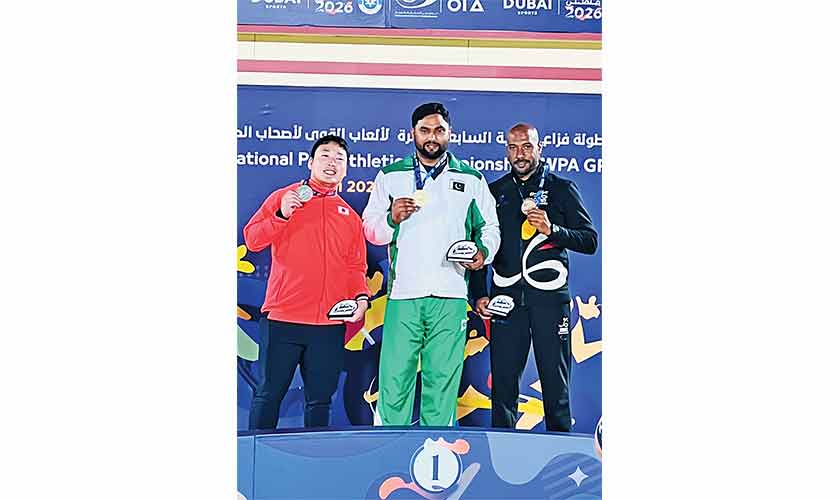
Pakistan’s most decorated Paralympian, Haider Ali, has once again etched his name in gold, this time at the IPC World Para Athletics Grand Prix 2026 in Dubai, reaffirming his status not just as a champion athlete, but as the enduring face of Pakistan’s para-sport movement. With a commanding throw of 54.71 meters in the F-37 Discus category, Haider outclassed competitors from more than 50 nations and sent a powerful message to the world: Pakistan’s para-athletes do not merely participate, they dominate.
The gold medal, secured at the prestigious championship held in the UAE from February 10 to 13, is not an isolated triumph. It is the latest chapter in a career that has spanned nearly two decades and redefined the narrative of disability sport in Pakistan. While others measure careers in seasons, Haider measures his in eras.
Speaking after his victory, an emotional Haider credited relentless preparation, faith, and unwavering institutional support for his success. He acknowledged the backing of the National Paralympic Committee of Pakistan and expressed gratitude to his sponsors especially ACTIVIT and its CEO Rd. Rizwan Aftab Ahmed for providing elite medical care, nutrition and financial stability that allowed him to focus solely on performance. His words reflected humility, but his throw reflected authority.
Haider’s journey began in 2006 when he entered Pakistan’s para-athletics system under NPC Pakistan. Since then, he has become the country’s most consistent and celebrated para-athlete, delivering podium finishes across Asian Para Games, World Championships, Grand Prix circuits and the Paralympic Games. His career is not built on occasional brilliance, it is built on sustained excellence.
His Paralympic record alone places him among the giants of global para sport. He won silver at the 2008 Beijing Paralympics, bronze in Rio 2016, made history with gold at Tokyo 2020, and added another bronze at Paris 2024. Four Paralympic medals across four editions, a feat unmatched in Pakistan’s para-sport history, have cemented his legacy as the nation’s most successful Paralympian.
Yet what makes this Dubai victory particularly significant is its timing. At a stage when many athletes contemplate winding down, Haider is expanding his legend. The 54.71-meter throw was not symbolic, it was technically world-class. Competing against elite throwers from 54 countries, including regional rivals, he delivered under pressure with the composure of a veteran and the hunger of a debutant.
This victory is also a testament to the quiet but crucial role of institutional collaboration. The NPC Pakistan acknowledged the solidarity support extended by the Asian Paralympic Committee and the Dubai Club for People of Determination, which facilitated participation at this international event. That assistance translated directly into gold, proof that when opportunity meets preparation, podiums follow.
Chef de Mission of Team Pakistan, Imran Jamil Shami, aptly described Haider as a symbol of courage, consistency and national pride. His words were not ceremonial. They were factual. For nearly twenty years, Haider Ali has carried Pakistan’s flag into arenas where representation alone is a victory and returned with medals. But beyond medals lies impact.
Haider’s career has fundamentally altered perceptions of athletes with disabilities in Pakistan. In a society where infrastructural and social barriers often limit opportunities, his achievements challenge outdated narratives. He has not asked for sympathy; he has demanded respect, and earned it through performance.
Equally important is the ripple effect of his success. Young athletes with disabilities across Pakistan now grow up with a role model whose journey proves that global dominance is achievable. In cities like Gujranwala, where preparations are reportedly underway to welcome him home, Haider’s victories are community victories. His return is not merely a sporting moment; it is a civic celebration.
Haider’s continued brilliance also poses an uncomfortable question: Why is Pakistan still relying so heavily on one man’s shoulders? For years, Haider Ali has been the standard-bearer, the headline and often the sole medal hope. His sustained dominance is inspirational but it also highlights the urgent need to institutionalize talent development, coaching pipelines and infrastructure for para-athletics nationwide. Champions should inspire systems, not substitute for them.
The Dubai gold medal must therefore serve as both celebration and catalyst. Pakistan possesses extraordinary athletic potential, but unlocking it requires consistent investment in training facilities, sports science, international exposure and athlete welfare. The support Haider acknowledged, medical care, nutrition, financial backing, should not be exceptional. It should be standard. What Haider really needs is acknowledgment and great financial and moral support from the Government, which will surely motivate Haider and other such athletes to win much bigger for Pakistan at international level.