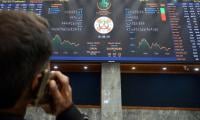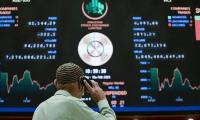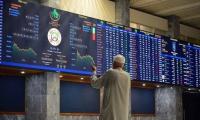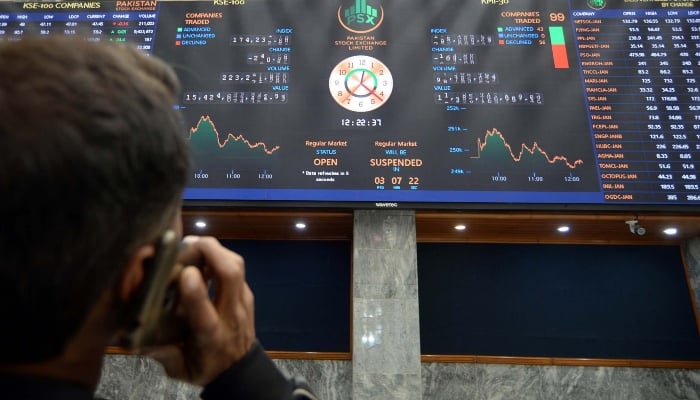
The equity market remained upbeat on Monday, led by mid-cap stocks, as investors bet on potential rate cuts, debt restructuring, and hopes for cheaper funding through a possible panda bond issuance, amid a moderate current-account deficit.
"Today we are seeing positivity in mid-caps due to expectations of interest rate cuts and mid-cap growth stories on Jaecoo launch, moderate Current Account Deficit, debt restructuring bets and expected cheaper rate on panda bond launch,” said AAH Soomro, an independent investment and economic analyst. "Expect this to continue."
The Pakistan Stock Exchange’s (PSX) benchmark KSE-100 Index settled at 187,761.69 points, up 2,662.86 points, or 1.44%, from 185,098.83. The index traded between a high of 187,882.04 (up 2,783.21 points, or 1.5%) and a low of 186,127.35 (up 1,028.52 points, or 0.56%).
A Topline Research survey ahead of the State Bank of Pakistan (SBP) Monetary Policy Committee meeting on January 26 shows 80% of participants expect a cut; of these, 56.4% see 50 bps, 15.4% expect 100 bps, 5% look for 25 bps and 3% foresee 75 bps, while 20% expect no change. The SBP cut 50 bps at its December 15, 2025 meeting.
SBP reserves rose $16 million to $16.072 billion in the week ended January 9, lifting total liquid reserves to $21.248 billion (commercial banks $5.177 billion, up $40 million). The SBP noted continued foreign-exchange purchases amid a steadier current account supported by remittances; from June 2024 to September 2025, net market purchases totalled $9.7 billion.
The central bank projects the FY26 current-account deficit at 0–1% of GDP and sees reserves at $17.8 billion by June 2026 with planned official inflows. Separately, the Ministry of Finance said it plans to tokenise up to $2 billion of domestic government debt in an initial phase to broaden access and modernise public-debt markets.
The KSE-100 ended last week at 185,099, up 689 points week-on-week as late buying offset midweek pressure. Volatility remained elevated, but sentiment improved on easing regional tensions, falling Pakistan Investment Bond (PIB) yields (down 59–70 bps across two, three, five and 10-year tenors), and reform-related news. Average daily traded volume fell 24.5% week-on-week to 1.2 billion shares.