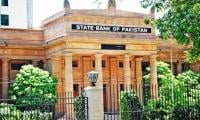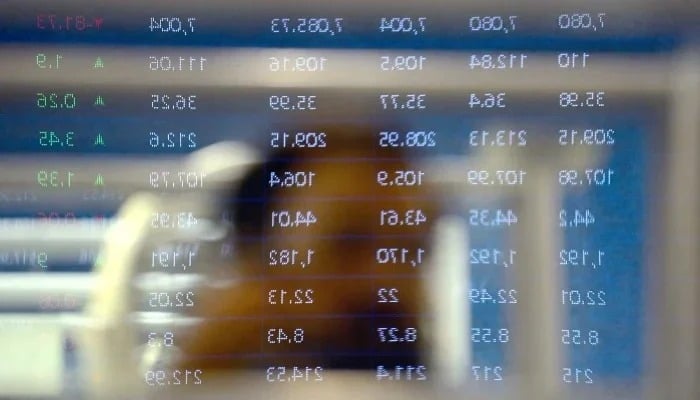
Pakistan's bourse extended its bull run on Friday, surging past the 179,000 mark for the first time as investors positioned ahead of next week's earnings and speculated on further State Bank of Pakistan (SBP) policy easing following a softer December Consumer Price Index (CPI) reading.
The benchmark KSE-100 Index gained 2,679.44 points, or 1.52%, to settle at 179,034.93 at market closing, from the previous closing of 176,355.49.
The bull run can be attributed to recent buying by local institutions on new allocations, with investor interest observed in the fertiliser sector, an analyst at Topline Securities said.
The ready market witnessed a trading volume of 1.11 billion shares with a traded value of Rs64.34 billion, the analyst added.
Market capitalisation increased to Rs20.21 trillion from Rs19.96 trillion a day earlier. Out of 484 active stocks, 253 advanced, 201 declined, while 30 remained unchanged.
Pakistan's inflation eased for a second straight month in December, raising hopes for further policy easing. The headline CPI inflation slowed to 5.6%, mainly on a sharp fall in perishable food prices; however, rising housing costs and sticky core inflation signalled lingering pressures.
CPI declined from 6.1% in November and 6.2% in October, but remained above 4.1% in December last year. On a month-on-month basis, consumer prices fell 0.4% in December, reversing a 0.4% increase in November.
The SBP cut its policy rate by 50 bps to 10.5% in December after four unchanged meetings at 11%.
Reserves and flows added to the constructive tone. The SBP said foreign-exchange reserves rose by $13 million to $15.915 billion in the week ended December 26, even as total liquid reserves edged down $10 million to $21.012 billion and commercial-bank reserves slipped $23 million to $5.097 billion.
Short-term local government bonds recorded a net $20 million foreign inflow in December versus $42.2 million of outflows in November; gross T-bill purchases were $77.29 million and divestments $57.27 million as of December 25.
Analysts noted that 2025 flows were weak in the first half amid geopolitics and competing yields, before stabilising in H2 as Pakistan’s risk premium eased and policy continuity improved.
The KSE-100 delivered a 51.2% total return in 2025. Data compiled by Zakheera show banks leading with a 103.8% total return (about 45% of index gains), followed by cement (88.1%), fertiliser (68.5%), power (62%), and chemicals (58.9%).
Textiles and technology rose 27% and 26.5%, respectively; food and autos were sub-20%; exploration and production gained 16.3%; pharmaceuticals and oil and gas were near 9%, while refineries ended flat.