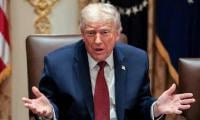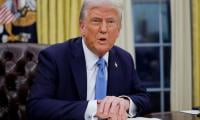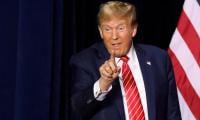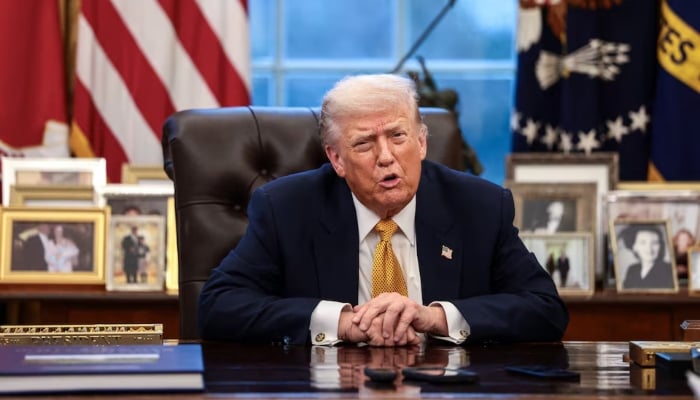
US President Donald Trump said Wednesday that he had been told that "executions" had stopped in Iran.
During an event at the White House, Trump said he had been told on "good authority" that the "killing in Iran is stopping. It's stopped...and there's no plan for executions," without providing further details.
Trump's comments during an Oval Office event come as fears have escalated in the Middle East that the United States could launch strikes on Iran, following the US president's repeated threats to intervene on behalf of protesters. He did not rule out possible US military intervention, however.
Some experts and regional diplomats warn that military intervention could backfire by smothering protests, fueling an intensified crackdown on those who participated and triggering retaliatory Iranian missile attacks on US bases in the Middle East.
In a more extreme scenario, several said, US strikes might hasten the government’s collapse, possibly unleashing chaos across the nation of 90 million, encouraging insurgencies by minority Kurdish and Baluch separatists and leaving Iran’s nuclear and missile programs unsecured.
Still, several US intelligence assessments earlier this week concluded that while the protests posed a serious challenge, the government did not appear close to collapsing, according to four knowledgeable sources.
“We have restive ethnic minorities. We have loose undeclared fissile materials. We have dispersed missile stocks with no command and control, and we have had for over a decade refugee flows ... and significant atrocities are happening,” said Behnam Ben Taleblu, an analyst with the Foundation for the Defense of Democracies. “All the fears that would come with regime change would be expedited.”
Meanwhile, Iranian Foreign Minister Abbas Araqchi said "there is no plan" by Iran to hang people, when asked about the anti-government protests in the Middle Eastern nation.
"There is no plan for hanging at all," the foreign minister told Fox News in an interview on the "Special Report with Bret Baier" show. "Hanging is out of the question," he said.
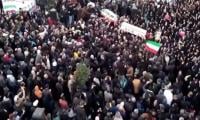
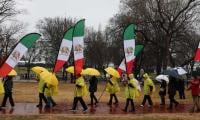
The protests appear to be the biggest domestic challenge Iran’s clerical establishment has faced since it took power in the 1979 Islamic Revolution, with massive crowds demanding the government’s ouster and clashing with security forces.
An Iranian official has said more than 2,000 people have died since the protests erupted on December 28. A rights group put the number of deaths at more than 2,600. Many experts believe the toll is much higher.
The White House and the Iranian delegation to the United Nations did not immediately respond to a request for comment.
Trump on Wednesday said "very important sources on the other side" had reported that killings in Iran's crackdown were subsiding, and that he believed there was currently no plan for large-scale executions.
He did not rule out potential US military action, saying "we are going to watch what the process is" before noting the US administration received a "very good statement" from Iran.
Gulf Arab governments “are freaking out” over possible US strikes, said a regional diplomat, speaking on condition of anonymity. “In every conversation they are having with the Americans and Iranians, (the Gulf governments) have been asking them to calm down.”
Trump's earlier warnings of intervention assumed fresh weight on Wednesday as the US began withdrawing some personnel in the region after a senior Iranian official said neighboring countries had been told that American bases would be struck in retaliation.
Not everyone expressed concern over possible US strikes.
Abdullah Mohtadi, the leader of the Komala Party of Iranian Kurdistan, a leading Kurdish party that advocates a secular democracy, dismissed the threat of separatism and said only significant US strikes can halt widespread killings of protesters by the security forces.
"The chaos is already there. The most important thing is to stop the massacre of people," said Mohtadi, who lives in exile in London, adding that he believes opposition groups could work together to replace the theocratic government with democratic rule.
Trump, who ordered strikes on three Iranian nuclear sites in June during a 12-day war between Israel and Iran, has declined to reveal what action he would take.
One source said that Trump aides have been reviewing a range of options, including limited strikes on symbolic military targets.
Some experts said that with his repeated vows to act, Trump may have left himself little choice but to intervene should the security forces pursue their harsh crackdown.
Otherwise, they said, he risks losing credibility.
The key question, said Taleblu, is what targets would be hit.
“The nature of the target can impact the next round of protests or dampen them altogether if the population senses that Washington’s strikes are merely symbolic … and will have no meaningful impact on the security forces,” he said.
Trump could have a greater impact by interrupting Iran's cash flows and waging cyber-attacks, giving the protests more time to play out, said Jon Alterman of the Center for Strategic and International Studies think tank.
"A military action would make everyone expect an instant result or complain it wasn’t working," he said.
Trump has been intent on keeping up pressure on Iran after strikes on its nuclear sites in June, a White House official said. His campaign against Tehran, including both actions and the latest rhetoric, is also intended to show US adversaries that he is not shy about using US military might, the official said, citing the attack on Venezuela that toppled the country's authoritarian leader Nicolas Maduro in early January.