_akhbar.jpg)
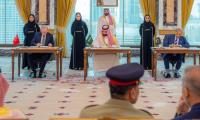
KARACHI: The defence pact signed by Pakistan, Saudi Arabia and Turkiye on Friday is being viewed by former diplomats and foreign policy experts as an early step towards a regional security architecture increasingly shaped by Middle Eastern powers rather than external guarantors.
While experts differ on how quickly the arrangement can evolve into a meaningful military framework, there is broad agreement that the pact reflects changing geopolitical realities following the Iran-US war and growing doubts within the Gulf over the reliability of traditional security arrangements.
Former permanent representative to the UN Munir Akram sees the agreement as a response to those changing realities.
“This is the foundation of an alternate security architecture for the region because the present one -- in which America is dominant -- has not worked for West Asia, particularly Saudi Arabia”, Akram says.
Former ambassador Asif Durrani echoes that assessment, describing the agreement as “a precursor to the new security architecture that the West Asian countries are discussing after the Iran-US war”.
Veteran diplomat Javid Husain also believes the significance of Friday’s announcement extends beyond the trilateral arrangement itself: “This is both a watershed regional security agreement and a political signal of mutual solidarity to potential aggressors”.
Former ambassador Touqir Hussain, however, offers a more cautious assessment, arguing that the pact remains in an “embryonic stage” whose eventual trajectory will depend on how the post-war Middle East evolves. “Who are the eventual winners and losers? What are the new security challenges?”, he explains. According to him, Saudi Arabia appears to be constructing “a web of overlapping alliances and coalitions to see what works and what does not”, with the new agreement fitting into that broader strategy. While the American security connection “will remain indispensable”, he argues, it is unlikely to remain exclusive as Gulf countries diversify their strategic partnerships.
Journalist Iftikhar Firdous similarly argues that the agreement should be viewed as part of a broader geopolitical transition rather than its starting point. According to him, “the emerging defence cooperation among the three countries is a consequence, rather than the cause. It reflects deeper geopolitical shifts already underway.” He says the pact signals both a perceived need for a regional security umbrella and an opportunity to expand that framework further, but argues that “it will be important that there are tangible next steps that will bring in more countries under its cover”.
That changing regional landscape is also highlighted by Raza Rumi, editor of The Friday Times-Naya Daur, who says the agreement “represents a significant shift at a time when the region has experienced wars, missile and drone attacks, and growing uncertainty about the durability of existing security guarantees”.
Despite the optimism, most experts caution against comparing the arrangement to Nato. Hussain says, “One thing remains very clear amid the much ambiguity that surrounds the agreement. It will not become an Islamic Nato”.
Instead, he believes each member has entered the arrangement for different strategic reasons and that Saudi Arabia will ultimately determine how the framework develops.
Rumi similarly says that declaring collective defence is only the first step, cautioning that “we still do not know the precise obligations each country has accepted or how rapidly they would respond in a crisis”. According to him, the next phase would need to include “joint military planning and exercises, intelligence-sharing, interoperability, air and missile defence cooperation and defence production”.
Javid Husain agrees that the absence of an integrated command structure limits the pact’s immediate military value. Per him, “The effectiveness of the agreement will be limited in practical terms in the absence of a permanent command or integrated force. However, it would still act as a deterrent against a potential aggressor”.
Analysts largely see the agreement as strengthening Pakistan’s strategic relevance while also creating new economic opportunities. Durrani says Pakistan’s gains are “obvious from a diplomatic, political and economic point of view”, pointing to opportunities for investment in defence technology, trade and broader economic cooperation. Husain likewise believes the arrangement will strengthen Pakistan’s security by enhancing defence and economic cooperation with other member states.
Rumi argues that the agreement reinforces Pakistan’s emergence as a security actor extending beyond South Asia, adding that cooperation in drones, missiles, naval systems, air defence, training and co-production could allow Pakistan to translate its military capabilities into greater diplomatic and economic leverage.
Akram similarly believes the arrangement could broaden over time. He says other countries could also associate themselves with the arrangement, “like Kuwait with which Pakistan already has a defence treaty. It is likely that Qatar and possibly Bahrain could also be part of it”, noting that the UAE remains “a question mark” because of its ties with Israel and India.
A recurring theme in the expert responses is the need to reassure Iran, with analysts saying Islamabad must balance its close ties with Riyadh and Ankara against its longstanding relationship with Tehran.
Akram argues that concerns in Tehran can be addressed. “As far as Iran is concerned, I think any critic there should be reminded that when we concluded the defence pact with Saudi Arabia, President Pezeshkian welcomed it and reminded us that Iran had proposed a regional security arrangement”. He adds that the three countries remain open to normal relations with Iran and believes “it would be much easier for Iran to develop a normalised relationship with Gulf countries through such a security architecture than through negotiations with an American-led association”.
Durrani is equally dismissive of suggestions that Tehran should oppose the agreement: “Iran had welcomed the Pakistan-Saudi strategic defence agreement. It shouldn’t have problems with the trilateral agreement. In any case, it is not aimed at Iran”. He suggests that “ideally, Iran should also join the pact to make it more effective”.
Husain also stresses that “we will have to assure Iran through diplomatic channels that this agreement does not pose any threat to it”, adding that Iran should eventually be invited to join a wider regional arrangement.
Touqir Hussain, however, identifies Pakistan’s balancing act as one of the key strategic challenges ahead. “For Pakistan, there is a risk, though, of getting entangled in intra-Arab rivalries and caught in the Arab-Iran crossfire”, he warns.
Analysts also believe the agreement is unlikely to undermine US interests in the region.
Durrani expects Washington to “react positively, as the move is aimed at the region’s stability”, though he cautions that much will depend on “President Trump’s maverick style of governance in international affairs”. Touqir Hussain similarly notes that all three countries maintain close relations with Washington and are “not likely to become part of a security arrangement which challenges fundamental US interests in the region”.
Rumi goes a step further, arguing that “without Washington’s nod, this would not have materialised”, adding that Islamabad will need to show that the arrangement “is intended to deter aggression rather than create new blocs or confrontations”.