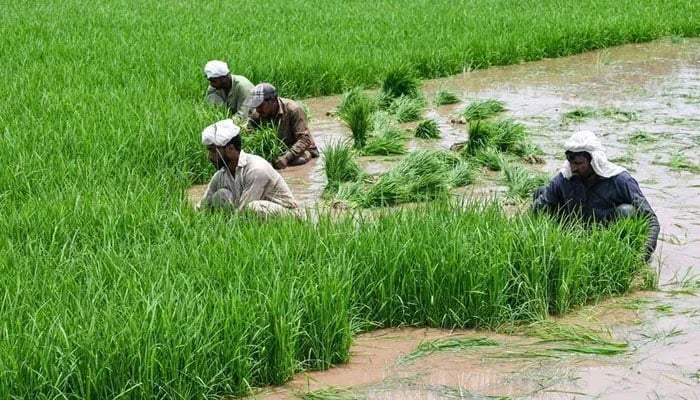
Islamabad:Pakistan has been ranked the 14th most water-stressed nation globally, presenting a critical threat to the country’s agriculture, food security and overall economic stability, according to a fresh research report.
The study, titled “Sustainable Agriculture in Pakistan: Can Pakistan Meet Its Future Food Requirements?” cautions against blaming climate change entirely for the country's ongoing agricultural crisis.
Instead, the authors argue that decades of weak governance, policy failures, and inefficient practices have significantly intensified the damage caused by natural disasters like floods, droughts, and heatwaves.
Agriculture remains the foundational backbone of the Pakistani economy, generating roughly 24 percent of the gross domestic product (GDP) and employing more than 37 percent of the national workforce. While the sector sustains the food and livelihood requirements of a population exceeding 240 million people, it is currently operating under unprecedented strain.
A primary driver of this crisis is the steady collapse of renewable freshwater availability per capita. Water availability has plummeted below the critical threshold of 1,000 cubic meters, signaling severe water scarcity.
This shortage is compounded by a heavy structural dependency, as nearly 90 percent of the nation's agriculture relies entirely on the Indus Basin irrigation system. Environmental pressures are accelerating these vulnerabilities. Rising temperatures, erratic monsoon patterns, prolonged dry spells, and recurring floods are actively driving down crop yields.
These shifting climate patterns have also triggered an increase in pest attacks, placing severe financial distress on local farmers. Furthermore, the report notes that widespread unsustainable farming practices -- including over-irrigation, continuous monocropping, and an over-reliance on chemical fertilizers and pesticides -- are actively degrading soil fertility and damaging the surrounding environment.
Rather than drafting new legislation, the report emphasizes that the path forward lies in the rigorous enforcement of existing frameworks. Initiatives such as the National Climate Change Policy, the National Food Security Policy, the Recharge Pakistan programme, and the Green Taxonomy framework are already established but currently suffer from weak implementation.
To reverse the decline, the research underscores the need for modernizing irrigation infrastructure, restoring degraded land, expanding advisory services, and introducing climate-smart financial facilities for farmers.
It also calls for robust collaboration among the government, academic institutions, and the private sector, alongside increased investment in agricultural extension services to equip farmers with better technology and guidance.