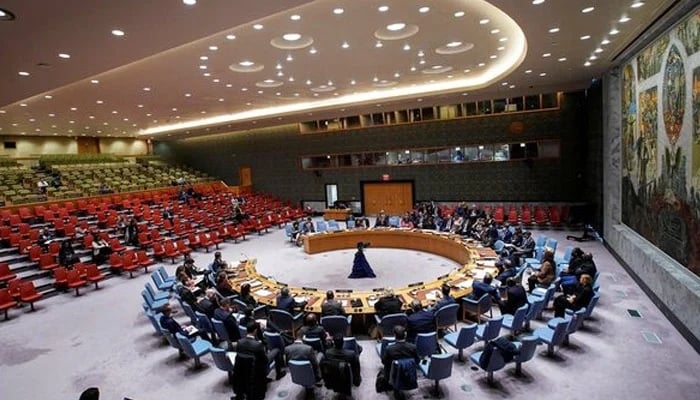
ISLAMABAD: Pakistan and China on Thursday co-organised the UN Security Council Arria-Formula Meeting on “Bridging the Implementation Gap: Security Council Resolutions and the Maintenance of International Peace and Security,” at the United Nations Security Council (UNSC).
Both the countries called for stronger mechanisms to ensure the implementation of UNSC resolutions, arguing that selective or prolonged non-implementation undermined the council’s credibility, weakened its authority, and prolonged unresolved conflicts, including those in Jammu and Kashmir and Palestine.
Pakistan’s Permanent Representative to the UN Ambassador Asim Iftikhar Ahmad said the UNSC resolutions were “not mere expressions of intent but legal obligations under the UN Charter.”
“This informal meeting provided a platform for the member states to discuss how the council can ensure the full, effective and non-selective implementation of its resolutions,” the Foreign Office said.
UN Assistant Secretary-General Khaled Khiari, UNSC Report Executive Director Shamala Kandiah and Richard Gowan of the International Crisis Group briefed the meeting.
They “emphasised that implementation lies at the heart of the Council’s credibility, authority and effectiveness”, the Foreign Office said.
The speakers stressed that UN resolutions must be accompanied by “realistic mandates, clear implementation pathways, sustained reporting, adequate resources, political will and follow-up mechanisms”. The member states stressed that the UNSC’s decisions should be realistic, actionable and supported by sustained diplomacy, calling for regular reviews, timely reporting and adequate resources.
“By jointly convening this timely discussion, China and Pakistan reaffirmed their shared commitment to multilateralism, the authority of the Security Council, and the purposes and principles of the UN Charter,” the FO noted.
Ambassador Ahmad “underscored that selective or prolonged non-implementation weakens the Council’s authority, prolongs unresolved disputes and deepens human suffering, including in situations such as Indian Illegally Occupied Jammu and Kashmir and Palestine”, added the statement.
He said that non-implementation of UN resolutions on the Jammu and Kashmir issue has led to the conflict remaining unresolved and caused prolonged human suffering for the Kashmiri people.
In the meeting, “Pakistan also proposed practical measures, including an annual review of unimplemented and partially implemented resolutions, clearer implementation pathways, stronger follow-up”, as well as better alignment of peace operations and regional arrangements with council decisions.
The FO further said that the council members and UN members participating in the meeting welcomed the initiative by China and Pakistan, sharing “concrete perspectives on strengthening the implementation of Security Council resolutions across country-specific and thematic situations”.
Meanwhile, at the UNSC, Pakistan raised its voice for the most vulnerable victims of armed conflict – children -- who bear its deepest and most enduring scars.
The rapid surge in armed conflicts all over the world has exposed them to a host of grave violations ranging from killing and maiming, and attacks on schools and to denial of humanitarian access.
It is appalling that more than 12,000 incidences of grave violations occurred only in one year against children in the Occupied Palestinian Territory.
Pakistan underscored the need for concrete measures to safeguard children, including by vigilant oversight and ending impunity for violators; protection of schools from attacks and military use; and reinforcement of safe education systems in conflict zones.
Compliance must be ensured with International Humanitarian Law, Convention on the Rights of Child and the principles of international law. Sustained investment in rehabilitation, reintegration and psycho-social support programmes, is equally essential to restore dignity, rebuild futures, and prevent cycles of re-recruitment.