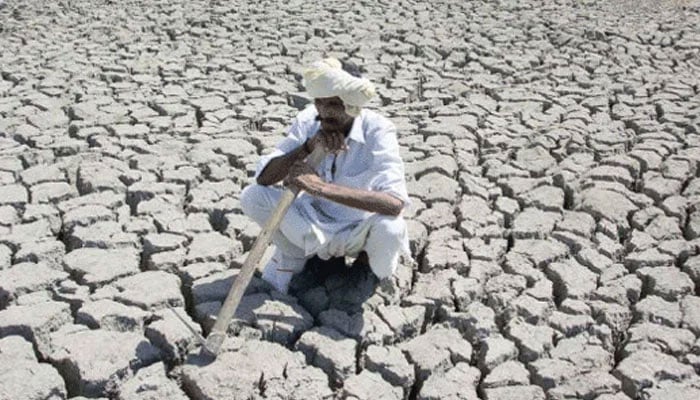
Extreme hot weather and water shortages are taking a heavy toll on agricultural sector with farmers in Sindh’s lower riparian areas reporting significant losses in key cash crops including chilli, cotton and sugar cane.
Sindh, which produces the majority of Pakistan’s chilli crop and is a major contributor to the country’s sugar cane and cotton production, is facing increasing challenges due to climate change and declining water availability.
The district of Umerkot, particularly Kunri, accounts for nearly 80 per cent of Pakistan’s chilli production. Kunri is renowned for producing the country’s famous red chilli.
Farmers say rising temperatures and chronic water shortages have made cultivation increasingly difficult, threatening both crop yields and rural livelihoods.
“We cultivate mostly chilies, which require irrigation every three to four days. Unfortunately, because our area lies at the tail-end of the irrigation system, we face severe water shortages,” said farmer Ghulam Akbar Dars. “As temperatures continue to rise, these difficulties have become even more intense.”
Dars explained that soaring agricultural input costs, combined with prolonged heatwaves and lack of water, were placing immense pressure on farmers.
“Heatwaves and water scarcity can cause devastating damage to crops, significantly reducing yields and, in some cases, leading to complete crop failure,” he said.
The farmer added that the stress caused by extreme heat also made crops more vulnerable to diseases. Farmers were going through a very difficult period and struggling to sustain their livelihoods, he lamented.
Another farmer Mian Saleem said chilli was one of the main cash crops of their region and an important source of income for local communities, however, increasing heat stress, declining water availability and changing climate conditions were putting its future at serious risk.
He said that during the current season, the chilli crop’s condition was extremely worrying and the only hope for the farmers was rainfall.
If it rained significantly, the damaged crops may recover and come back to life, Saleem said.
However, he feared that if the expected rains did not come during June, the losses would be severe, and the chilli crop and farmers would suffer greatly as a result.
The impact of climate change and water scarcity is not limited to chillies. “Sugar cane, which is widely cultivated in our area, is also drying out because of the extreme heat and lack of water. Cotton crops are facing similar challenges. The ongoing heat wave and water shortage are causing serious damage across the agricultural sector,” said Saleem.
Chilli is one of Pakistan’s most valuable cash crops generating an estimated 114,000 to 143,000 tonnes annually. Agricultural experts warn that rising temperatures are already affecting crop productivity.
“If temperatures remain high, there will be increased fruit shedding and reduced fruit formation,” said Syed Mahmood Nawaz Shah, president of the Sindh Abadgar Board. “Plants may survive, but they will not be healthy, and yields will decline.”
He noted that chilli cultivation, traditionally carried out between May and June, had become increasingly difficult due to extreme weather conditions.
“With higher temperatures and the use of hybrid seeds, the challenge has become more severe. Plants lose productivity and fail to achieve their expected yield potential,” he said.
Farmers are calling for practical solutions, improved technologies and climate-resilient farming methods to help conserve water and reduce the impact of extreme heat.
“If the situation continues to worsen, farmers may be forced either to abandon chilli cultivation or shift agricultural production to other areas,” Dars warned.
Traders are also expressing concern over the declining quality of chilli crops.
“Water shortages and extreme heat directly affect the quality of our produce,” said chilli trader Mukhi Yudhister.
“When crops do not receive enough water, their quality declines significantly. If we cannot produce high-quality crops, it becomes difficult to sell them in larger markets or export them.”
Yudhister emphasised that addressing water scarcity must be the government’s top priority.
“Everything begins with water. The entire agricultural system depends on it. When water is scarce, yields decline, quality deteriorates and farmers struggle to earn a living,” he said. “Without adequate water, it becomes increasingly difficult to sustain farming and support our families.”
Kunri’s red chilli, famous for its distinctive flavour and quality, has long been a symbol of Sindh’s agricultural strength. However, experts warn that if climate change continues to alter the region’s environment and water resources, this iconic crop could face an uncertain future.
With heatwaves becoming more frequent and water shortages worsening in riparian areas, farmers fear that without urgent intervention, one of the country’s most important agricultural regions could face lasting damage.
It is pertinent to mention that a major opposition parties alliance - Tehreek Tahaffuz-i-Ayeen Pakistan (TTAP) — has also criticised the federal government’s financial, water policies and controversial water projects affecting Sindh.
TTAP leaders have said Sindh was already facing acute water shortages, degradation of the Indus delta and an agricultural crisis, and that any additional projects affecting downstream water flows would inflict irreparable damage on the province’s economy and farming sector.