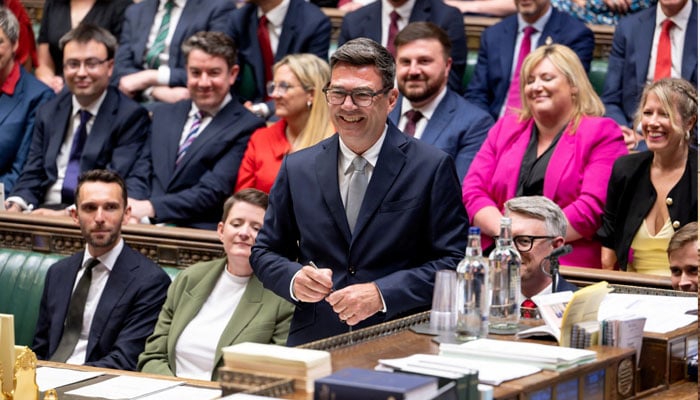
LONDON: The man who appears destined to be Britain´s next Labour prime minister received a hero´s welcome in parliament on Monday, after incumbent Keir Starmer stood announced his resignation.
Veteran politician Andy Burnham, fresh from his UK by-election victory last week, was sworn in as an MP. Afterwards he greeted supporters in parliament´s medieval Westminster Hall with a fist pump and snapped a selfie in front of a group of around 200 Labour colleagues.
The newly-elected MP was clapped by fellow Labour lawmakers including Wes Streeting, a former minister seen until earlier on Monday as his main rival for the premiership. One MP heckled him shouting “he´s not the messiah”.
It was all another step towards Burnham´s long-held dream of moving into No 10 Downing Street and leading his party, with everything pointing to it being third time lucky. Seen as representing the Labour party´s “soft left” and a pro-business socialist, Burnham has twice sought the party leadership, losing out to Ed Miliband in 2010 and Jeremy Corbyn in 2015.
He first entered parliament in 2001, and held senior cabinet posts under prime ministers Tony Blair and Gordon Brown. He quit parliament in 2017 to run for mayor of Greater Manchester, where three successive election victories and his staunch defence of the region have earned him the nickname “King of the North”.
He has described his campaign to return as MP and challenge Starmer as “a final chance to change” the Labour party.Burnham was born in Liverpool, where his father worked as a telephone engineer and his mother a receptionist. He won a place to study English at the University of Cambridge and after graduating, took a familiar path to political prominence, first as a researcher and then adviser in parliament.
He first served as a junior minister under former prime minister Tony Blair, and later culture secretary and health secretary under Gordon Brown. Now 56, the loyal Everton football fan enjoyed the “Madchester” party music scene of the late 1980s and early 1990s.He joined the Labour party as a young teenager before studying English at the University of Cambridge, where he said he often struggled with “imposter syndrome” because of his working-class background.