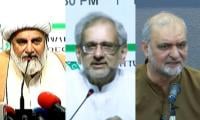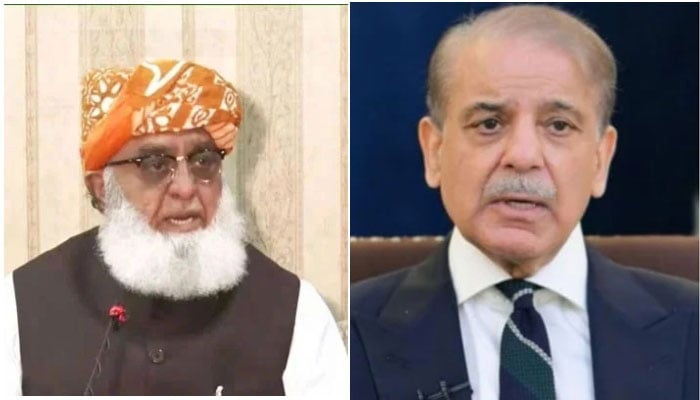
ISLAMABAD: Jamiat Ulema-e-Islam Fazl (JUIF) chief Maulana Fazlur Rehman on Monday welcomed Prime Minister Shehbaz Sharif’s proposal for a renewed Charter of Democracy (CoD), urging political forces to move towards a fresh consensus framework to ease mounting political tensions in the country.
Taking part in the budget debate in the National Assembly, he said the prime minister’s call for a Charter of Democracy should be taken forward in the larger national interest. “The prime minister has spoken about the Charter of Democracy, so let us move forward,” he said, stressing that political dialogue and reconciliation were essential for restoring stability.
The JUIF chief observed that the level of confrontation between the government and Pakistan Tehreek-e-Insaf (PTI) was unprecedented. Drawing a parallel with the political rivalry between former prime ministers Nawaz Sharif and Benazir Bhutto, he noted that despite their differences, both leaders ultimately reached an understanding that culminated in the signing of the Charter of Democracy.
Fazl reiterated his demand for the release of PTI founder Imran Khan, arguing that such a step could help create an atmosphere conducive to dialogue and national harmony. “If political tensions can be reduced through his release, then that option should be considered,” he said. Referring to recent efforts to improve relations between JUIF and PTI despite longstanding differences, he urged the government to adopt a similar approach and engage its political opponents through dialogue.
The veteran politician recalled that although he was not among the original signatories to the Charter of Democracy, he later endorsed its principles through seminars and political discussions, helping transform it into a broader consensus document.
He said the charter had envisaged democratic norms under which governments would not be destabilised through non-democratic means and the opposition would play a constructive role within the parliamentary system. “Unfortunately, those principles have steadily eroded,” he remarked.
Turning to foreign policy, Fazlur Rehman said that if Pakistan supported diplomatic efforts aimed at reducing tensions between the United States and Iran, a similar approach should be adopted towards Afghanistan. “A strong Pakistan requires a strong and stable neighbour,” he said.
The JUIF chief also voiced concern over lawlessness, unemployment and economic hardship in various parts of the country, alleging that ordinary citizens continued to face severe challenges while economic issues remained unresolved.
Referring to the government’s commitment to economic reforms, he questioned progress towards eliminating the interest-based banking system by January 1, 2028, as envisaged under constitutional arrangements.
Fazlur Rehman further expressed regret over what he described as the censorship of opposition speeches during the ongoing budget session, saying that parliamentary debate should remain free and open in a democratic system.
JUIF lawmaker Noor Alam Khan said Defence Minister Khawaja Asif’s assertion that there was no national consensus on terrorism did not reflect the ground realities, arguing that the entire Pashtun nation stood united against the menace.
Participating in the budget debate in the National Assembly, Noor Alam said the people of Khyber Pakhtunkhwa, alongside the armed forces and police, were making immense sacrifices in the fight against terrorism.
“In Khyber-Pakhtunkhwa, not only the military but also the police and ordinary citizens are fighting terrorism. Our people have rendered countless sacrifices. What more are they expected to do?” he asked.
Criticising the federal budget, he termed it an “IMF budget” and accused the Federal Board of Revenue (FBR) of poor performance. He alleged that the government’s economic policies disproportionately burdened low-income groups.
“The finance minister only knows how to squeeze the poor. Electricity and petroleum prices continue to rise, while independent power producers (IPPs) have benefited,” he said. Opposition member Shehram Khan Tarakai also criticised the government’s economic narrative, questioning official poverty benchmarks. Referring to remarks by the finance minister regarding the poverty line, he said the reality on the ground painted a far grimmer picture.
“A bottle of mineral water and a cup of coffee cost more than the amount cited. A poor person today cannot even afford one proper meal a day,” Tarakai said. Meanwhile, MNA Fatahullah Khan highlighted the lack of development initiatives in South Punjab and complained of persistent electricity supply issues in the region.
He further expressed concern over the growing vulnerability of young people in South Punjab to extremist influences, warning that increasing incidents of Talibanisation among the youth required urgent attention from policymakers.
Adds Saleh Zaafir: The National Assembly will pass the national budget before the 24th of June and the house would be adjourned sine die the same day. Highly placed parliamentary sources told The News/Jang here Monday evening that the upper house of the Parliament, Senate, would formulate its recommendations for the budget proposals in the middle of this week and transmit the same to the NA on the day of their receipt.
The National Assembly commenced it current (28th session) on June 10, and it is viewed as the briefest budget session of the NA in recent years. Speaker Sardar Ayaz Sadiq has decided that despite shortage of time, the house would be allocated 40-hour debate on budget so that all aspects of the budget and economy could be discussed by the members. The treasury and opposition benches have been given equal time for debate.
The sources said that if the opposition opted not to put up cut motions in large numbers during the adoption of the proposals and grants, the session could be prorogued a day earlier on June 23. The speaker is of the view that the members should return to their respective constituencies during the Ashura Muharram days.
He is holding the session even on official holidays to provide the opportunity to the members to articulate their views about budget and grievances of their constituencies in maximum number, the sources added.