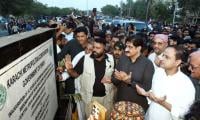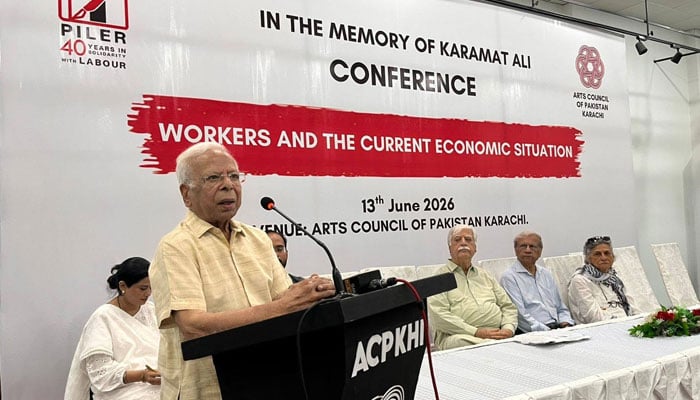
Speakers at a conference organised by the Pakistan Institute of Labour Education and Research (Piler) on Saturday called for the government to treat climate change as a labour crisis and demanded that the federal budget reflect the disproportionate burden the climate emergency placed on the working class.
The conference was held in memory of Piler founder Karamat Ali at Haseena Moeen Hall of the Arts Council of Pakistan under the theme ‘Workers and the Current Economic Situation’.
Addressing the occasion, former State Bank of Pakistan governor Dr Ishrat Husain warned that Pakistan’s informal sector — estimated to be 80 to 85 per cent of the economy — remained entirely outside the protection of climate or social policy.
“Manufacturing is being outsourced, the gig economy is expanding, and food delivery and ride-hailing workers are multiplying — yet none of this is captured in our budgetary frameworks,” he said.
Dr Husain pointed to deepening income inequality as a structural threat, noting that rising billionaire wealth in South Asia coexists with mass poverty in regions such as Bihar and Uttar Pradesh. “This inequality is a snake venom for social cohesion,” he said.
Piler Director Abbas Haider raised alarm over the recently proposed Sindh Labour Code, which, he said, was effectively stripping workers of hard-won rights through redefinition of key terms. He also highlighted research conducted by Piler in Karachi’s industrial areas showing that power load-shedding in working-class neighbourhoods had increased domestic violence and deepened economic precarity for daily-wage earners.
Haider also drew attention to the 2012 Baldia factory fire, in which 259 workers perished, and held employers and government agencies responsible for the tragedy, saying their criminal neglect of workplace safety caused the deaths.
He added that weak prosecution left the workers without justice and sent a dangerous signal that corporate and state impunity for safety failures would go unpunished. Architect and urban planner Arif Hasan, the guest of honour, told the audience that climate adaptation required structural changes at the household and community level.
He recommended practical heat mitigation measures including cross-ventilation, insulated roofing and reflective wall coatings as low-cost interventions for working-class localities. “The heat wave challenge can be solved,” he said, “but it requires research, root-level finding, and practical work.”
Human Rights Commission of Pakistan (HRCP) Chairperson Asad Iqbal Butt expressed concern over the broader human rights environment, describing enforced disappearances as Pakistan’s most critical ongoing crisis.
He lamented that while laws existed on paper covering forced conversions, child marriages and honour killings, their implementation remained negligible. Historian Dr Jaffar Ahmed, speaking on the constitutional vision of Karamat Ali, said the labour leader had focused his life’s work on three pillars: raising awareness of existing rights, ensuring their implementation and securing constitutional reforms to extend protections to women, children and informal workers.
He urged the labour movement to gather its disintegrated forces. Trade union leader Abdul Latif Nizamani called for the revival of the Pakistan Labour Council as a unified platform to carry forward Ali’s organisational legacy.
Women Action Forum leader Mahnaz Rahman said progress on labour rights was inseparable from gender justice, arguing that women’s issues must be brought fully under the ambit of working-class struggles.
Artist and activist Sheema Kermani, recalling the 1972 Feroz Textile Movement in which three workers were killed in police firing, criticised the erasure of women’s leadership from labour movement history.
Economist Qaiser Bengali noted that Ali had begun resisting injustice at the age of 10 and built a training infrastructure that gave trade unionists tools to negotiate with governments, businesses and courts alike.