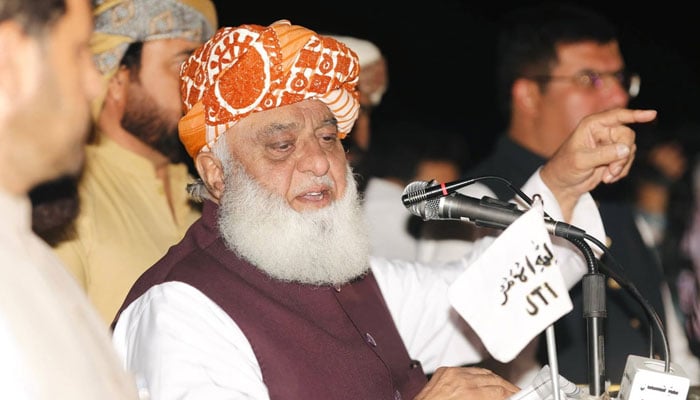
Quetta: Emir Jamiat Ulema-e-Islam (JUIF) Maulana Fazlur Rehman said that his party has fought to unite the nation against sectarianism and ethnic divisions.
He stated that despite repeated military operations against terrorism, the problem has continued to grow. He criticised border closures, saying they have severely damaged the country’s economy, and argued that the establishment, bureaucracy, and an unsuccessful foreign policy have left Pakistan isolated.
He vowed that his party would foil any attempts to recognise Israel. Expressing concern over the Pakistan Peoples Party’s silence regarding the protection of the Constitution and the 18th Amendment, he said JUIF would ensure the protection of the Constitution drafted under Zulfikar Ali Bhutto and would not allow even an inch of Baloch or Pashtun land to be occupied.
He also criticised the government for failing to run public schools effectively while imposing restrictions on religious seminaries (madrasas). He reiterated that his party does not accept what it considers “rigged assemblies” and called for major Islamic countries to form a strong united bloc. He further stated that the outdated practice of labeling patriotic citizens as traitors simply because they disagree with the establishment must come to an end.
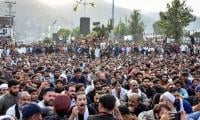
He expressed these views while addressing the ‘Rights of Balochistan and Protection of Madrasas Conference’ in Pishin on Thursday.
Maulana Fazlur Rehman said that the massive gathering in Pishin reflected the people’s growing confidence in the party. He stated that no power in the world could break the bond between JUIF and its supporters and that this relationship would continue to strengthen.
He described JUIF as an “impregnable fortress” that could never be defeated.
He praised party workers and supporters who traveled long distances despite unfavorable conditions and government obstacles to attend the event. He emphasised that JUIF is not merely a political party but a great movement with a proud history spanning more than 200 years of struggle and sacrifice.
According to him, this movement would continue advancing towards its goals and ultimate destination.
He highlighted JUIF’s role in Pakistan’s constitutional history, saying that although Pakistan was created in the name of Islam, it took a long time for the country to receive a constitution. He claimed that JUIF played a key role in helping provide Pakistan with a unanimous Islamic constitution. He said that as a result, Islam was established as a state system and that all legislation in Pakistan must conform to the teachings of the Quran and Sunnah, with no laws contrary to them being permissible.
He claimed that JUIF has worked to eliminate sectarianism and ethnic hatred and has opposed divisive politics based on provincialism, ethnicity, language, regionalism, and sectarian identity. He accused elements within the bureaucracy and establishment of creating divisions among communities in order to maintain control.
Criticising state institutions, he said that if they were truly innocent, they would deserve praise, but where policies were wrong, criticism would continue. He stressed that JUIF would never accept pressure from the bureaucracy or the establishment when it conflicted with the interests of the people and the country.
Discussing security issues, he noted that Pakistan has been fighting terrorism for four decades and referred to military operations conducted from Swat to various parts of Khyber Pakhtunkhwa. He argued that despite these efforts, terrorism continued to worsen, causing significant damage to the country and creating public frustration.
He reiterated his opposition to any move towards recognising Israel and argued that Pakistan possesses all the resources and capabilities needed to solve its problems, provided that the country’s leadership demonstrates sufficient determination and political will.
He called on major Muslim countries — including Pakistan, Saudi Arabia, Egypt, Turkey, Iran, Indonesia, and Malaysia — to establish a strong Islamic bloc that could lead broader Asian cooperation.
. Referring to the 18th Constitutional Amendment and provincial autonomy, he questioned why the Pakistan People’s Party appeared reluctant to defend these principles and accused it of compromising on provincial rights.