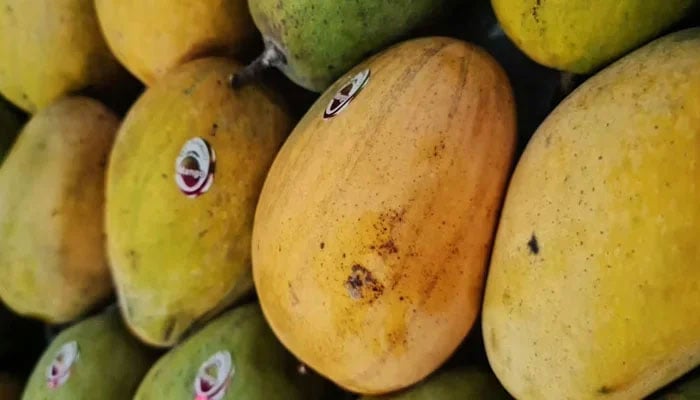
MULTAN: The ongoing crisis in the Middle East and climate-related challenges have pushed Pakistan’s mango export sector into difficulty, forcing exporters to significantly reduce their export targets for the current season, industry stakeholders said.
The mango export season commenced on June 1, but exporters fear a substantial decline in shipments due to regional instability, unfavourable weather conditions, lower fruit yields and rising transportation costs. Patron-in-Chief Pakistan Fruit and Vegetable Exporters, Importers and Merchants Association (PFVA) Mian Waheed Ahmed told journalists that Pakistan’s mango export season has begun under mounting pressure from geopolitical tensions in the Middle East, soaring freight charges, climate-related disruptions and declining production.
As a result, exporters have revised this year’s export target downward by nearly 30 per cent. The first consignments of Pakistani mangoes are scheduled to reach international markets this month, but industry stakeholders fear one of the most challenging export seasons in recent years. Exporters are facing unprecedented logistical and financial difficulties as instability in the region disrupts access to key Gulf markets, which remain the largest destination for Pakistani mangoes. In view of these extraordinary challenges, the export target has been reduced to 80,000 tonnes from last year’s 110,000 tonnes. The decline is expected to significantly impact export earnings. Pakistan earned approximately $110 million from mango exports last season, but revenues this year are projected to fall between $75 million and $80 million.
The Gulf region, which accounts for nearly 35 percent of Pakistan’s mango exports, is expected to be among the hardest-hit markets due to the fallout from escalating tensions involving Iran and the wider Middle East. The crisis has triggered a sharp increase in transportation costs, further squeezing exporters already burdened by rising production expenses. Sea freight charges to Gulf destinations have surged from $1,200-$1,400 per container last season to as much as $6,000-$7,000 this year. Air freight rates have also more than doubled, rising from 70-90 cents per kilogram to nearly $2 per kilogram. Mian Waheed Ahmed said the burden has been compounded by increasing domestic fuel prices, which have raised transportation costs from orchards to packing facilities and ports.
He added that the relatively stronger Pakistani rupee has created another challenge for exporters. While operating costs continue to climb, export returns in local currency terms have declined, putting additional pressure on profitability.
Despite the difficult environment, the PFVA remains committed to maintaining Pakistan’s presence in both traditional and emerging export markets.
The association also expressed concern over the closure of trade routes through Afghanistan, warning that exports to Afghanistan and Central Asian countries could suffer as a result. However, Ahmed noted that exports to Iran could increase if both countries improve coordination on quarantine procedures and harmonize regulatory requirements. He praised the Ministry of Commerce and the Ministry of National Food Security for resisting pressure from vested interests seeking an earlier export season. By maintaining the June 1 export start date, the government has ensured that Pakistani mangoes reach international buyers fully matured, preserving the fruit’s renowned taste, aroma and quality.
Beyond trade-related challenges, Ahmed highlighted deeper structural issues facing the mango industry. Climate change, erratic weather patterns and the weak disease resistance of existing orchards have steadily eroded production over the past five years.
This year’s mango crop is expected to be around 20 per cent lower than the country’s average annual production of 1.9 million tonnes, raising concerns about the long-term sustainability of the sector. Calling for urgent action, Ahmed urged the government to invest in research and development, improve orchard management practices and support quality enhancement initiatives. He stressed that Pakistan has the potential to significantly increase mango exports if fruit quality is improved and growers receive better technical guidance. “Pakistan’s mango industry possesses enormous untapped potential, but realising it will require coordinated efforts by farmers, exporters and policymakers to address the challenges threatening one of the country’s most valuable horticultural exports,” he said. To achieve the revised export target of 80,000 tonnes, robust government support will be essential. With vessel schedules disrupted and shipping services severely affected by the regional crisis, timely intervention in freight facilitation, port clearance and diplomatic engagement with Gulf buyers is urgently needed.
Industry stakeholders warn that without coordinated efforts to address logistical bottlenecks, even the reduced export target may remain out of reach, further impacting Pakistan’s export earnings and global market share.