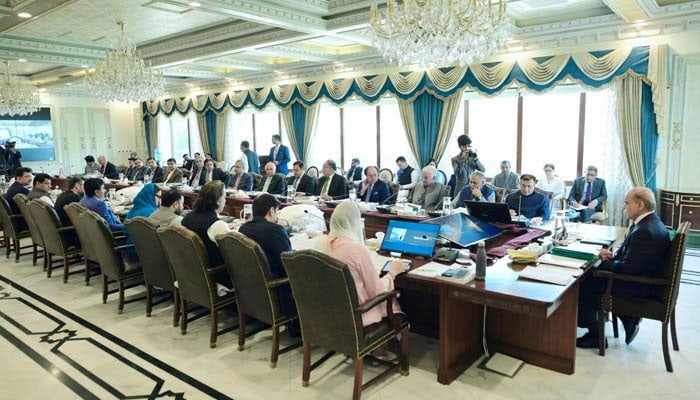
ISLAMABAD: With a national development outlay of over Rs4 trillion, the Annual Plan Coordination Committee (APCC) is all set to meet on Monday (today) to recommend the National Economic Council (NEC) macroeconomic framework for the Budget 2026-27, including a GDP growth rate of 4 percent and CPI-based inflation of 8.2 percent.
The NEC is scheduled to meet under the chairmanship of Prime Minister Shehbaz Sharif on June 3 to approve macroeconomic and national development outlay for the next budget.
The federal Public Sector Development Program (PSDP) has been envisaged at Rs1,126 billion, while the provincial Annual Development Plans (ADPs) will hover around Rs3 trillion, so the total national development outlay will be standing at Rs4 to Rs4.5 trillion in the upcoming budget.
The working paper for the APCC illustrates that the ongoing conflict in the Middle East has emerged as a significant external risk to both the global economy and emerging economies.
Before the conflict, the IMF had projected global growth of 3.3 percent in 2026 and 3.2 percent in 2027. However, the growth forecasts were revised downward due to the conflict and projected global growth is 3.1 percent in 2026, followed by a modest recovery to 3.2 percent in 2027.
Emerging markets and middle-income economies are projected to rebound from 3.8 percent in 2026 to 4.1 percent in 2027, while low-income developing countries are expected to accelerate from 4.8 percent to 4.9 percent over the same period. Under a moderate conflict scenario, assuming an early resolution, the IMF projects that emerging and developing economies will remain relatively resilient, supported by robust domestic demand driven by a growing middle class and sustained investment in technology and infrastructure.
Following the outbreak of the conflict in late February 2026, global oil prices surged sharply from approximately $72 per barrel (pre-conflict) to a peak of nearly $120 per barrel.
In Pakistan, this external price shock resurfaced inflationary pressures. Average inflation during July-April FY2025-26 rose to 6.2%, compared to 4.7 percent in the same period of the previous fiscal year.
More notably, monthly inflation rose to 10.9 percent in April 2026 compared to 0.3 percent in April 2025. In response, the National Price Monitoring Committee (NPMC) effectively managed these growing inflationary pressures through weekly monitoring of essential item prices.
Pakistan’s GDP growth in FY2025-26 rose to 3.7 percent, up from 3.2 percent in the previous fiscal year, reflecting broad-based improvements across agriculture, industry and services. LSM showed a notable turnaround, posting growth of 6.1 percent in FY2025-26 compared to a contraction of 0.7 percent in FY2024-25. On the external front, weakening exports and a recovery in import demand led to a widening of the trade deficit. However, robust remittance inflows and growing services exports helped contain pressures on the external account, supporting the balance of payments.
The resulting improvement in foreign exchange reserves contributed to exchange rate stability, while continued fiscal discipline and prudent macroeconomic management reinforced overall economic stability.
For FY 2026-27, Pakistan’s economy is targeted to grow by 4 percent signaling a continued growth trajectory. The commodity-producing sectors are targeted to expand by 3.9%, driven by 3.8 percent growth in agriculture and 4.5 percent growth in LSM. Agricultural growth will be supported by a recovery in important crops (3.6 percent) and cotton ginning (2.5 percent), as well as robust performance in livestock (3.9 percent).
The industrial sector is targeted to grow by 4.0 percent mainly due to a revival in LSM, alongside growth momentum in mining and quarrying, construction and energy (gas and water supply). The services sector is set to grow at 4.2 percent, underpinned by stronger performance in wholesale & retail trade (4.2 percent); transport, storage, & communications (3.7 percent) and financial services (4.5 percent), as well as information & communication (7.7 percent). These targets are contingent on effective macroeconomic management and stable external conditions.
The national savings are targeted to grow by 14.3 percent of GDP in FY 2026-27, while investment is targeted to reach 15 percent of GDP, reflecting a narrowing savings-investment gap to be financed through modest external inflows. Public investment (including General Government) is targeted to remain at 3.0 percent of GDP, while private investment is targeted to rise to 10.3 percent of GDP. Inflation is targeted at 8.2 percent due to supportive fiscal consolidation and improved macroeconomic stability. The external sector may face pressures as easing import controls and debt repayments are likely to widen the current account deficit. However, strong remittance inflows, export recovery and anticipated external financing are expected to help cushion these pressures and support external sustainability.
The employment is targeted to increase by 2.0 million in FY2026-27 through higher investment and improved economic growth. Public investment crowds in private investment, thereby, expanding employment opportunities across all sectors.
The ongoing federal and provincial employment generation programmes further strengthen labor market participation, entrepreneurship, technical skills and job matching mechanisms. The duo efforts are expected to add 1.1 million jobs in the services sector, 0.5 million jobs in the industry, and 0.4 million jobs in the agriculture sector in FY2026-27. Thus, the increasing trend of employment creation is expected to support broad-based, inclusive and employment-intensive economic growth.