KARACHI: In what is being described as one of the most aggressive organised campaigns yet against rampant urban deforestation in Pakistan, the FPCCI (Federation of Pakistan Chambers of Commerce & Industry) Central Standing Committee on Sustainable Development Goals (SDGs) has formally initiated a nationwide drive to engage civic, municipal and administrative authorities in major metropolitan cities to halt indiscriminate tree cutting, restore shrinking green spaces and substantially increase urban tree cover before the environmental crisis spirals beyond control.
The decision was taken following a hard-hitting seminar held at the Federation House, Karachi, where environmental experts, lawyers, researchers, journalists, climate activists and representatives of the business community warned that Pakistan’s rapidly disappearing urban forests are pushing the country towards ecological disaster, deadly heat extremes and irreversible environmental degradation.
The seminar, titled “Pakistan’s Vanishing Forests: From 5% to 3% — What’s Next?”, was organised by the FPCCI Central Standing Committee on SDGs under the convenership of Muhammad Naeem Qureshi, who announced that the committee has now started approaching relevant government departments, municipal bodies, development authorities and land-owning agencies across Pakistan to seek institutional cooperation for a large-scale national afforestation and environmental protection initiative.
In official communications being sent to civic authorities, the committee expressed grave concern over the “rapidly worsening issue of deforestation and shrinking urban tree cover” in Pakistan’s major cities, warning that unchecked urbanisation and infrastructure expansion had devastated ecological balance in urban centres.
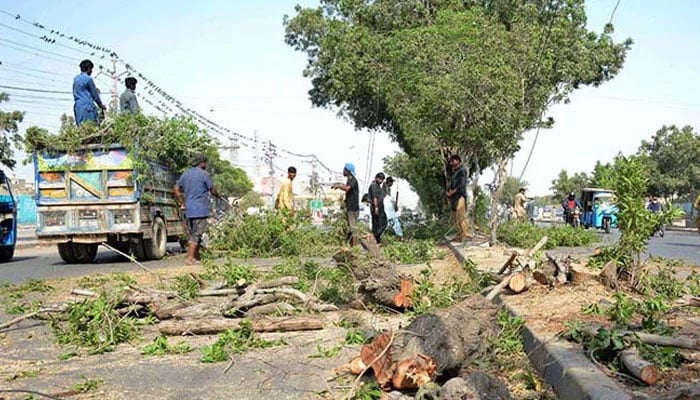
The letters highlighted alarming claims discussed during the seminar, including reports that nearly 40,000 trees have been lost in Islamabad within a few months, while Karachi has allegedly lost approximately 50,000 trees during the last five years due to road expansion projects, transport corridors and other mega infrastructure schemes.
According to the FPCCI committee, Karachi’s tree cover has now plummeted to nearly two per cent, while green cover in many urban centres of Pakistan has fallen below five per cent — a situation environmentalists described as catastrophic for public health, biodiversity and climate resilience.
The committee warned authorities that the continued destruction of trees is intensifying urban heat island effects, air pollution, flooding risks, ecological imbalance and climate-related disasters, stressing that future generations can face irreversible consequences if immediate corrective measures are not adopted.
The letters sought detailed information from municipal and administrative institutions regarding the approximate loss of tree cover during the past five years, compensatory plantation efforts undertaken against environmental damage caused by development projects, and future plans for increasing and protecting urban greenery.
The FPCCI committee also made it clear that symbolic plantation campaigns alone would no longer suffice, and that legal, constitutional and judicial avenues would now be actively pursued against unlawful deforestation and environmental destruction.
During the seminar proceedings, speakers repeatedly criticised what they termed weak enforcement of environmental laws and the absence of accountability for entities involved in large-scale tree cutting.
Senior lawyer Muhammad Hassan Qureshi delivered one of the strongest statements of the event, declaring that indiscriminate tree cutting amounts to “environmental terrorism”. He warned that the consequences extend far beyond environmental degradation, and pose direct threats to human survival, biodiversity, climate resilience and public health.
“Environmental terrorism through relentless tree cutting is pushing our cities towards a deadly future of heatwaves, toxic air, flooding and ecological collapse,” he observed, and urged environmental organisations and civil society groups to immediately move courts and environmental tribunals against those responsible for destroying green cover.
Participants of the seminar particularly condemned tree cutting in Islamabad’s Margalla Hills region for development and monument-related projects, as well as the destruction of mature trees in Karachi during the construction of bus rapid transit corridors and road expansion schemes.
Environmental researcher Zainab Naeem informed the gathering that Pakistan has suffered an estimated 18 per cent decline in forest cover since 1992, and continues to lose more than 11,000 hectares of tree cover annually.
She cautioned that deforestation is aggravating landslides, urban flooding, flash floods and glacial lake outburst disasters, and stressed the urgent need to prioritise indigenous tree species in plantation campaigns for long-term ecological sustainability.
Sindh Solid Waste Management Board Managing Director Tariq Ali Nizamani briefed the participants on awareness campaigns promoting the composting and recycling of organic waste for horticulture and plantation purposes, emphasising that sustainable waste management is also critical for environmental restoration.
Senior environmentalist Rafiul Haq observed that although Pakistan still lacks comprehensive scientific mapping of urban tree cover, there is unanimous agreement among stakeholders that emergency intervention has become unavoidable.
Journalist Uneeba Zameer Shah criticised the failure to convert media exposure of deforestation into strong legal action, while senior environmental journalist Shabina Faraz urged authorities to deploy satellite mapping, artificial intelligence and digital monitoring systems to protect forests and urban green spaces.
The standing committee’s Deputy Convener Abdul Rehman called for strengthening environmental safeguards nationwide, whereas Khoja Shiraz Ali urged the country’s youth to spearhead a mass movement for forest protection and ecological restoration.
Meanwhile, FPCCI Senior Vice President Saquib Fayyaz Magoon strongly endorsed the nationwide campaign launched by the committee, saying that the business community fully supports urgent collective action to reverse environmental destruction in urban Pakistan.
Magoon said that the protection of trees and green spaces is no longer merely an environmental issue but has become essential for economic sustainability, public health and climate security.
He expressed confidence that with coordinated support from government institutions, municipal bodies, industries, civil society and citizens, the campaign against relentless tree cutting can become a major national environmental movement capable of restoring ecological balance in Pakistan’s rapidly expanding cities.
FPCCI Standing Committee Convener Naeem Qureshi announced that a dedicated panel of lawyers would soon be constituted to pursue environmental litigation in courts and tribunals across the country, while a broader collaborative afforestation campaign involving both public and private sectors would also be launched in the coming weeks.
Declaring that Pakistan stands at a “critical environmental crossroads”, he said that collective action against deforestation is no longer optional but an absolute national necessity.