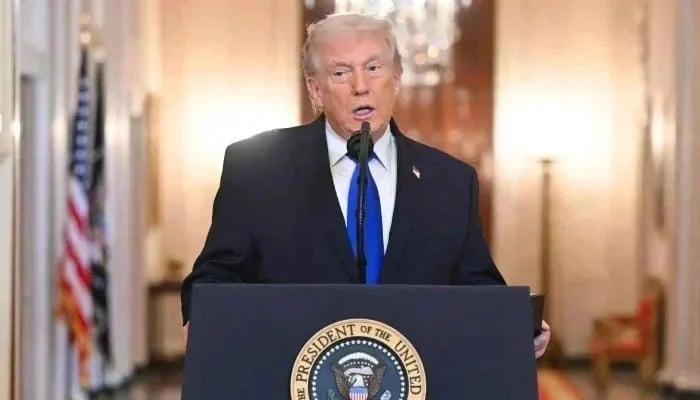
WASHINGTON: US President Donald Trump said on Monday that he asked Saudi Arabia, Qatar, Pakistan, Turkiye, Egypt and Jordan to join the Abraham Accords en masse to normalise relations with Israel as he tries to negotiate an agreement to end the war with Iran.
Saudi Arabia has linked normalising ties with Israel to Palestinian statehood. Public mistrust of Israel in Muslim nations remains high over the scale of its military offensive in Gaza.Trump said he spoke on Saturday to leaders of those countries, as well as the United Arab Emirates and Bahrain, which have already signed the accords, a set of agreements to normalise relations with Israel.
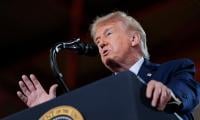
“I am mandatorily requesting that all Countries immediately sign the Abraham Accords, and that, if Iran signs its Agreement with me, as President of the United States of America, it would be an Honor to have them also be part of this unparalleled World Coalition,” Trump wrote in a post on Truth Social.
He cited “all the work done by the United States to try and pull this very complex puzzle together.”
Trump’s statement reflected an attempt to use Iran ceasefire diplomacy for a wider push around the Abraham Accords, according to a Pakistani source familiar with the matter, who also said the two issues were “not interlinked and cannot be made so.” “Pakistan is under no compulsion to adhere to any such demand,” the source said.
Israeli Prime Minister Benjamin Netanyahu’s office also did not immediately respond to a request for comment on Trump’s post.Trump said one or two of the countries he spoke with may have a reason for not joining, but most should be “ready, willing, and able to make this Settlement with Iran a far more Historic Event than it would, otherwise, be.”
The issue is fraught as countries like Gulf heavyweights Saudi Arabia and Qatar have said they will never normalise ties with Israel unless an independent Palestinian state is created.Saudi Arabia’s position on the Palestinian issue remains unchanged, a Saudi source told Riyadh-based broadcaster Al Arabiya on Monday, adding that “there needs to be an irreversible pathway to a Palestinian state.”
Saudi Arabia’s foreign minister said the kingdom could be prepared to normalise relations with Israel only if a process is launched to establish a Palestinian state and that process is irreversible. He reportedly made the remarks in an interview with CNN host Fareed Zakaria.
For Saudi Arabia -- the birthplace of Islam and custodian of its two holiest sites, Makkah and Medina -- recognising Israel would be more than just a diplomatic milestone. It is a deeply sensitive national security issue tied to resolving one of the region’s oldest and most intractable conflicts.
The kingdom’s longstanding position has been that it would not sign the accords unless there is an agreement on a roadmap to Palestinian statehood.Egypt, Jordan and Turkiye already have diplomatic relations with Israel, even as those ties have been strained since the start of the Gaza war.
Trump also said negotiations with Iran were “proceeding nicely,” but gave no indication a deal was imminent. Trump said that a deal with Iran would either be “great and meaningful” or there would be “no deal.”
Longtime Trump ally Senator Lindsey Graham has embraced the idea of linking an Iran deal to expanding the Abraham Accords as “beyond transformative for the region and world.” Others see the strategy as something to make an Iran deal more palatable to sceptics.
“Trump is trying to sell an Iran deal as an Abraham Accords sequel: good for Israel, good for the region, tough enough for Washington,” said Ali Vaez, Iran project director at the International Crisis Group.
“But he is trading one fantasy for another -- from forcing Iran to surrender to pretending a fragile deal can anchor a new Middle East order.” Trump has repeatedly said he wants to expand the accords that he brokered during his first term in the White House. The United Arab Emirates and Bahrain signed during Trump’s first term in 2020. Morocco and Sudan followed suit.
Iran’s top negotiator and its foreign minister were in Doha for talks with Qatar’s prime minister on a potential deal with the US to end the three-month-old war, an official briefed on the visit said on Monday, after Washington and Tehran played down hopes for an imminent breakthrough.
“Iran’s Parliament Speaker Mohammad Bagher Ghalibaf and Foreign Minister Abbas Araghchi arrived in Doha earlier today for talks on ongoing diplomatic efforts to end the conflict,” a source briefed on the matter told AFP, requesting anonymity.
The visit will focus, the source added, “on issues relating to the Strait (of Hormuz) and highly enriched uranium. The Central Bank governor is part of the delegation to discuss the issue of frozen funds, which is addressed in the MoU as part of an eventual final deal”.
Iranian media including Tasnim and Fars news agencies also said the delegation included Araghchi and Central Bank Governor Abdolnaser Hemmati.Iran’s official news agency IRNA said the visit was “part of the diplomatic process” and that the delegation would meet with Qatari Premier Sheikh Mohammed bin Abdulrahman Al Thani.
US Secretary of State Marco Rubio told reporters in New Delhi earlier that the US would give diplomacy every chance to succeed before considering whether to deal with Iran in “another way”.
There was a “pretty solid thing on the table in terms of their ability to open up the strait (of Hormuz), get the strait open, enter into a very real, significant, time-limited negotiation on the nuclear matter, and hopefully we can pull it off,” Rubio said.
In a lengthy post on Truth Social on Monday, US President Donald Trump said talks with Iran were going “nicely”, but warned of fresh attacks if they failed. It “will only be a Great Deal for all, or no Deal at all,” he wrote.
Iran’s foreign ministry spokesperson Esmaeil Baghaei said in a briefing that conclusions had been reached on many topics but that did not mean the sides were close to agreement.
The official briefed on the Iranians’ Doha visit told Reuters the discussions focused primarily on the Strait of Hormuz and Iran’s stockpile of highly enriched uranium while Iran’s central bank governor attended to discuss the potential release of frozen Iranian funds as part of a final deal.
Baghaei said earlier that nuclear issues would only be negotiated on if the framework accord is agreed first.Trump has said his key aim in the war is to prevent Iran from developing a nuclear weapon with its highly enriched uranium. Tehran has consistently denied it has plans to do that.
The two sides remain at odds on several other issues, such as Israel’s war in Lebanon with the Iranian-backed Hezbollah militia and Tehran’s demands for the lifting of sanctions and the release of tens of billions of dollars of Iranian oil revenues frozen in foreign banks.
As efforts to reach a deal continued, Iran said it had downed a “hostile” stealth drone using a new air defence system, Iranian news agencies reported, without saying where it had come from. “This is a sign from us that no more stealth drones can penetrate the skies of the Persian Gulf,” Fars quoted unnamed officials as saying.
Baghaei said the potential Iran deal contained no specific details on management of the Strait of Hormuz. Iran will not charge tolls for ships to pass through but there will be a cost for services offered such as navigation and steps to protect the environment, he said, under a protocol to be agreed with Oman, which lies on the opposite shore of the waterway.
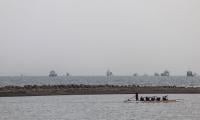
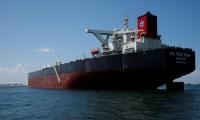
Iran’s state TV said on Monday that 32 vessels and five oil tankers passed through the strait in the past 24 hours with the authorisation of Iran’s Revolutionary Guards naval forces.
Separately, two sources said Netanyahu has told his confidants that Israel now has little ability to influence Trump’s decision-making over the conflict.
Iran on Monday executed a man on charges related to protests this year. The latest man to be hanged was Abbas Akbari, who was accused of attacking an official building in Nain in the central province of Isfahan during the peak of the protest movement in January.
An Iranian health ministry official said the injuries suffered by supreme leader Ayatollah Mojtaba Khamenei in US-Israeli strikes in late February were only “superficial”, offering a rare account of the day he was wounded.
On Monday, health ministry spokesman Hossein Kermanpour described the day Mojtaba was wounded and his arrival at a hospital, which he did not identify.He said Mojtaba arrived at the hospital around 1:00 pm Tehran time on February 28 and “entered the operating room along with several other wounded individuals.”
“Apart from superficial injuries to the face, head and legs, which caused neither amputation nor any particular medical problem, nothing major had happened,” Kermanpour told ILNA news agency.
He added that Mojtaba, who was fasting until nightfall during the Muslim holy month of Ramadan, “refused to break his fast and kept fasting until iftar, which itself showed his good health.”
Kermanpour said he was discharged from the hospital at around 2:00 am on March 1, but did not say to where he was moved.
Oil prices fell nearly 7 per cent on Monday as optimism grew that the United States and Iran were moving closer to a peace deal that would reopen the Strait of Hormuz, even though Washington and Tehran played down hopes for an imminent breakthrough. Brent crude futures LCOc1 were down $7.24, or almost 7 per cent, at $96.30 a barrel at 2:29 p.m. ET (1843 GMT) and US West Texas Intermediate CLc1 futures were down $6.30, or 6.5 per cent, at $90.88. Trading volumes were light due to the US Memorial Day holiday.
Iran’s foreign ministry said on Monday that Tehran was collecting fees for “navigational services” on ships transiting the strategic Strait of Hormuz, rather than imposing tolls.
Iran’s President Masoud Pezeshkian has issued an order to reopen international internet access, Iranian state media reported on Monday, citing an official.The US and Iran are discussing a plan to open the Strait of Hormuz about 30 days after the two countries reach a deal to end hostilities, the Nikkei newspaper reported on Monday citing a Middle East diplomatic source.
Iran would proceed to clear mines from the strait during a 30-day window following an agreement, after which ships from all countries would be able to navigate freely and safely, and Iran would stop collecting transit fees, Nikkei said. The ceasefire agreed in early April would be extended for 60 days, with the plan to hold talks on Iran’s nuclear programme during the two-month pause, the report added.
Secretary of Iran’s supreme national security council said in a published message that there will be “no surrender or retreat”.Iran’s foreign ministry spokesperson said if MoU finalised, some details of the MoU and other subjects including nuclear issue will be negotiated in a 60 day period
Iran’s foreign ministry spokesperson said on Monday that conclusions have been reached on many topics discussed in a potential memorandum of understanding with the US, but this does not mean Tehran is close to signing an agreement.
Russian President Vladimir Putin and Bahrain’s King Hamad bin Isa Al Khalifa discussed by phone the need to find a rapid diplomatic resolution to the Iran crisis, the Kremlin said on Monday.
Iran’s top negotiator in talks with the United States, Mohammad Bagher Qalibaf, has been reelected as the country’s parliamentary speaker, semi-official Fars news agency reported on Monday.
Israel’s two far-right ministers on Monday called for an escalation of military operations in Lebanon, with one advocating strikes on Beirut in response to Hezbollah’s drone attacks.“It is time for the prime minister to take a firm stand with Donald Trump and tell him that Israel is returning to war in Lebanon,” National Security Minister Itamar Ben Gvir said on X.
“Electricity to Lebanon must be cut off, the Zahrani must be seized, and intensive warfare resumed,” he said, referring to a river in southern Lebanon which runs further north than current Israeli ground operations.
Finance Minister Bezalel Smotrich, also from the far right, called for strikes on Beirut to counter Hezbollah’s drone attacks on Israeli forces in southern Lebanon and across the border.
Lebanese President Joseph Aoun said Israel’s withdrawal from the country’s south was a “non-negotiable” demand that authorities would pursue through negotiations, days ahead of a new round of talks in Washington.