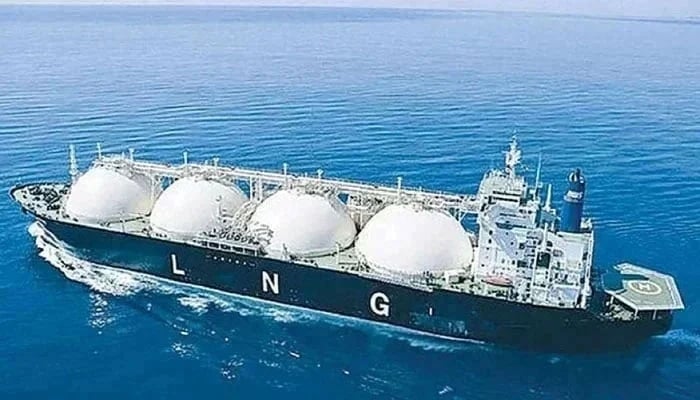
ISLAMABAD: Pakistan received another major boost to its fragile energy supply chain as the LNG tanker Fuwairit from Qatar crossed the strategically sensitive Strait of Hormuz and entered Pakistani waters, where it is expected to berth at the Engro LNG Terminal on Monday.
Senior officials in Pakistan’s Petroleum Division confirmed that another LNG vessel is also scheduled to arrive within the next few days and will dock at the Pakistan GasPort Consortium Limited (PGPL) Terminal, underscoring Islamabad’s urgent push to secure uninterrupted fuel supplies amid soaring summer electricity demand and heightened regional tensions in the Gulf.
The arrival of Fuwairit marks the third consecutive LNG shipment from Qatar in less than two weeks. On May 15, the LNG carrier Mihzem, carrying approximately 160,000 cubic meters of liquefied natural gas, berthed at the PGPL Terminal-12 at Port Qasim. Just two days earlier, on May 13, the Q-Flex LNG carrier Al Kharaitiyat had docked at the Engro terminal.
Energy sector officials say the back-to-back arrivals reflect Pakistan’s reliance on long-term LNG arrangements with Qatar at a time when global spot market prices are climbing sharply due to geopolitical uncertainty, shipping risks and fears of supply disruptions linked to tensions around the Strait of Hormuz.
According to officials, Pakistan has managed to secure all incoming LNG cargoes under long-term contractual arrangements priced at 13.37 per cent of Brent crude oil, shielding the country from the volatility of the spot market. In contrast, the Japan/Korea Marker (JKM), the benchmark for spot LNG in Asia, has surged to around $18.81 per MMBtu, significantly increasing procurement costs for countries dependent on short-term purchases.
Officials described the term pricing arrangement as a major relief for Pakistan’s strained energy economy, particularly at a time when foreign exchange reserves remain under pressure and the government is struggling to contain rising power generation costs.
Official linepack data released on May 25 showed that the power sector is currently consuming nearly 397 million cubic feet per day (mmcfd) of regasified LNG for electricity generation. Officials confirmed that both LNG terminals operating at Port Qasim are now fully functional and handling cargoes without disruption.
The safe movement of LNG vessels through the Strait of Hormuz has become a key strategic concern for Islamabad amid continuing regional instability. Senior government sources said the National Crisis Management Cell (NCMC), Petroleum Minister Ali Pervaiz Malik, and Pakistan’s sensitive security institutions remained in close coordination with authorities in Iran, Qatar, and the United States to ensure secure passage for LNG shipments navigating the Gulf corridor.
Officials emphasised that uninterrupted LNG supplies remain essential for sustaining Pakistan’s electricity generation system, industrial activity, and urban gas demand as the country enters the most energy-intensive phase of the summer season.
Oil, LNG tankers exit Hormuz, heading for Pakistan and China
Ship-tracking data showed three liquefied natural gas tankers passed through the Strait of Hormuz in recent days, heading to Pakistan, China and India, as well as a supertanker with Iraqi crude for China after being stranded for nearly three months.
The US-Israeli war on Iran that began on February 28 has severely curtailed shipping through the Strait of Hormuz, through which about a fifth of the world’s oil and LNG supply normally flows.
A HANDFUL OF TANKERS HAVE LEFT THE GULF THIS MONTH
The vessels join a handful of supertankers leaving the Gulf this month via a transit route that Iran has ordered ships to use. Last week, three Very Large Crude Carriers (VLCCs) made their way to China and South Korea with 6 million barrels of crude.
LNG tanker Fuwairit crossed the Strait of Hormuz on Monday and is expected to discharge its cargo in Pakistan on Tuesday, LSEG and Kpler shipping data showed. The vessel, sailing under the Bahamas flag, loaded LNG at Qatar’s Ras Laffan port around March 28.
Japan’s Mitsui OSK Lines, which owns the Fuwairit, declined to comment.The LNG tanker Al Rayyan has also passed through the waterway. Carrying a cargo loaded at Ras Laffan, it was last seen in the Gulf on May 22, and is now located outside the strait between Iran and Oman. It is expected to discharge its cargo in China on June 27, LSEG and Kpler data shows.
QatarEnergy, which owns Al Rayyan, did not respond immediately to a request for comment outside office hours.
A tanker managed by Abu Dhabi National Oil Company (Adnoc) also crossed the strait. The Al Hamra was last seen on April 19 east of the strait. It reappeared on ship-tracking data on May 23 off the coast of India, Kpler data shows.
Adnoc did not respond immediately to a request for comment.Separately, the VLCC Eagle Verona, which exited the strait on Saturday, is expected to reach Ningbo port in eastern China on June 12 to discharge its cargo, LSEG and Kpler data showed.
The Singaporean-flagged vessel chartered by Unipec, the trading arm of Asian refiner Sinopec loaded nearly 2 million barrels of Basrah crude around February 26, the data showed.
The Eagle Verona was among seven ships for which Malaysia had sought permission to transit, two sources had told Reuters. Five of the ships have since exited the waterway while two more remain in the Gulf.
Sinopec and Malaysian state shipper MISC, which owns the vessel, could not be reached for immediate comment.Before the war began, shipping traffic through the strait averaged 125 to 140 daily passages. About 20,000 seafarers remain stranded on hundreds of ships in the Gulf.