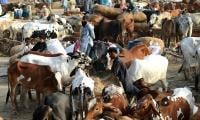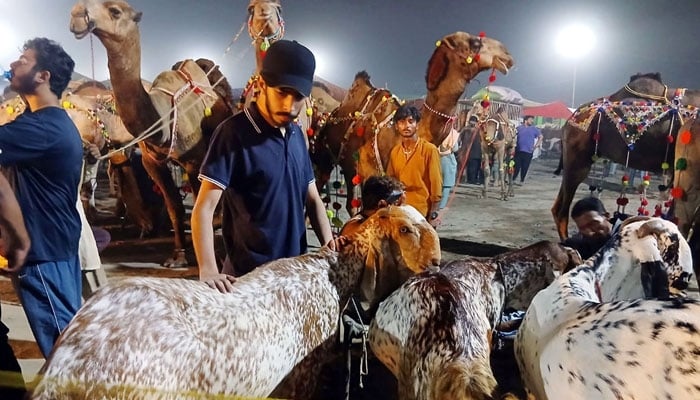
LAHORE: As Eidul Azha approaches, Pakistan’s traditional cattle markets (mandis) are once again witnessing their characteristic bustle, even this year against a challenging economic backdrop. The occasion also raises broader questions about wealth distribution, charity, and the role of the state.
The latest estimates and market dynamics highlight how inflation is impacting the festival this year, particularly for the country’s low-income population. Pakistan typically slaughters approximately 7.4 million animals over the three days of Eid. However, traders across major hubs like Karachi, Lahore and Peshawar report a noticeable slowdown in footfall and transactions compared to previous years. Driven by rising inflation and petrol prices hovering around Rs400 per litre due to Middle East supply strains, transport and fodder costs have skyrocketed.
Every year, Eidul Azha generates one of the largest economic activities in Pakistan. Millions of goats, sheep, cows, bulls and camels are traded across the country, supporting livestock farmers, transporters, fodder suppliers, butchers, traders and temporary labourers. Estimates suggest that around seven million sacrificial animals were slaughtered in Pakistan last year, generating economic activity worth well over Rs1 trillion.
Because overall individual purchases are down, the raw volume of meat flowing directly from household doors to the needy may see a localized dip in middle-class urban neighbourhoods. Because Eid 2026 falls in late May, extreme summer heat (40-45 degrees C) poses a major logistical hurdle. Swift distribution is critical, as many impoverished households lack the refrigeration infrastructure to store large quantities of fresh meat safely.
The rates of healthy goats that cost Rs100,000 to Rs125,000 last year are frequently being priced between Rs180,000 and Rs220,000 in urban markets. Even basic, smaller goats the rates double than last year. Medium bulls are fetching between Rs300,000 and Rs700,000. For weaker cattle and goat the prices are much lower but then the meat after sacrifice would be much less.
Pakistanis are among the world’s most charitable people, especially during Ramazan and Eid seasons. Welfare organizations, religious groups, and individuals distribute meat and financial assistance to millions. However, even philanthropy is under pressure this year because donors themselves are struggling financially.
Eidul Azha is approaching at a time when millions of Pakistanis are struggling merely to survive. Inflation, stagnant wages, shrinking employment opportunities, and rising utility bills have badly eroded the purchasing power of the common man. Yet, despite economic hardship, cattle markets across Pakistan are bustling again as people prepare to perform the religious obligation of Qurbani.
For a large segment of society, performing Qurbani is becoming financially painful. Many families who once bought goats are now opting for collective shares in cows, while others may not be able to participate at all. This decline is not merely a religious or cultural issue; it also has social implications because Eidul Azha traditionally ensures that millions of poor families receive meat, often for the first meaningful time in months.
For daily wage earners, unemployed labourers, widows, and people living in urban slums or remote villages, Eid meat is not simply festive food; it is nutritional support and a rare source of dignity. The flow of food temporarily softens the harsh divide between rich and poor.
Yet the occasion also exposes Pakistan’s growing inequality. On one side are families struggling to arrange even a single share in a cow. On the other are extravagant displays of wealth, where expensive imported or specially bred animals worth millions of rupees are showcased on social media. In many cases, Qurbani risks turning into a display of status rather than an act of sacrifice, humility and social solidarity.
The role of the state in protecting vulnerable citizens also comes under scrutiny. Pakistan’s welfare mechanisms remain weak compared to the scale of poverty. Government assistance programmes provide some relief, but inflation has outpaced support. There is still no comprehensive system to ensure food security for the poorest segments of society, particularly during times of economic stress.