HANGZHOU: Pakistani and Chinese companies signed agreements and memorandums of understanding worth more than seven billion dollars to promote cooperation and investment in various sectors.
The agreements and MoUs were signed during the Pakistan-China B2B Investment Conference on IT & Telecom, battery energy storage systems (BESS) and agriculture in Hangzhou, China, on Sunday.
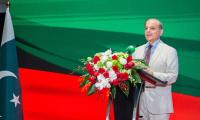
Speaking on the occasion, Prime Minister Shehbaz Sharif invited the Chinese companies and entrepreneurs to relocate their industries and businesses to Pakistan, enter into joint ventures with the local firms, and benefit from the country’s investor-friendly policies, describing the initiative as a “win-win model” for both nations. He said that labour in China today had become pretty expensive and that China was obviously moving towards a very high level of industrialisation.
He observed that the industry where China was no longer competitive because of expensive labour could come to Pakistan, bring in plant and machinery, enter into joint ventures with Pakistani entrepreneurs, manufacture goods and export to third countries. “This model will be a win-win model for Chinese and Pakistani entrepreneurs and this will be something of a roaring success in times to come, whether it is textile or leather or other areas,” the prime minister maintained in his speech broadcast on national TV channels.
He also invited Chinese businessmen to come and see the export zone in Karachi, where they would have great opportunities to undertake business propositions.
Referring to the potential in mines and minerals, he said that it was also a very important area where Pakistan had large deposits of minerals and gemstones.
About the agriculture sector, he said Pakistan was basically an agrarian economy. Last year, they sent 1,000 youth to China for advanced training, who returned and are doing a great job, but this was just the first step.
Deputy Prime Minister/Foreign Minister Ishaq Dar, Governor of Zhejiang Province, Shaza Fatima Khawaja, Minister for IT and Telecommunication, Attaullah Tarar, Minister for Information and Broadcasting, Rana Tanveer Hussain, Minister for National Food Security and Research, Haroon Akhtar, Special Assistant to the Prime Minister on Industries and Production, Ambassador of Pakistan to China Khalil Hashmi, Omar Saeed, CEO of Servis Group of Pakistan, and Chairman Jin Yongsheng of Long March Tyre, Qian Xiaojun, President of IBI Goulian Gufen, and Chen Jianzhang, Chairman China Council for the Promotion of International Trade, Zhejiang Provincial Committee, were also present on the occasion.
The prime minister emphasised that they really needed to move forward to improve their per acre yield with the highest quality seeds, best agricultural practices and mechanization through which they could really advance their agriculture sector manifold. He said China imports about $100 billion worth of agricultural products from abroad. Pakistan’s share was just a fraction, adding that they needed their cooperation in this regard.
The prime minister hoped that in this manner, they would be able to produce agri products as per their requirement in terms of quality and other controls and if they worked together as iron brothers in this sector, they would be able not only to provide massive job opportunities in the rural areas of Pakistan but also be able to raise hundreds of thousands of small, medium entrepreneurs in the rural areas and have value addition and export those items to China. In the next five to seven years, he said they expected an increase in their agri product trade to China by about $10 billion which was not a big task.
The prime minister said IT and AI had huge potential, while special economic zones were also very important and shared that at the port city of Karachi, they had come up with a special economic zone spreading over more than 6,000 acres of land, where all basic amenities would be provided so that Chinese investors and Pakistani entrepreneurs together could invest there.
He said Pakistan was looking for expertise, experience, investments and not loans, not aid, not handouts, because handouts and aid never made a nation vibrant, never made a nation stand on its own feet. Prime Minister Shehbaz Sharif further said that under President Xi Jinping’s very dynamic leadership, their friendship was deeper than the deepest ocean and higher than the Himalayas, and ever since they had launched their space programme, it had reached to new heights.
The prime minister said that they had signed MoUs worth billions of dollars, starting from Shenzhen and here in Hangzhou, stressing that these MoUs now needed to be converted into agreements. He also expressed his satisfaction over knowing that 30 percent of these MoUs had been converted into agreements, which most definitely ran into billions of dollars.
The prime minister further said that it was no coincidence that they were celebrating 75 years of the great friendship between Pakistan and China and this third B2B event in a row, starting from Shenzhen to Beijing and now here in Hangzhou, was a reflection of the same.
He also appreciated the city’s beauty, its organisation, structure and wonderful management, adding that the city showed beyond any doubt the footprints of President Xi Jinping, who as governor and as secretary general of the city during 2002 to 2007 did a remarkable job to transform this province and this city into one of the fastest-growing cities around the globe.
The prime minister said President Xi Jinping is a visionary leader who has, over the years, made China a world-class economic and military power, second to none, and Pakistan, as a true and sincere friend of China, took a lot of pride in this.
In the presence of Prime Minister Muhammad Shehbaz Sharif and Governor of Zhejiang Province Liu Jie, a $1.12 billion agreement was signed between Haolu Engineering and Technology Company Limited and Fauji Fertilizer for the production of fertilizer, while a $100 million memorandum of understanding was signed between IBI Beijing United Information Technology Company and RIC for the production of agrochemicals, agro machinery and establishing a regional office in Multan. More than 200 memorandums of understanding worth more than $20 billion have been signed in the five business-to-business conferences held between Pakistan and China so far.
Meanwhile, Prime Minister Shehbaz Sharif met with senior Chinese corporate executives representing a number of important companies in Hangzhou. As part of his outreach to China’s corporate sector, the prime minister met with representatives of Sheng Huo Neng Yuan Ke Ji Company, CATL, StarCharge and Xiuzheng Pharmaceutical Group.
In the meetings, the potential of increasing investment, establishment of manufacturing facilities and expansion of the existing facilities in Pakistan was also discussed in detail.
Meanwhile, Prime Minister Shehbaz Sharif attended the ceremony of signing and exchange of agreements and memorandums of understanding with Alibaba Group in diverse sectors of the economy. During his visit to Alibaba headquarters in Hangzhou, he was briefed about the company by Alibaba Chairman Joe Tsai. A long-term cooperation agreement between Pakistan and Alibaba was signed in the presence of the prime minister.
In his remarks on the occasion, the prime minister said Pakistan and China had built a unique relationship which had strengthened by every generation. He said Pakistan had diligently played the role of a peacemaker in the region and this would not have been possible without support of China and friendly countries.
Pakistan fully supports agenda of China’s President Xi Jinping for lasting peace in the region and beyond, he said adding the bilateral relations of Pakistan and China had expanded to bring progress and prosperity to the people.
Alibaba Chairman Joe Tsai in his remarks gave details of the areas in which his company intended to collaborate with Pakistan. He said Pakistan and China had strategic partnership through the Belt and Road initiative and his company would work to improve digital infrastructure, industrial capabilities and cross border trade between the two countries.
The cooperation would enhance in areas of cloud computing, data centres, artificial intelligence, trade facilitation, global market access, financial technology, financial literacy, healthcare, smart hospitals, telemedicine, pharmaceuticals and agriculture, he added.
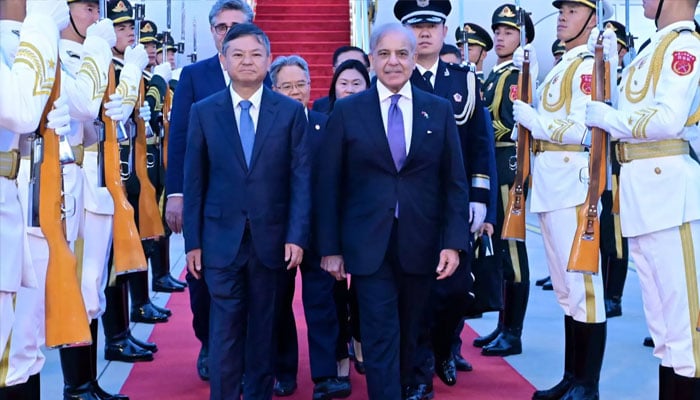
Meanwhile, Prime Minister Shehbaz Sharif arrived Sunday after concluding his official programme in Hangzhou, Zhejiang Province. Huang Runqiu, Minister of Environment & Ecology of China, received the prime minister at the Beijing Capital International Airport.
In Hangzhou, the prime minister chaired the opening ceremony of the third Pakistan-China B2B Investment Conference, focused on charging infrastructure, battery energy storage and solar technologies, and pharmaceuticals. He also engaged with provincial leadership, leading Chinese enterprises, including StarCharge, CATL and Xiuzheng Pharmaceutical, to explore practical investment and industrial cooperation. He also visited Alibaba Headquarters, where he was received by Executive Chairman Joe Tsai.